
When it comes to protecting digital assets, knowing how your systems respond to a real-world attack is far more valuable than a checklist-based audit. That is where Black Box Penetration Testing comes in a method that mirrors how an actual threat actor would attempt to breach your environment, with zero internal knowledge. In black box testing, ethical hackers assess your external attack surface without any prior access to credentials, source code, or architectural insights. They rely only on publicly available information, exposed interfaces and visible threats to identify potential entry points. This “outsider approach” is essential for organizations who want a realistic view of their security posture from the eyes of a potential attacker.
A financial services firm conducted 16 internal penetration tests, all of which failed to identify a critical vulnerability in their external-facing application. This oversight was due to the tests being conducted from an internal perspective, lacking the external viewpoint that a black box test would provide. The vulnerability, if exploited by an external attacker, could have led to over $103 million in PCI fines alone.This blog breaks down the fundamentals of black box penetration testing, how it differs from other testing methods and why it plays a critical role in modern cyber risk management.
What Is Black Box Penetration Testing?
Black Box penetration testing is a kind of security assessment where ethical hackers attempt to breach an organization’s digital systems without any prior knowledge of its internal structure. The tester is given no access to source code, credentials, network maps or system configurations they interact with the system exactly as an external attacker would. This approach is designed to simulate a real-world cyberattack as accurately as possible. Just like a malicious hacker scouring the internet for weak spots, the tester begins with public information and uses various tools and techniques to identify vulnerabilities, exploit entry points and assess the impact of a potential breach. This method is also referred to as external penetration testing in some industries.
Why Black Box Testing Reflects Real-World Threats?
Black box penetration testing closely mirrors how real attackers operate with no internal access, no credentials, and no insider knowledge. Testers approach your systems the same way a threat actor would: by scanning publicly available assets, probing for vulnerabilities and trying to break in from the outside. Unlike internal audits or white box tests, black box testing shows you what the world sees and what a motivated attacker might exploit. It puts your actual security controls to the test, not just what is documented on paper. Because it mimics real-world attack conditions, this method helps uncover blind spots, validate perimeter defenses, and reveal how exposed your organization truly is. It is the most accurate way to understand your risk from an attacker’s point of view.
Key Objectives of Black Box Pen Testing
Black box penetration testing isn’t just about finding flaws it’s about understanding how your systems hold up when tested under real-world conditions. Here are the core goals this type of testing aims to achieve:
1. Identify External Vulnerabilities
The primary objective is to uncover weaknesses in publicly exposed systems websites, APIs, login portals, cloud infrastructure that an outsider could exploit without needing insider access.
2. Evaluate Perimeter Security
It tests the effectiveness of your firewalls, intrusion detection systems (IDS) access controls and other external defenses, helping ensure they are not just configured but working as intended.
3. Simulate a Real Attack Path
By mimicking how a threat actor would move from initial access to deeper layers of your system, black box testing maps out potential attack paths without assuming any privileged information. Testers often leverage frameworks like MITRE ATT&CK to model attacker behaviors, techniques, and tactics, ensuring the simulation aligns with real-world threat scenarios.
4. Assess Detection and Response Capabilities
It checks whether your monitoring tools and security teams can detect, respond to, or block suspicious behavior during an actual intrusion attempt. This includes validating SOC (Security Operations Center) processes and SIEM (Security Information and Event Management) alerts, ensuring that real attacks trigger timely and actionable responses rather than going unnoticed.
5. Reveal Unknown Risks and Misconfigurations
Since testers begin with no internal knowledge, they often discover overlooked vulnerabilities or misconfigured assets that wouldn’t surface in traditional reviews or white box tests.
6. Support Risk-Based Decision Making
The insights gained help security leaders prioritize remediation efforts based on real exposure – not hypothetical threats.
How Black Box Testing Works: Step-by-Step Overview
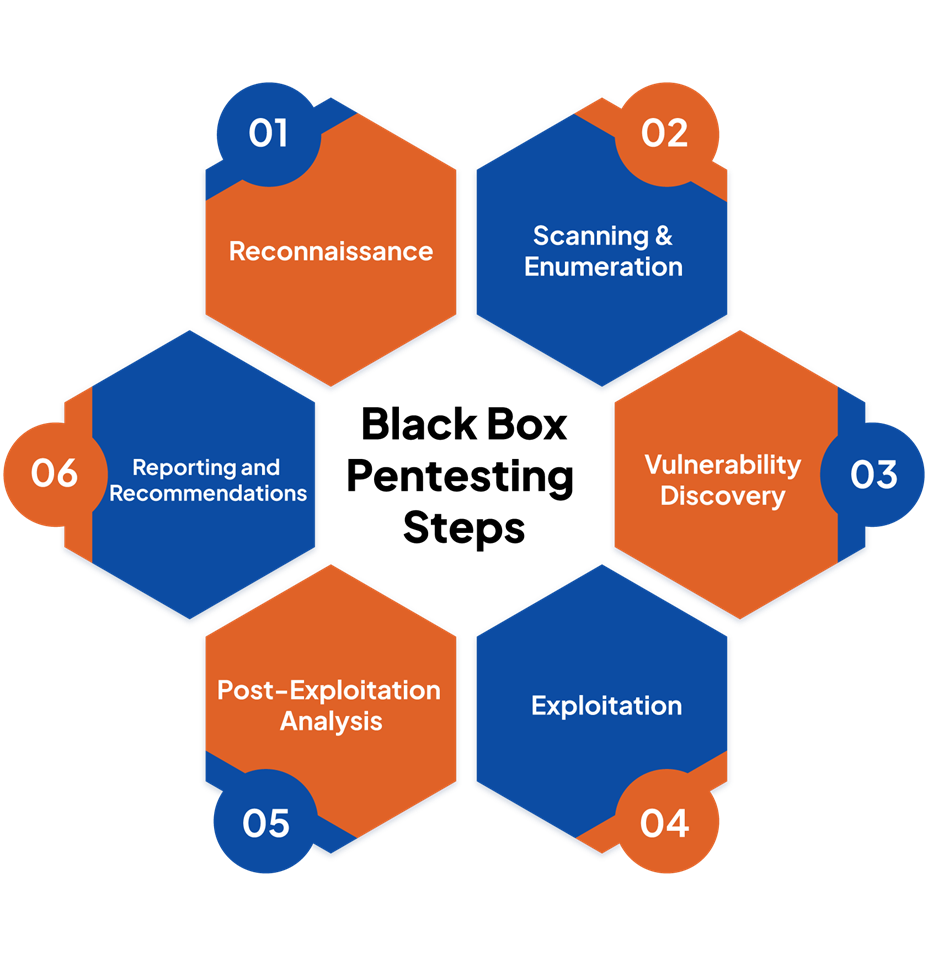
Black box penetration testing follows a methodical process – starting from zero knowledge and ending with a clear picture of how far an attacker could go. Here’s how it typically unfolds:
1. Information Gathering (Reconnaissance)
Testers begin by collecting publicly available information about the target. This includes domain names, IP addresses, DNS records, employee details, exposed assets, and anything that can be used to build an attack surface. Tools like WHOIS, Shodan, and Google dorking are often used at this stage.
2. Scanning and Enumeration
Once the surface is mapped, testers scan for open ports, running services, and software versions. The goal is to identify potential vulnerabilities or misconfigurations. Tools like Nmap, Nikto, and Burp Suite help dig deeper into what’s exposed.
3. Vulnerability Identification
At this stage, testers analyze the gathered data to pinpoint exploitable weaknesses – such as outdated software, misconfigured servers, or insecure login portals. This combines automated tools with manual analysis to validate findings.
4. Exploitation (If allowed)
With permission, testers attempt to exploit the discovered vulnerabilities. This could involve SQL injection, command execution, session hijacking, or privilege escalation – depending on what they uncover.
5. Post-Exploitation Analysis
If access is gained, testers assess how far they can go – for example, whether sensitive data can be extracted, systems can be controlled, or lateral movement is possible. This step helps measure real-world impact.
6. Reporting and Recommendations
Finally, a detailed report is created outlining:
- Vulnerabilities found
- Exploits attempted (and successful ones)
- Business impact
- Risk severity
- Actionable remediation steps
The report helps stakeholders understand the risks and prioritize fixes based on actual exp
Black Box vs. Grey Box vs. White Box Testing
Penetration testing comes in different forms, each offering a unique level of insight into your systems. Black box testing simulates a real-world attacker with no internal knowledge or access. It focuses on identifying vulnerabilities in public-facing assets and evaluating how well your external defenses hold up, making it ideal for external audits.
On the other end of the spectrum, white box testing gives the tester complete visibility into the environment, including access to source code, system configurations, and architecture. This allows for deeper analysis and is particularly useful for source code review and detailed internal risk assessments. Sitting in the middle is grey box testing, which offers a blend of both approaches. Testers have limited internal knowledge, such as user-level access or network credentials, allowing them to simulate insider threats or compromised users, making it best suited for insider threat simulations. While black box testing offers the most realistic attack simulation, white box testing provides the most coverage, and grey box testing balances efficiency with realistic context. Each method has its place in a comprehensive security testing strategy.
| Feature | Black Box Testing | Grey Box Testing | White Box Testing |
|---|---|---|---|
| Tester Knowledge | No knowledge of internal systems | Partial knowledge (e.g., credentials) | Full knowledge (code, architecture, etc.) |
| Access Provided | None | Limited (user-level or internal access) | Full (admin access, source code, docs) |
| Perspective Simulated | External attacker | Insider with limited privileges | Developer or privileged insider |
| Focus Areas | Public-facing assets (e.g., web apps, firewalls) | APIs, internal services, user roles | Source code, back-end logic, configurations |
| Testing Depth | Surface-level to limited depth | Moderate depth | Deep and comprehensive |
| Use Cases | External threat simulation | Insider threats, privilege escalation | Code reviews, compliance testing |
| Advantages | Realistic, unbiased, attacker mindset | Balanced view, practical, efficient | Thorough coverage, faster identification |
| Limitations | Limited visibility, time-intensive | May miss deeper or broader issues | Less realistic, higher resource demand |
Tools Commonly Used in Black Box Testing
Black box penetration testers mostly rely on a wide range of tools to mimic real-world attacks, uncover vulnerabilities and probe network and application defenses all without having any insider access. These tools help in various phases of testing, from reconnaissance and scanning to vulnerability exploitation and reporting. Since testers operate without privileged information, choosing the right toolset is crucial for gathering intelligence, mapping the attack surface, and identifying exploitable weaknesses effectively. Below are some of the most widely used tools in black box testing categorized by function.
Popular Tools Used in Black Box Pen Testing
| Tool | Category | Purpose |
|---|---|---|
| Nmap | Network Scanning | Scans hosts and ports to discover live systems and open services. |
| Burp Suite | WebApplication Testing | Intercepts and analyzes HTTP/S traffic; useful for finding web flaws. |
| Nikto | Web Server Scanning | Scans web servers for outdated software and misconfigurations. |
| OWASP ZAP | WebApplication Scanning | Identifies security issues in web applications through automated scans. |
| DirBuster / Dirsearch | Directory Bruteforcing | Finds hidden directories and files on web servers. |
| Shodan | InternetSearch Engine | Finds devices connected to the internet and gathers exposed data. |
| Metasploit | Exploitation Framework | Used for exploiting known vulnerabilities in networks or applications. |
| Hydra | Brute Force Tool | Attempts to crack login credentials for various protocols. |
| Recon-ng | Reconnaissance Framework | Collects OSINT (open-source intelligence) for target profiling. |
| TheHarvester | OSINT Gathering | Gathers emails, domains, IPs, and subdomains from public sources. |
These tools are typically used in combination, depending on the test scope and target environment. A skilled black box tester selects tools strategically – not just for scanning and discovery, but for simulating a real attacker’s workflow in a safe, ethical, and effective manner.
When Should You Choose Black Box Pen Testing?
Black box penetration testing is best suited for scenarios where organizations want to understand their security posture from the perspective of an external threat actor. It’s particularly valuable when launching public-facing applications, websites, or APIs, as it helps identify exploitable vulnerabilities before they become targets. This method is also ideal for assessing the effectiveness of perimeter defenses like firewalls, intrusion prevention systems, and web application firewalls. Additionally, black box testing supports compliance efforts by meeting regulatory requirements for external security assessments under standards such as PCI DSS, ISO 27001, and HIPAA.
It is a practical choice when internal access is limited such as in third-party environments or during external vendor assessments and provides meaningful insights by highlighting vulnerabilities that can be exploited without privileged information. If the goal is to prioritize real-world risks and validate how well your external defenses stand up to attack, black box testing offers a clear, focused, and impactful approach.
Benefits of Adopting an Attacker’s Perspective
Adopting an attacker’s perspective through black box penetration testing offers security teams a fresh and unfiltered view of their organization’s true exposure. Instead of relying on assumptions or internal knowledge, this approach uncovers vulnerabilities that are visible and exploitable from the outside – just like a real-world adversary would see them. It helps identify misconfigurations, weak points in authentication, or overlooked assets that internal teams may miss. By thinking like an attacker, organizations can prioritize fixes that matter most, improve incident response preparedness, and strengthen their overall defense strategy. Ultimately, this perspective shifts the focus from theoretical risks to practical, high-impact threats enabling more informed, risk-driven security decisions.
Limitations of Black Box Testing
While black box penetration testing offers a realistic view of external threats, it does come with certain limitations. Since testers have no internal access or prior knowledge of the system, they may miss vulnerabilities hidden deeper within the network or application layers especially those that require authenticated access or insider context to exploit.
- Limited Visibility: Testers don’t have access to internal code or infrastructure, which can leave deeper or logic-based vulnerabilities undetected.
- Time Constraints: Due to its exploratory nature and lack of internal insight, more complex vulnerabilities might remain hidden during short test windows.
- No Insight into Root Causes: While black box testing can reveal symptoms of a vulnerability, it often doesn’t explain the underlying issue, making remediation harder.
- Misses Insider Threats: This method doesn’t simulate internal attacks or evaluate internal security policies and user behavior risks.
- Incomplete Coverage: Some security aspects like source code flaws, access control logic, or internal misconfigurations may be overlooked.
- Require Supplementation: To get a well-rounded view of security, black box testing often needs to be combined with white box or grey box methods.
Final Thoughts
Black box penetration testing brings a valuable outsider’s lens challenging systems the same way a real adversary would. With no internal access, it strips away bias, uncovers exploitable entry points and reveals the true exposure of your public-facing assets. But its real strength lies in helping organizations shift their mindset. It’s not about ticking a compliance box it is about proactively identifying what an attacker could see, do and damage. From uncovering misconfigurations and insecure APIs to testing perimeter defenses, black box testing keeps your security grounded. Black box is not a silver bullet, but a critical piece of layered security. Yes, it has its limitations like reduced internal visibility but when used strategically, especially alongside grey or white box testing, it becomes a powerful tool in any layered security approach. Ultimately, adopting the attacker’s view helps businesses move from reactive firefighting to proactive protection and that shift makes all the difference.
FAQs
1. Is black box penetration testing suitable for all organizations?
Not always. Black box testing is most effective for organizations that want to assess their external-facing systems from an attacker’s point of view. However, internal risks or logic-based flaws may require white or grey box testing for a more comprehensive picture.
2. How is black box testing different from vulnerability scanning?
Vulnerability scanning is largely automated and identifies known issues. Black box pen testing goes further it mimics a skilled attacker to exploit weaknesses, chaining them together for real-world impact.
3. Does black box testing require any prior information about the system?
No. The tester starts with little to no knowledge about the environment, such as login credentials, architecture, or source code. This mirrors the scenario of an external hacker probing for weaknesses.
4. What types of attacks can black box testing uncover?
It can reveal a wide range of threats like SQL injection, cross-site scripting, broken authentication, misconfigured firewalls, exposed APIs, and insecure third-party integrations.
5. How long does a black box penetration test typically take?
Depending on the scope, complexity, and goals, it can take anywhere from a few days to several weeks. More critical systems or larger infrastructures usually require extended testing periods.
6. Can black box testing cause system disruptions?
While testers aim to avoid causing disruptions, there’s always a small risk. Ethical hackers follow strict protocols, use safe testing methods, and schedule tests during non-peak hours to minimize any impact.
7. Should black box testing be performed regularly?
Yes. Since threats evolve constantly, regular testing (quarterly or annually) ensures that new vulnerabilities, system changes, or updated threat tactics are accounted for.
8. How do I know if the black box test was successful?
A detailed final report is provided, including all findings, severity levels, exploitation paths, and recommended remediation actions. Success is measured by the depth of issues identified and how actionable the insights are.
9. Can black box testing be automated?
Parts of it, like reconnaissance and scanning, can use tools like Nmap or Nikto. However, true black box testing requires human intelligence to simulate real-world attack patterns and decision-making.
10. Should I combine black box testing with other testing types?
Absolutely. For robust security coverage, organizations should complement black box testing with grey or white box testing to uncover both external and internal vulnerabilities.