A robust culture of responsible AI is not something that is driven by policies. It is driven by values, leadership, and behaviours that are infused throughout the organization. As organizations are accelerating the integration of AI into products, services, and processes, a robust AI governance culture is just as important to build as a robust cybersecurity and information protection culture. The real challenge is not creating AI policies. It is making responsibility a part of how decisions are made.
We have seen this transformation before. Over the last two decades or so, we have moved from considering privacy simply a compliance activity to making it part and parcel of strategy, operation, and organizational identity especially in the wake of the GDPR. The learnings from GDPR and privacy for AI are incredibly powerful: effective governance frameworks require effective cultures. In this blog, we will look at how we can leverage these learnings to build a sustainable, scalable, and pragmatic Responsible AI culture.
Why are companies now treating responsible AI as a governance priority?
In the early stages of digital transformation, many organisations adopted AI primarily for efficiency and automation. However, real-world incidents involving biased algorithms, privacy concerns, and regulatory scrutiny have highlighted the risks of deploying AI without proper oversight.
Businesses are realizing that AI governance cannot remain limited to technical teams. Instead, it must become an organisational priority supported by leadership, risk teams, compliance officers, and employees across departments.
A strong AI governance culture helps companies:
- Reduce algorithmic bias and discrimination risks
- Protect sensitive customer data
- Ensure compliance with evolving AI regulations
- Maintain customer trust and brand reputation
This shift mirrors the transformation that occurred when privacy regulations forced organisations to rethink how they manage data.
What can AI governance learn from the evolution of data privacy programs?
The development of global privacy frameworks taught companies an important lesson: compliance cannot succeed without cultural change. When regulations like GDPR were introduced, organisations initially responded with legal documentation and technical fixes.
However, they soon realized that sustainable compliance required:
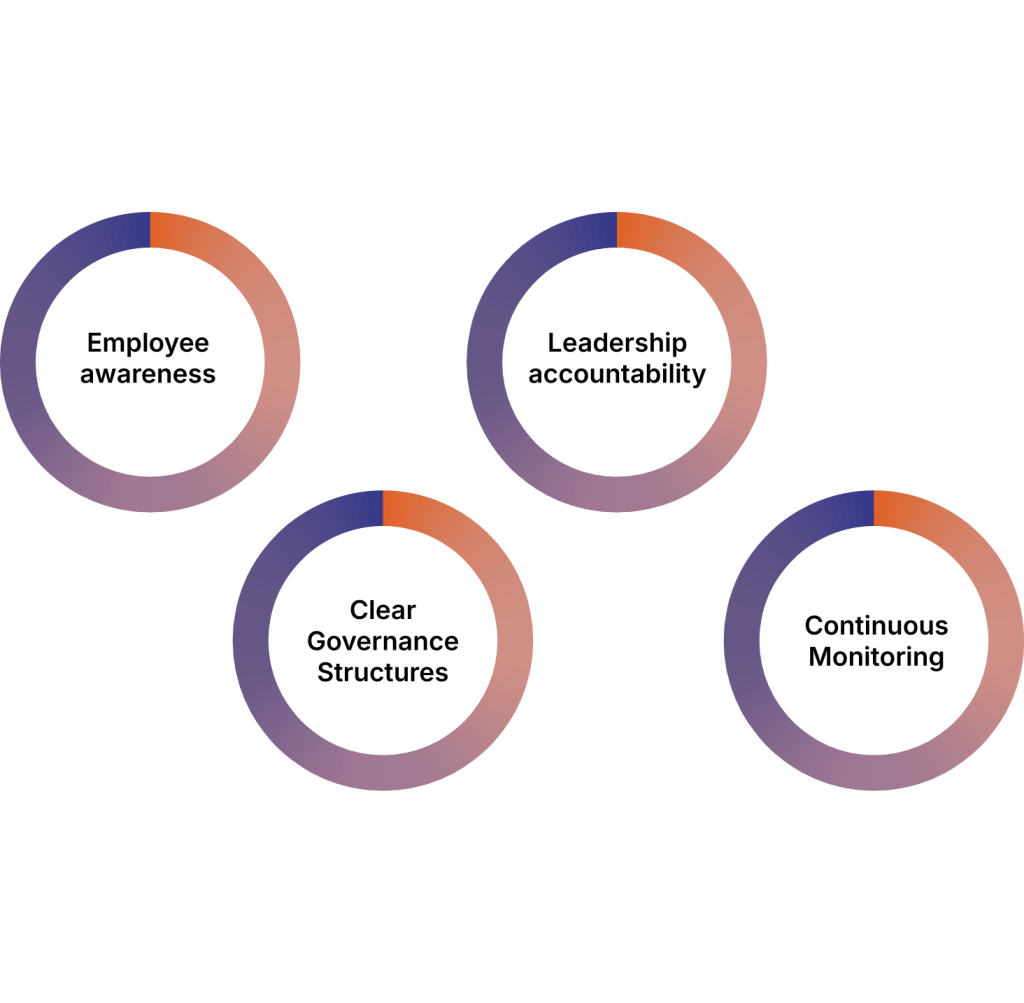
These experiences offer powerful lessons from GDPR and privacy for AI governance today. Just as privacy programs matured through education and cultural adoption, responsible AI must also become embedded in daily decision-making processes.
Organisations that successfully integrated privacy into their culture were better prepared for regulatory audits, security incidents, and evolving legal standards.
How can leadership set the foundation for a responsible AI culture?
One of the most important drivers of governance transformation is leadership commitment. In privacy governance, change only accelerated when executives began treating data protection as a strategic priority rather than a compliance burden.
The same principle applies to AI.
Senior leaders play a crucial role in shaping organisational culture for AI governance by:
- communicating ethical AI expectations across the organisation
- allocating resources for governance and monitoring
- ensuring AI risks are regularly discussed at board level
- holding teams accountable for responsible development practices
When employees see leadership prioritizing responsible AI practices, they are more likely to adopt them in their daily work.
How to embed ethics into AI systems from the start?
Another lesson from privacy governance is the importance of proactive design principles. Privacy regulations introduced the concept of “privacy by design,” requiring companies to integrate data protection safeguards into systems from the beginning.
Similarly, responsible AI programs rely on ethics by design principles.
This means organisations should:
- evaluate datasets for bias before model training
- perform AI impact assessments prior to deployment
- document decision-making logic and model limitations
- include fairness testing and transparency checks in development cycles
Embedding ethics into AI development reduces risks before they escalate and helps organisations build trustworthy systems.
Why AI awareness training is essential for employees?
Technology governance programs succeed only when employees understand their role in managing risks. Many organisations learned this during privacy compliance efforts, when staff training became a key requirement.
Today, AI awareness training plays a similar role in responsible AI initiatives.
Effective training programs should:
- explain how AI systems work and where risks may arise
- provide practical examples of ethical dilemmas in AI usage
- educate employees about fairness, transparency, and accountability
- clarify reporting procedures for AI-related concerns
Different departments may require tailored learning modules. For instance, developers need deeper technical guidance, while business teams should focus on responsible use cases and ethical considerations.
Clear Do’s and Don’ts for everyday decisions
One of the clearest lessons from GDPR and privacy for AI is the importance of clarity. Employees need concise guidance.
Do:
- Validate training data sources.
- Document assumptions and limitations.
- Use approved AI tools.
- Report anomalies or unexpected outputs.
Don’t:
- Upload confidential data into unauthorized tools.
- Rely blindly on automated outputs.
- Skip validation testing for the sake of speed.
- Ignore potential discriminatory impacts.
Simple guidelines transform governance from abstract policy to actionable behavior.
How can organisations align incentives with Responsible AI Practices?
One thing that people often forget about when they’re making rules for a company is what motivates the employees. If the only things that matter are how fast something gets done or how well the company runs people might forget to think about what’s the right thing to do.
When a company wants to use Artificial Intelligence in a way it is really important that they make sure what the employees are working towards is the same, as what the company wants to achieve.
Some simple ways to do this include:
- recognizing teams that identify and mitigate AI risks early
- integrating governance compliance into performance evaluations
- rewarding responsible innovation practices
- supporting transparent risk reporting
When ethical behavior is encouraged and rewarded, responsible AI becomes part of everyday business culture rather than an external compliance requirement.
What governance structures support responsible AI Programs?
Strong governance structures help organisations coordinate AI oversight across departments.
Many companies now establish cross-functional AI governance committees that include representatives from:
- legal and compliance teams
- technology and data science departments
- risk management professionals
- human resources and ethics officers
These committees review high-risk AI applications, define risk policies, and monitor implementation practices. Cross-functional collaboration strengthens AI governance culture and reduces the risk of siloed decision-making.
How to measure progress when building a responsible AI culture?
Cultural transformation takes time, but organisations can track progress through measurable indicators.
Common metrics include:
- completion rates for AI awareness training
- number of AI risk assessments conducted
- governance review outcomes for AI systems
- employee feedback on ethical awareness
Monitoring these indicators helps companies continuously improve their responsible AI initiatives while demonstrating accountability to regulators and stakeholders.
Conclusion
The evolution of privacy and information security provides a clear blueprint for AI governance. Policies and frameworks are important. They are not enough without the right culture. When leaders show they care and people learn about intelligence and get rewards for doing the right thing and think about ethics from the start and everyone works together to be responsible then organizations can move away from just following rules to really having an artificial intelligence culture. The path to having a responsible artificial intelligence culture is long. It takes thinking about what we do changing when we need to and always trying to get better. The good things we get from it. Like trust being strong and coming up with new ideas that last. Are really worth it. The problems with intelligence are changing faster than the rules.
Organizations that start working on a Responsible Artificial Intelligence culture now will be ready for what comes. Start by looking at what’s missing making a plan for who is in charge and making sure everyone gets rewards for being accountable. ValueMentor helps big companies turn rules into things that actually work. Making sure their artificial intelligence culture is strong can be measured and ready, for the future.
FAQS
1. What is the difference between AI governance and Responsible AI culture?
AI governance refers to formal frameworks and controls, while Responsible AI culture ensures those controls are consistently practiced across the organization.
2. Why can’t AI governance rely only on policies?
Policies provide direction, but culture drives behavior. Without cultural alignment, governance frameworks remain ineffective.
3. What lessons from GDPR and privacy apply to AI?
The key lesson is that sustainable governance requires leadership tone, training, accountability, and embedded processes-similar to the impact of the General Data Protection Regulation on privacy culture.
4. How often should AI risk assessments be conducted?
AI risk assessments should occur before deployment and periodically after launch to address model drift, bias, and evolving regulatory requirements.
5. Who should receive AI awareness training?
All employees who interact with AI tools-including HR, marketing, procurement, and leadership-should receive role-based AI awareness training.
6. What are the core pillars of a strong AI governance culture?
Leadership commitment, ethics by design, cross-functional oversight, employee training, measurable controls, and aligned incentives.
7. How does ethics by design reduce the risks of Artificial Intelligence?
Ethics by design helps find problems with fairness and security on so we do not have to fix them later and spend a lot of money.
8. How can companies make sure people use Artificial Intelligence in a way?
Companies can do this by saying thank you to people who report problems by making sure everyone follows the rules and by telling people what they can and cannot do with Artificial Intelligence.
9. What does a leader do to help create a culture of Responsible Artificial Intelligence?
A leader makes sure everyone knows what is important, gives people the tools they need makes sure someone is responsible and reminds everyone that using Artificial Intelligence in a way is very important for the company.
10. How does having a culture of Responsible Artificial Intelligence help a company succeed?
When a company has rules for using Artificial Intelligence people trust the company the company has fewer problems with the government and the company can use Artificial Intelligence in a safe and effective way to grow and innovate with Artificial Intelligence.