
When AI decisions are perceived to be unfair, unsafe, or unexplainable, the trust in the organization disappears in just one night. The lack of proper AI governance allows these failures to happen silently until they become public issues. The damage done to the trust relationship between an organization and its customers, regulators, and employees as a result of AI governance mistakes has an exponential impact on the credibility of that organization. Building and maintaining trust in AI requires more than just deploying an innovative technological tool; it requires organizations to abide by AI Governance best practices, allowing them to effectively manage risk and develop responsible and sustainable usage policies for AI.
In this blog, we will outline several of the common errors organizations make with AI governance and provide an example of what can happen by making these mistakes, as well as concrete actionable steps to prevent this from happening to your organization.
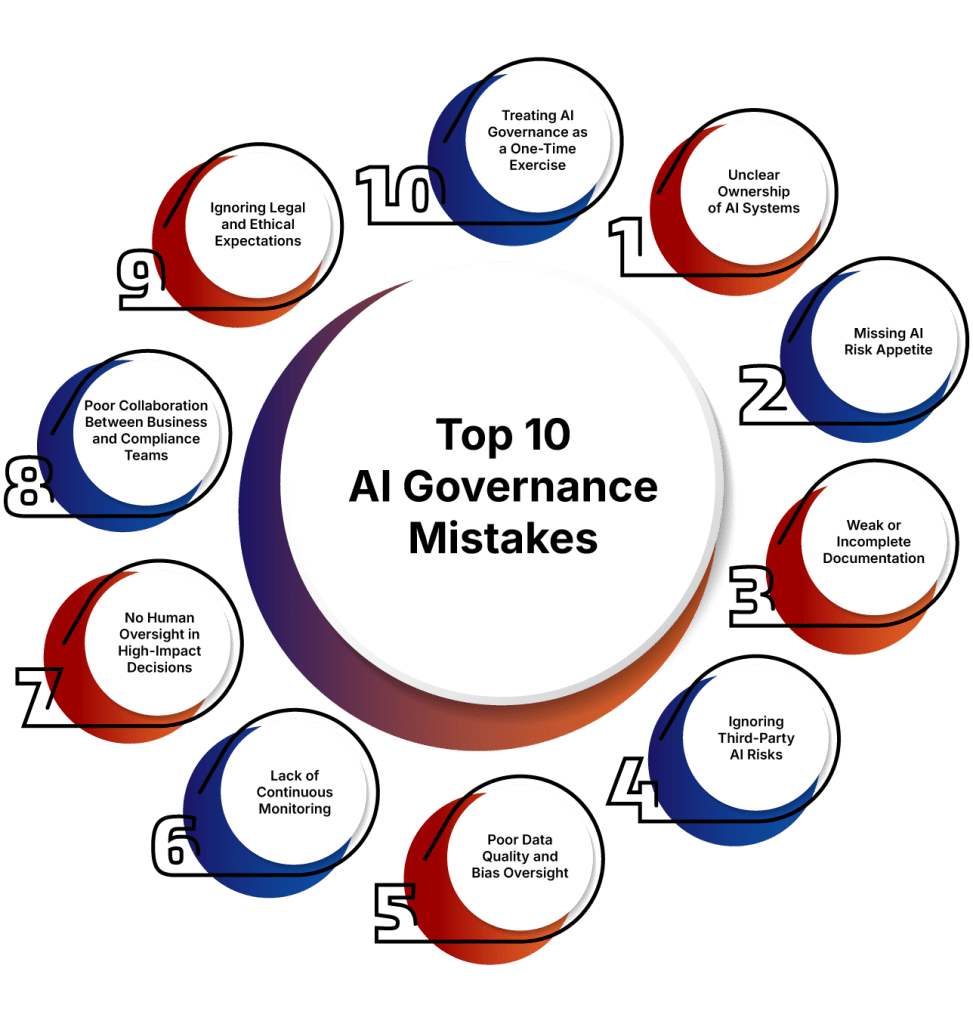
1. Unclear Ownership of AI Systems
One of the most common AI governance failures is unclear ownership. Many organizations deploy AI tools without clearly defining who is responsible for decisions, risks, and performance. When problems arise, teams often shift responsibility, causing delays and unresolved issues.
For example, a retail company introduced an AI pricing system. When customers complained about unfair price changes, the business team blamed IT, IT blamed the vendor, and no one took action. The lack of ownership allowed the issue to continue, damaging customer trust.
To fix this problem correctly:
-
- Assign one clear business owner for every AI system and Data
-
- Define technical and risk ownership roles in writing
-
- Ensure accountability is reviewed regularly
Clear ownership is a foundation for avoiding AI governance mistakes and improving decision accountability.
2. Missing AI Risk Appetite
Many organizations adopt AI without defining how much risk they are willing to accept. This creates confusion when AI systems produce unexpected results or controversial outcomes.
A financial institution launched an AI-based loan approval system without setting limits on acceptable error rates or bias. When rejection rates increased, leadership struggled to decide whether the system should be adjusted or paused.
Correct ways to fix this issue include:
-
- Defining acceptable levels of error, bias, and automation
-
- Categorizing AI use cases by risk level
-
- Linking AI risk appetite to overall enterprise risk strategy
These actions help reduce AI risk pitfalls before they impact customers or regulators.
3. Weak or Incomplete Documentation
Poor documentation is one of the most frequent AI compliance errors. When AI systems are built quickly, records about data sources, model purpose, and limitations are often ignored.
A healthcare provider faced regulatory questions about its AI decision-support tool but could not explain how the system worked. Due to missing documentation, the AI tool had to be temporarily withdrawn.
To fix documentation gaps properly:
-
- Document AI purpose, data sources, data flow and known limitations
-
- Maintain simple explanation of how decisions are made
-
- Update documentation whenever the context or model changes
Strong documentation supports transparency and helps avoid common AI governance failures.
4. Ignoring Third-Party AI Risks
Many organizations believe that when they purchase third-party AI solutions, they are compliant; this could lead to serious problems for the organization. Even if the AI vendor has developed the solution, the customer organization still holds liability.
One example of this is an organization that used a third-party AI recruitment solution that eventually resulted in biased screening practices. This company’s lack of a risk assessment created potential reputational and legal risks to continue using this type of solution.
Correct fixes for third-party AI risks include:
-
- Applying internal governance standards to vendor AI
-
- Requesting transparency and risk disclosures from vendors
-
- Including AI risk and audit clauses in contracts
These steps help prevent hidden AI risk pitfalls caused by external systems.
5. Poor Data Quality and Bias Oversight
Knowing your data is crucial. AI systems depend heavily on the data they are trained on. When data is incomplete, outdated, or biased, AI outcomes can become inaccurate or unfair. Many organizations fail to regularly review data quality, assuming that once a model is trained, the data issues are resolved.
For example, a company used an AI hiring system trained on historical employee data. Because past hiring practices favored certain backgrounds, the AI system continued to reinforce those patterns, filtering out qualified candidates from diverse groups without anyone noticing.
To fix this issue correctly:
-
- Regularly review and validate data sources and data lineagefor bias and accuracy
-
- Update training data as business conditions and user behavior change
-
- Test AI outcomes across different user groups to detect unfair patterns
Strong data governance helps organizations avoid AI governance mistakes and ensures AI systems produce fair and reliable results.
6. Lack of Continuous Monitoring
AI systems change over time as data, behavior, and environments evolve. Treating AI as a one-time deployment often leads to unnoticed failures.
A fraud detection model worked well at launch, but fraud patterns changed. Without monitoring, losses increased before the issue was identified.
To fix this correctly:
-
- Track AI performance metrics regularly
-
- Review outcomes for unexpected behavior
-
- Schedule periodic model audits and updates
Ongoing monitoring is essential to maintaining AI governance best practices.
7. No Human Oversight in High-Impact Decisions
Allowing AI to make critical decisions without human review can lead to unfair or harmful outcomes. AI lacks context and cannot handle complex human situations alone.
An insurance company used AI to automatically reject claims, leaving customers with no explanation or appeal option. This led to complaints and regulatory scrutiny.
Correct ways to fix this issue include:
-
- Keeping humans involved in high-risk decisions
-
- Allowing manual overrides when needed
-
- Training staff to understand AI recommendations
Human oversight is critical for reducing ethical and legal AI compliance errors.
8. Poor Collaboration Between Business and Compliance Teams
A major reason for AI compliance errors is weak coordination between business teams and compliance or risk teams. Typically, business units want to start using AI quickly to improve efficiency and/or allow for strategic growth. However, compliance and legal teams are generally ignored and brought in only after problems surface.
In one example, the marketing team rolled out an AI-enabled personalization tool without consulting their legal and privacy team. Because of this, the tool ended up breaking data protection laws and resulted in numerous customer complaints, as well as an urgent rollout of patches to fix the problem.
To fix this issue correctly:
-
- Involve legal, risk, and compliance teams early in AI projects
-
- Create cross-functional AI governance committees
-
- Define shared accountability across business and compliance teams
Strong collaboration reduces common AI governance failures and speeds up safe deployment.
9. Ignoring Legal and Ethical Expectations
Some organizations focus only on AI performance and innovation while overlooking legal and ethical responsibilities. This approach often leads to regulatory penalties and loss of trust.
A global company deployed the same AI system across multiple regions without adjusting it for local AI laws. As regulations differed by country, the organization faced fines and forced system changes in certain markets.
Correct ways to address this mistake include:
-
- Monitoring local and global AI regulations regularly
-
- Aligning AI systems with ethical principles like fairness and transparency
-
- Reviewing AI use cases against industry guidelines and standards
Addressing legal and ethical requirements early helps reduce top AI governance risks for enterprises.
10. Treating AI Governance as a One-Time Exercise
Many organizations treat AI governance as a one-time task completed during deployment. In reality, AI systems evolve as data, users, and regulations change.
A mid-sized bank created AI policies during initial rollout but never updated them. Over time, new AI tools were introduced without governance controls, creating unmanaged risk across the organization.
To fix this issue properly:
-
- Review AI governance policies on a regular schedule
-
- Update controls as AI systems and regulations change
-
- Train employees continuously on AI risks and responsibilities
Making governance an ongoing practice is essential for avoiding long-term AI governance mistakes.
Conclusion
Strong AI governance is essential for building trust, meeting regulatory expectations, and protecting your business as AI adoption grows. If your organization is facing governance gaps, unclear ownership, or rising AI risks, expert guidance can help you move forward with confidence.
Partner with ValueMentor to strengthen your AI governance strategy. Our experts help you assess AI risks, close governance gaps, and implement practical controls that support compliant, ethical, and scalable AI adoption-without slowing innovation.
FAQS
1. How do small and mid-sized enterprises approach AI governance?
Small and mid-sized enterprises can start with simple AI policies, clear ownership, and basic risk reviews. AI governance does not require complex systems at the beginning-clarity and consistency matter more than scale.
2. Is AI governance only required for regulated industries?
No. While regulated industries face higher scrutiny, any organization using AI can face reputational, legal, and ethical risks. AI governance helps protect businesses across all sectors.
3. How often should AI governance policies be reviewed?
AI governance policies should be reviewed at least once a year or whenever new AI tools, regulations, or business use cases are introduced.
4. Can AI governance slow down innovation?
When done correctly, AI governance supports innovation. Clear rules reduce uncertainty, help teams move faster, and prevent costly rework later.
5. Who should be involved in AI governance decision-making?
AI governance works best when business leaders, IT teams, legal, risk, compliance, and data teams collaborate rather than working in isolation.
6. What role does employee training play in AI governance?
Employee training helps teams understand AI limitations, risks, and responsibilities. Well-informed employees are less likely to misuse AI tools.
7. How do organizations prioritize which AI systems need governance first?
Organizations should focus first on AI systems that impact customers, financial decisions, personal data, or regulatory compliance.
8. Can existing risk management frameworks support AI governance?
Yes. Many organizations adapt existing enterprise risk and compliance frameworks to include AI-specific risks and controls.
9. What is the biggest early warning sign of weak AI governance?
A major warning sign is when teams cannot clearly explain how an AI system works or who is responsible for it.
10. How can leadership support effective AI governance?
Leadership can support AI governance by setting clear expectations, providing resources, and encouraging responsible AI use across the organization.