Artificial intelligence (AI) has become a cornerstone of modern business, driving analytics, enhancing customer experiences, automating operations, and supporting decision‑making. The benefits are real: speed, efficiency, smarter calls. But here’s what gets overlooked: the risk. Biased outcome. Accountability that vanishes when something goes wrong. You can’t just adopt AI and hope for the best. You have to manage it, deliberately across every stage.
That starts with clarity. Who owns each risk? You can’t answer with a vague ‘everyone’s responsible.’ Structured approaches – like AI-adapted RACI matrices- force product, IT, risk, legal, and compliance teams to actually collaborate. When accountability is clear, the gaps close.
This is where AI ethics governance becomes real- not policies on paper, but AI ethics committees tackling hard questions. Some organisations are forming dedicated AI risk committees because AI risk moves fast. It’s about responsible AI oversight as a discipline, not a checkbox. If you’re not embedding AI ethics into risk governance, you’re already behind. So, here’s the question: how do risk committees actually oversee AI? Because enforcing AI ethics in enterprises doesn’t happen by accident. It happens when someone’s explicitly responsible.
Why ownership fails in most organisations?
Even as companies move faster to adopt AI, many still can’t answer a basic question: Who actually owns the risk?
It’s not that no one cares. It’s that everyone is focused on their own piece of the puzzle.
- Product teams are busy chasing business goals and delivering customer value. That’s their job.
- IT teams are deep in development, deployment, and keeping systems running smoothly.
- Risk teams are scanning for operational and reputational threats.
- Legal and compliance teams are tracking regulations and trying to keep the company out of trouble.
Each group has its own priorities. And that’s exactly where the problem starts.
Fragmented roles create blind spots
Because AI initiatives cut across so many teams, responsibilities naturally overlap in some areas-and disappear entirely in others. Those gaps are dangerous. Risks slip through. And when something goes wrong, no one is clearly accountable. It becomes a game of pointing fingers instead of fixing problems.
Structure closes the gap
That’s why structured frameworks matter. Approaches like RACI-or better yet, a version adapted specifically for AI-give teams a practical way to divide up the work. They define who’s responsible, who needs to be consulted, and who signs off. When everyone knows their role, collaboration replaces confusion. Oversight tightens. And managing AI risk stops feeling like guesswork.
What are the benefits of clear AI risk ownership?
Once organisations overcome fragmented roles and adopt structured frameworks, the benefits of clear AI risk ownership become evident.
- Reducing oversight gaps and strengthening compliance
When AI governance roles and responsibilities are clearly defined, organisations experience significant improvements in oversight, compliance, and risk control. Processes are streamlined, duplicated reviews are avoided, and critical risks are actively monitored.
- Accountability in AI
A clear AI RACI structure ensures that accountability is not loosely shared across teams but explicitly assigned to designated individuals. Clear accountability prevents finger‑pointing during errors and reduces downtime, improving operational efficiency.
- Stronger regulatory compliance
Regulators expect documented governance because it shows accountability and transparency in how AI risks are managed. Transparency builds confidence with regulators and investors, who can see that the organisation proactively manages AI risks. A clear role definition demonstrates organisational maturity and strengthens compliance.
- Faster risk response
When bias, drift, or other AI‑related issues surface, teams with clearly defined roles can act immediately. Clear escalation routes guarantee accountability and rapid resolution.
- Innovative enablement
Clear ownership not only prevents errors but also allows teams to innovate safely. Knowing that risks are monitored encourages experimentation with AI initiatives, driving efficiency and competitive advantage. Ultimately, structured AI governance roles turn uncertainty into control and enable sustainable growth across the business.
Why does clear ownership prevent oversight gaps?
When no one is clearly responsible, things slip through the cracks. Risks get missed. Problems fester. Clear ownership closes those gaps.
- Accountability: Someone owns every risk. Whether it lives in an AI model, a dataset, or a business decision, there is a name attached to it.
- Efficiency: Teams stop stepping on each other’s toes. No more duplicate work. No more waiting on approvals that contradict each other.
- Trust and Transparency: Leaders can see what is actually happening. They know where the risks are and whether those risks are being handled.
- Resilience: When something goes wrong, the organisation moves. There is no hesitation. No one stands around asking who is supposed to deal with it.
Clear ownership is not just about avoiding mistakes. It builds trust. Across teams. Across the business. Across the entire ecosystem that depends on getting this right.
How can organisations implement AI risk ownership and AI RACI?
Implementing AI risk ownership is not a check-the-box exercise. You cannot just assign a few names and call it done. It takes a structured approach. One that starts at the top and runs through every layer of the organisation.
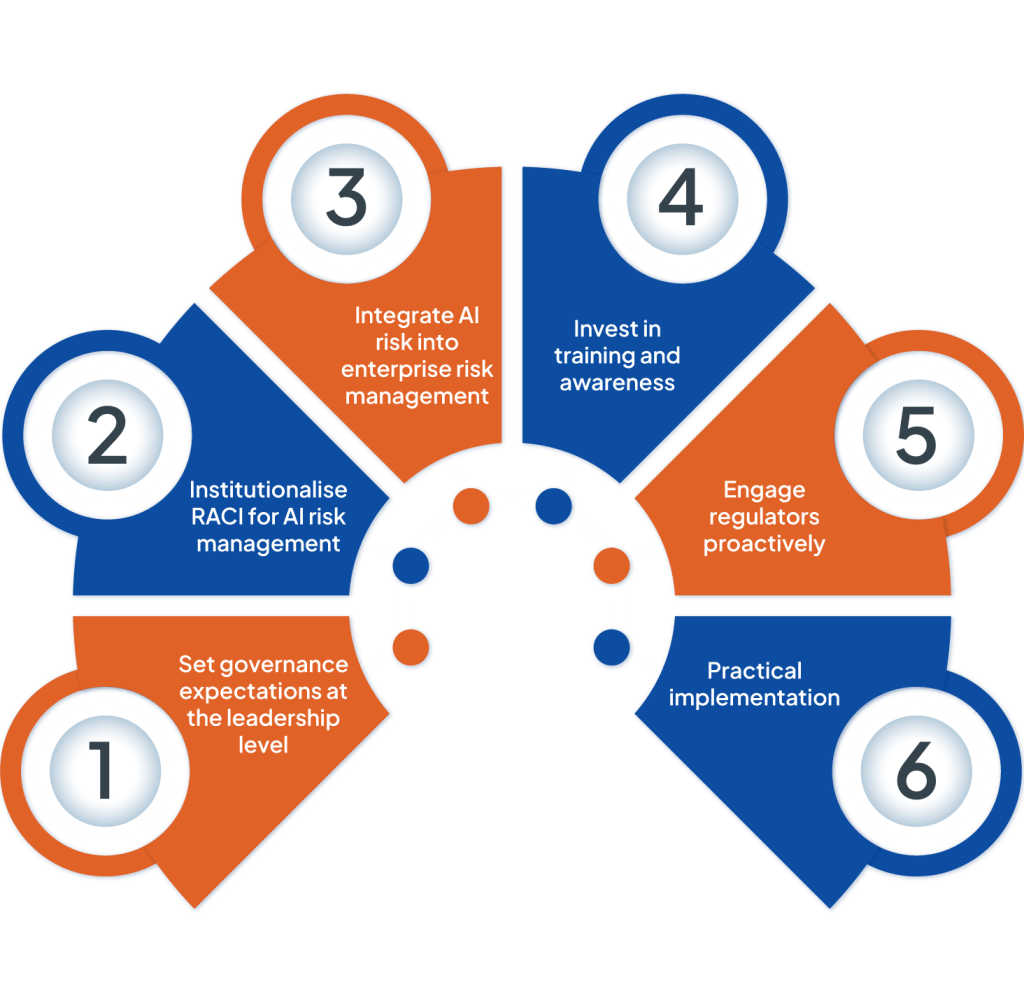
- Set governance expectations at the leadership level: It has to start with leaders. When executives treat AI governance as a priority, everyone else pays attention. It signals that risk management matters. That accountability is non-negotiable. That cuts down on the usual problems-teams ignoring responsibilities, oversight becoming inconsistent, risks going unmanaged.
- Institutionalise RACI for AI risk management: Every AI initiative needs a documented RACI chart. Not a one-time thing. A living document. It gets reviewed and updated as business priorities shift, technology changes, or new regulations land.
- Integrate AI risk into enterprise risk management: AI risks do not sit in their own little world. They belong inside the organisation’s broader enterprise risk management framework. Aligning them that way creates consistency. It also means fewer blind spots.
- Invest in training and awareness: People need to understand what they are managing. Training risk teams, compliance staff, and technical teams on emerging regulations and ethical AI practices makes the entire organisation stronger. More resilient.
- Engage regulators proactively: Talk to regulators before you have to. Structured engagement shows you are serious about accountability. It also keeps you aligned with recognised frameworks and best practices. That matters when rules start shifting.
- Practical implementation: On the ground, this means mapping responsibilities across teams. Building RACI charts that actually get used. Running bias audits. Making sure staff know what AI risk management looks like in practice. These steps move organisations from fragmented responsibility to real ownership. Risks get monitored. Managed. Improved. Not just once, but continuously.
How do organisations move from theory to practice in AI risk ownership?
Many organisations try to map responsibilities across teams and document AI RACI charts. They know it is the right thing to do. But moving from theory into practice? That is where it gets hard.
The gap between planning and doing is real. Here is what actually works.
Practical measures organisations can adopt:
- Map AI responsibilities across teams. Not in broad strokes. Go team by team. Role by role. Make it specific.
- Build RACI charts tailored to your structure. Off-the-shelf frameworks are a start, but they need to fit how your organisation actually works.
- Conduct bias audits and compliance reviews. Run them regularly. Treat them as part of the process, not a one-off exercise.
- Train teams on AI risk management best practices. People need to know what they are looking for and what to do when they find it.
These measures do one thing: they move organisations from fragmented, unclear responsibility to defined ownership. Risks get watched. Managed. Improved. Not just once, but continuously. That strengthens accountability. It builds operational resilience. And it turns governance from a concept into something real.
Future-proofing AI governance
AI governance is not static. It never was. It has to move as fast as the technology and the rules around it. Organisations need to see what is coming.
- Global compliance challenges
Regulations keep shifting. Different countries, different rules. Organisations have to track them all. For multinational companies, that means making sure AI models meet data privacy standards here, fairness requirements there, and sector-specific rules somewhere else. Stay on top of it, or risk fines and legal trouble.
- Integration with ESG reporting
Governance does not sit in a silo anymore. It is tied to sustainability, ethics, and corporate responsibility. Transparent AI policies show stakeholders you mean it. They align with broader ESG commitments and build trust where it matters.
- Cross-border risks
Operating across borders means complexity. Oversight requirements vary. Standards differ. Multinationals have to coordinate governance across regions to keep things consistent and accountability clear.
The point is simple. Embed governance now. Build it into how you work today. That is how you prepare for tomorrow. When regulations shift, when new rules land, when technology takes another leap-you are ready. Your AI initiatives stay compliant. Ethical. Effective. No scrambling. No surprises.
Conclusion
AI governance is no longer just about ticking boxes or keeping up with regulations. It is about running a business the right way.
Clear ownership changes everything. When you put frameworks like RACI behind it, fragmented responsibility turns into real accountability. Roles get defined. Duplication disappears. Compliance tightens. And risks stop falling through the cracks-they get watched, managed, and dealt with.
Making it work takes more than talk. It means mapping responsibilities. Documenting RACI charts. Running bias audits. Training teams. These steps take governance out of presentations and into daily operations. That is how organisations move from theory to practice.
Looking ahead, governance has to keep evolving. Global compliance challenges will keep coming. ESG reporting is becoming part of the picture. Cross-border risks will get more complex. The organisations that embed governance now-that build it into how they work today-will be ready for whatever comes tomorrow.
At ValueMentor, we see resilient AI governance as more than just risk management. It strengthens cybersecurity. It makes responsible innovation possible. It builds trust with stakeholders. And it sustains long-term business value. We help organisations understand the frameworks and strategies that make all of this real.
FAQS
1. Why is RACI particularly important for AI governance compared to other domains?
AI brings risks that cut across multiple teams-product, tech, legal, risk, and compliance. That is where things usually get messy. RACI forces clarity. It makes sure someone is accountable, and it prevents the kind of duplication or gaps that show up more often in AI than in traditional IT or compliance work.
2. How often should organisations update their AI RACI charts?
Regularly. At least once a year. But also, whenever something changes-a new AI initiative, a shift in regulations, or a reorganisation. The chart should reflect how things actually work, not how they used to work.
3. What practical steps help embed AI governance into daily operations?
Start with the basics. Map responsibilities across teams. Run bias audits. Keep shared documentation that people actually use. Schedule cross-functional risk reviews and treat them as part of the workflow, not an extra task.
4. How do bias audits fit into compliance frameworks?
Bias audits do two things. They show whether your AI is fair, and they give you evidence to prove it. That evidence supports compliance with data privacy laws, anti-discrimination rules, and sector-specific regulations. Regulators ask questions. Audits give you answers.
5. What challenges arise when coordinating AI governance across regions?
Different countries have different rules. What works in one jurisdiction may not fly in another. Multinational organisations have to harmonise their oversight practices while still adapting to local laws. It is a balancing act, and it takes constant attention.
6. How does AI governance intersect with ESG reporting?
Governance is part of ESG. Strong AI governance shows ethical responsibility and transparency. That builds trust with stakeholders and aligns AI practices with broader sustainability and corporate accountability goals. It is not a separate thing-it is all connected.
7. What are the risks of unclear ownership in AI governance?
When no one owns a risk, it does not get managed. That leads to oversight gaps, duplicated effort in some areas and none in others, and problems that fester until they become compliance failures or reputational damage. Clear ownership closes those gaps.
8. How can cross-functional collaboration improve AI risk management?
AI risk is not just a tech problem or a legal problem. It is all of them. When technical, legal, ethical, and operational perspectives come together, blind spots shrink. Collaboration forces teams to see what they would miss on their own.
9. What role will regulators play in shaping AI governance?
Regulators set the floor. They provide standards and guidance that organisations have to meet. But proactive engagement changes the dynamic. When organisations talk to regulators early, they can anticipate requirements instead of scrambling to catch up. That builds trust on both sides.
10. What is the long-term vision for resilient AI governance?
Governance that lasts enables responsible innovation. It keeps AI compliant across jurisdictions without slowing things down. And over time, it builds trust-with stakeholders, with regulators, with the public. That trust is what makes AI sustainable.