Businesses that operate in or target the European Union must follow strict rules when handling user data online. e-Privacy Directive compliance means following EU rules for cookies, tracking technologies, and electronic communications to ensure user consent and privacy. While many organizations focus on GDPR, the e-Privacy Directive compliance requirements specifically address how businesses use cookies, tracking technologies, and electronic communications such as emails, messaging, and online interactions.
This guide provides a practical and business-friendly overview of EU ePrivacy Directive compliance, designed especially for EU-facing B2B businesses. It explains how privacy rules apply to cookies, tracking tools, and communication data without using complex legal language. Whether you run a SaaS platform, a digital service, or an online business, this guide will help you understand what is required and how to stay compliant. While GDPR focuses on personal data, the e-Privacy Directive focuses on how that data is collected through cookies, tracking tools, and communication systems.
Strengthen AWS Security from Initial Migration to Global Scale.
Strengthen AWS Security from Initial Migration to Global Scale.
What is e-Privacy directive compliance?
e-Privacy Directive compliance refers to the rules businesses must follow when managing user privacy in electronic communications. It focuses on how companies collect, store, and use data generated through digital interactions such as website visits, emails, messaging platforms, and tracking technologies.
The main purpose of the directive is to protect users from unwanted tracking and misuse of their communication data. It ensures that businesses are transparent about how they monitor user activity and that users have control over their data.
Unlike GDPR, which covers all types of personal data, the e-Privacy Directive specifically focuses on electronic communications privacy compliance, including cookies, tracking tools, and communication content. Both regulations work together, and businesses must comply with both to ensure complete data protection.
Scope of the EU e-Privacy directive

The EU ePrivacy Directive compliance framework applies to a wide range of digital activities and data types used in online environments.
It mainly covers:
- Cookies and similar tracking technologies used on websites
- Metadata such as time, location, and device information
- Content of electronic communications like emails and messages
- Tracking tools such as analytics, pixels, and monitoring software
The directive impacts not only telecom providers but also digital platforms, SaaS businesses, and any organization that interacts with users online. If your business collects data through websites or communication tools, it likely falls within the scope of this directive.
Who must comply with the e-Privacy directive?
The e-Privacy Directive applies to a broad range of businesses, regardless of their location.
You must consider e-Privacy Directive compliance services if:
- Your business is based in the EU
- Your website or platform targets EU users
- You use cookies, tracking tools, or online communication systems
- You run email marketing or digital campaigns
This includes both B2B and B2C businesses. For example, a SaaS company based outside the EU but serving EU clients must still follow EU Cookie Law compliance requirements if it tracks user behavior or uses cookies on its website.
In simple terms, if your business interacts digitally with users in the EU, e-Privacy compliance is not optional.
Why e-Privacy directive compliance matters for businesses?
For EU-facing businesses, e-Privacy Directive compliance is not optional; it is a critical part of operating responsibly in a privacy-focused market.
Regulators in the EU take user consent and tracking transparency seriously. Businesses are expected to clearly inform users about how their data is collected and used, especially when it comes to cookies and online monitoring tools.
Beyond regulatory expectations, compliance directly impacts business performance. Users today are more aware of privacy practices and are more likely to engage with brands they trust. Poor privacy practices can lead to user drop-offs, reduced engagement, and long-term brand damage.
In short, compliance is not just about avoiding penalties, it’s about building trust, improving user experience, and maintaining credibility in the EU market.
Legal and business risks of non-compliance
Ignoring e-Privacy Directive enforcement risks can have serious consequences for businesses.
Key risks include:
Even simple mistakes like improper cookie banners can attract attention from regulators. Businesses that fail to address these risks may struggle to maintain long-term growth in the EU market.
e-Privacy directive requirements explained
e-Privacy Directive requirements focus on user consent, transparency, and control over tracking and communication data. Businesses must clearly inform users and obtain approval before collecting or using their data.
Here are the key requirements:
These requirements apply to websites, apps, marketing tools, and any platform that interacts with EU users digitally.
Cookie consent rules under the e-Privacy directive
e-Privacy Directive requirements focus on user consent, transparency, and control over tracking and communication data. Businesses must clearly inform users and obtain approval before collecting or using their data.
Here are the key requirements:
1. Prior consent is mandatory
Users must give consent before cookies (except essential ones) are placed on their devices.
2. What valid consent means
3. Cookies that require consent
4. Common cookie banner mistakes
A poorly designed cookie banner is one of the most common failures in cookie compliance under e-Privacy Directive.
Online tracking and monitoring requirements
Compliance is not limited to cookies. These requirements are often referred to as online tracking consent requirements under the e-Privacy Directive. Tracking technologies compliance also includes tools that monitor user behavior across platforms.
This includes:
- Website analytics tools
- Tracking pixels (e.g., for ads or remarketing)
- Session recording tools
- Behavioral monitoring software
Businesses must:
- Inform users about tracking tools
- Obtain consent before activating them
- Provide clear choices to accept or reject tracking
- Ensure transparency about how data is used
Users should always feel in control of how their data is tracked and processed.
Electronic communications and marketing rules
The electronic communications privacy compliance rules focus on how businesses handle communication data.
These apply to:
- Email marketing campaigns
- SMS and messaging platforms
- Telecom and VoIP services
Key requirements include:
- Obtaining consent before sending marketing messages
- Clearly identifying the sender
- Providing an easy opt-out option
- Protecting communication metadata (such as time, location, and sender details)
- Avoiding unauthorized access to communication content
Businesses must ensure that communication data is used responsibly and only for legitimate purposes.
e-Privacy compliance includes a structured review of your tracking setup
So our team evaluates your cookies, consent mechanisms, and communication practices and flags likely issues before they become risks. Most businesses strengthen compliance faster.
How to comply with the e-Privacy directive?
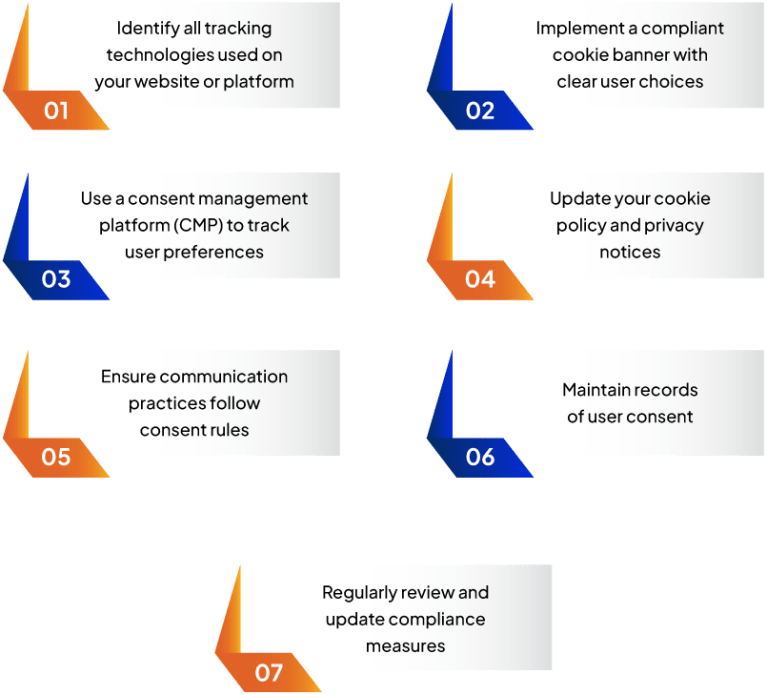
Achieving e-Privacy Directive requires a structured and practical approach. Businesses should focus on implementing systems that support transparency, consent, and control.
Here’s a step-by-step approach:
- Identify all tracking technologies used on your website or platform
- Implement a compliant cookie banner with clear user choices
- Use a consent management platform (CMP) to track user preferences
- Update your cookie policy and privacy notices
- Ensure communication practices follow consent rules
- Maintain records of user consent
- Regularly review and update compliance measures
This approach helps businesses stay aligned with evolving regulatory expectations.
Consent collection and management
Effective consent management under e-Privacy is essential for compliance.
Businesses should:
- Use clear and user-friendly consent mechanisms
- Allow users to easily accept or reject tracking
- Provide options to withdraw consent anytime
- Maintain detailed records of user consent
- Periodically review consent validity
Strong consent management under e-Privacy ensures that businesses can demonstrate compliance during audits and regulatory reviews.
Policies, Notices, and Internal controls
Strong internal practices support long-term EU Cookie Law compliance.
Businesses should:
- Maintain an updated cookie policy
- Clearly explain tracking and data usage in privacy notices
- Assign internal responsibility for compliance
- Train teams handling marketing and data
- Align internal processes with consent requirements
Clear documentation and accountability help reduce compliance risks.
e-Privacy directive vs GDPR: Key differences
Many businesses assume that GDPR compliance is enough, but that’s not the case. Both regulations serve different purposes and must be followed together.
Here’s a simple comparison to understand the difference between GDPR and e-Privacy Directive compliance:
In simple terms, the difference between GDPR and e-Privacy Directive is that GDPR protects personal data broadly, while the e-Privacy Directive focuses on how that data is collected through digital communication channels.
| Aspect | e-Privacy Directive | GDPR |
| Focus | Cookies, tracking, and electronic communications | Personal data protection |
| Scope | Website tracking, cookies, emails, telecom data | All personal data processing |
| Consent | Required before placing tracking technologies | Required for processing personal data |
| Coverage | Electronic privacy | Broader data privacy |
| Use Case | Cookie banners, email marketing, tracking tools | Data storage, processing, user rights |
PECR and its role in e-Privacy compliance
PECR plays a key role for businesses operating in or targeting users in the UK and often requires PECR compliance services. Businesses targeting UK users must comply with PECR alongside GDPR, and many rely on PECR compliance services to ensure proper implementation.
PECR covers:
- Cookie consent requirements
- Email and SMS marketing rules
- Confidentiality of communications
- Use of tracking technologies
Even after Brexit, PECR remains highly relevant. Businesses targeting UK users must comply with PECR alongside GDPR, making it an essential part of overall e-Privacy compliance.
Industry-specific e-Privacy compliance considerations
Different industries face different challenges when implementing telecom data privacy compliance and e-Privacy rules.
While the core principles remain the same, how they apply can vary depending on the type of business and the technologies used.
Telecom and electronic communications providers
Telecom and communication service providers have stricter responsibilities due to the nature of the data they handle.
They must focus on:
- Secure handling of communication content
- Protection of metadata (such as call duration, location, and time)
- Ensuring lawful use of communication data
- Obtaining proper consent where required
- Preventing unauthorized access to user communications
Because of the sensitivity of this data, compliance expectations are significantly higher in this sector.
e-Privacy compliance audits and ongoing support
Regular e-Privacy Directive audits help businesses identify gaps in their compliance strategy and reduce risks. Many businesses use e-Privacy Directive compliance services to identify gaps and ensure their tracking and communication practices meet regulatory expectations.
An e-Privacy Directive audit typically reviews:
- Cookie implementation and consent mechanisms
- Tracking tools and technologies in use
- Privacy policies and disclosures
- Consent records and management systems
- Communication practices (email, SMS, etc.)
Ongoing monitoring is important because tracking technologies and regulations continue to evolve. Businesses that regularly review their practices are better prepared to stay compliant.
When to use e-Privacy directive consulting services
Businesses often require e-Privacy Directive consulting when compliance becomes complex.
You should consider expert support if:
- Your website uses multiple tracking and analytics tools
- You operate across multiple regions (EU + UK + global)
- You are unsure about consent requirements
- Your business handles large volumes of user data
- You need ongoing compliance monitoring
Working with experienced advisors like ValueMentor can help simplify compliance, identify risks early, and ensure your business stays aligned with evolving privacy expectations.
Common e-Privacy compliance mistakes
Many businesses fail to meet e-Privacy compliance requirements due to simple but critical mistakes.
Some of the most common issues include:
- Using cookie banners that do not collect valid consent
- Providing only an “Accept All” option without a clear reject choice
- Assuming GDPR compliance alone is sufficient
- Failing to maintain proper consent records
- Not updating cookie policies regularly
- Using tracking tools without informing users
Avoiding these mistakes can significantly reduce compliance risks and improve user trust.
Ensuring full e-Privacy Directive compliance can be challenging, especially with evolving rules around cookies, tracking, and electronic communications.
Partner with ValueMentor to simplify your compliance journey. From audits to end-to-end e-Privacy Directive compliance services, experts help identify risks, implement solutions, and maintain ongoing standards.
Download our e-Privacy compliance checklist or request a consultation with ValueMentor today to stay ahead of regulatory requirements.
Avoid compliance risks that can impact revenue and growth
Ensure your cookies, tracking tools, and communication practices meet EU requirements before they affect performance or trust
FAQs
1. What is e-Privacy Directive compliance?
It refers to the rule’s businesses must follow when using cookies, tracking technologies, and electronic communications to ensure user privacy in the EU.
2. Does the e-Privacy Directive apply to cookies?
Yes, it specifically requires businesses to obtain user consent before placing non-essential cookies on their devices.
3. How is the e-Privacy Directive different from GDPR?
The e-Privacy Directive focuses on electronic communications and tracking, while GDPR covers all aspects of personal data protection.
4. Who must comply with the e-Privacy Directive?
Any business that operates in the EU or targets EU users, including non-EU companies offering digital services.
5. What are the risks of not following e-Privacy rules?
Businesses may face fines, reputational damage, loss of customer trust, and increased regulatory scrutiny.
6. Is PECR part of the e-Privacy Directive?
PECR is the UK’s version of the e-Privacy Directive and applies to businesses targeting UK users.
7. How often should e-Privacy audits be done?
Audits should be conducted regularly, especially when new tracking tools are added or regulations are updated.