
Most organizations invest significant effort into building their Records of Processing Activities(RoPA). They map data flows, document legal bases, and establish maintenance routines. Yet many still face a critical gap: they cannot systematically identify which processing activities require deeper scrutiny. This is precisely where the ROPA-to-DPIA pathway becomes essential.
A well-maintained ROPA is not merely an inventory. It is the primary tool for spotting high-risk processing that triggers mandatory Data Protection Impact Assessment obligations. Understanding how to move from records to risk assessment, separates organizations that merely comply from those that genuinely protect data subjects. This article explains that transition for privacy professionals operating across Middle Eastern jurisdictions.
What DPIA actually means in regional context?
A Data Protection Impact Assessment is a structured evaluation of risks that processing activities pose to individuals’ rights and freedoms. It requires organizations to examine the nature, scope, context, and purposes of processing before implementation, identify specific risks, and implement measures to mitigate them.
The concept appears across multiple regional frameworks, though triggers and expectations vary:
- UAE PDPL: Mandatory before processing involving new technologies likely to result in high risk. Specifically required for systematic evaluation of personal aspects based on automated processing with legal or significant effects, and for large-scale processing of sensitive personal data.
- Saudi PDPL: Required where processing is likely to result in high risk to data subjects, including large-scale sensitive data processing, automated decision-making with significant effects, and processing of vulnerable populations.
- GDPR (for comparison): Required for systematic profiling, large-scale sensitive processing, and extensive systematic monitoring.
The common thread is proactive risk evaluation. Regulators across jurisdictions expect organizations to identify high-risk processing before harm occurs, not after incidents force retrospective analysis.
How ROPA becomes your DPIA starting point?
Your ROPA contains the raw material for DPIA identification. The challenge lies in reading it diagnostically rather than merely descriptively.
Key ROPA fields that reveal DPIA triggers:
- Processing purpose and technology: New technologies, AI systems, or automated decision-making flagged here require immediate attention
- Data categories: Large volumes of sensitive personal data or biometric information trigger enhanced obligations in both UAE and Saudi frameworks
- Data subjects: Vulnerable populations including children, employees under monitoring, or individuals subject to profiling
- Scale indicators: Processing affecting large numbers of data subjects or conducted over extended periods
- Cross-border elements: International transfers involving sensitive data or jurisdictions without adequacy determinations
High-risk processing categories in the GCC context
Through regulatory guidance and enforcement patterns, several processing types consistently trigger DPIA obligations across the region:
1. Automated decision-making and AI systems
Both UAE and Saudi regulators emphasize processing with legal or similarly significant effects. Credit scoring, recruitment algorithms, insurance pricing models, and automated eligibility determinations fall squarely within this category. The Saudi PDPL explicitly references automated decision-making with significant effects as a high-risk trigger.
2. Large-scale sensitive data processing
Healthcare providers processing patient records, biometric systems for authentication, and genetic data repositories require DPIAs under both regimes. The UAE PDPL specifically references large-scale sensitive personal data processing as a mandatory trigger.
3. Systematic monitoring and surveillance
Workplace monitoring, customer behaviour tracking across physical and digital environments, and public space surveillance trigger assessment requirements. The systematic nature matters more than the technology used.
4. Processing of vulnerable populations
Children’s data, employee monitoring in asymmetric power relationships, and data processing affecting individuals with limited capacity all attract heightened scrutiny.
5. Novel technology deployment
Blockchain-based identity systems, facial recognition, emotion detection, and predictive analytics using personal data require proactive assessment before deployment.
The assessment process: From identification to mitigation
Once your ROPA review identifies potential high-risk processing, the DPIA follows a structured methodology:
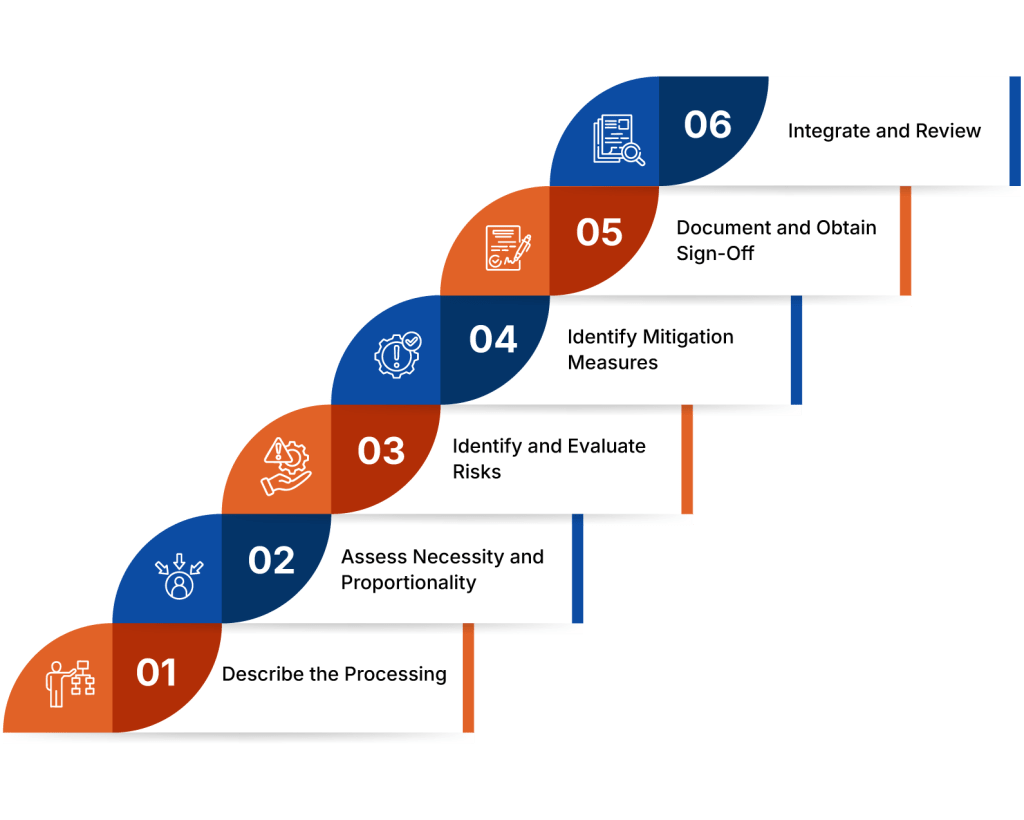
Step 1: Describe the processing: Document nature, scope, context, and purposes using ROPA as foundation. Specify data flows, systems involved and intended outcomes.
Step 2: Assess necessity and proportionality: Evaluate whether the processing is necessary for the stated purpose and proportionate to the benefits sought. This step often reveals that less intrusive alternatives exist.
Step 3: Identify and evaluate risks: Examine risks to data subjects’ rights and freedoms, including privacy violations, discrimination, financial loss, or reputational harm. Consider both likelihood and severity.
Step 4: Identify mitigation measures: Specify technical and organizational controls that reduce identified risks to acceptable levels. These might include pseudonymization, enhanced access controls, or human review of automated decisions.
Step 5: Document and obtain sign-off: Maintain comprehensive records of the assessment process, conclusions, and approved mitigation measures. Senior management approval demonstrates organizational accountability.
Step 6: Integrate and review: Embed DPIA outcomes into project implementation. Schedule regular reviews, particularly when processing conditions change or new risks emerge.
Common organizational failures in DPIA implementation
Despite clear regulatory guidance, organizations repeatedly stumble in similar ways:
1. Treating DPIA as a checkbox exercise
Rushed assessments conducted after system deployment rather than before implementation fail to achieve risk prevention objectives. SDAIA and the UAE Data Office increasingly look for evidence that DPIAs influenced design decisions.
2. Isolating DPIA from broader governance
DPIAs that sit in privacy team silos without integration into project management, procurement, or IT development methodologies become ignored artifacts. Successful organizations embed DPIA requirements into standard project approval workflows.
3. Inadequate stakeholder involvement
Effective DPIAs require input from business owners, technical teams, legal counsel, and often data subjects themselves. Narrow assessments miss operational realities and alternative perspectives.
4. Weak risk evaluation methodology
Organizations frequently identify risks generically without assessing likelihood or severity rigorously. This produces meaningless risk ratings and inadequate mitigation planning.
5. Failure to track residual risks
Even after mitigation, some risk typically remains. Organizations that fail to document and monitor residual risks lose visibility into ongoing exposure.
The regulatory enforcement reality
Both UAE and Saudi regulators have moved beyond policy-based compliance to evidence-based accountability. The UAE Data Office examines whether DPIAs influenced processing design and whether residual risks are monitored. SDAIA’s enforcement approach specifically targets organizations that cannot demonstrate proactive risk assessment, with fines reaching SAR 5 million for PDPL violations.
The practical implication is clear: a DPIA that exists only as a document is insufficient. Regulators want evidence that the assessment process meaningfully shaped processing activities, that identified risks were addressed, and that ongoing monitoring occurs.
Building the ROPA-DPIA bridge in your organization
- Governance integration: Assign responsibility for ROPA review and DPIA triggering to a specific role or function. The DPO or privacy lead should maintain a standing agenda item reviewing new or changed processing activities for high-risk indicators.
- Standardized trigger assessment: Develop a simple checklist based on your jurisdiction’s specific DPIA triggers. Apply this checklist to every new processing activity documented in ROPA before implementation approval.
- Escalation workflow: Define clear pathways for activities triggering DPIA requirements. Specify who conducts the assessment, timeline expectations, approval authorities, and integration with project management.
- Documentation standards: Establish consistent templates and evidence requirements for DPIAs. Ensure these integrate with ROPA entries so regulators can trace from inventory through risk assessment to mitigation.
- Training and awareness: Educate business teams on high-risk indicators so they flag potential triggers during project conception rather than after implementation begins.
The business value beyond regulatory defense
Organizations that master the ROPA-to-DPIA transition gain operational advantages beyond compliance:
- Early risk identification: Catching privacy issues during design prevents costly retrofitting
- Stakeholder confidence: Demonstrating proactive risk management builds trust with customers, partners, and investors
- Project efficiency: Clear assessment criteria prevent delayed approvals and last-minute compliance surprises
- Competitive positioning: Privacy-conscious design differentiates offerings in increasingly aware markets
Conclusion: Making the connection operational
The journey from ROPA to DPIA is not merely a regulatory requirement. It is the mechanism through which organizations transform data inventory into genuine risk management. Your ROPA tells you what processing occurs. Your DPIA process ensures that high-risk processing receives appropriate scrutiny before implementation.
Organizations that treat these as connected, continuous processes build privacy resilience. Those that treat them as separate, static documents remain vulnerable to regulatory enforcement and operational disruption. The investment in connecting ROPA maintenance to DPIA identification pays dividends in reduced risk, smoother project delivery, and demonstrable accountability.
FAQS
1. What is the main difference between ROPA and DPIA?
ROPA is an inventory of all processing activities. DPIA is a risk assessment for specific high-risk activities identified through that inventory.
2. Does every processing activity in my ROPA need a DPIA?
No. Only activities meeting high-risk thresholds under your jurisdiction’s law require formal DPIA. Most routine processing does not qualify.
3. How do I know if my processing is “high-risk”?
Check against your regulator’s specific triggers. Common indicators include automated decision-making, large-scale sensitive data, systematic monitoring, and novel technologies.
4. Can I use one DPIA for multiple related processing activities?
Yes, if activities are similar in nature, scope, and risk profile. However, significantly different processing requires separate assessments.
5. When should the DPIA be conducted?
Before processing begins. Retrospective DPIAs fail the fundamental purpose of proactive risk prevention.
6. Who should be involved in conducting a DPIA?
Privacy lead, business owner, technical team, legal counsel, and potentially external stakeholders or data subjects depending on processing nature.
7. How long does a DPIA take?
Simple assessments may take days. Complex technology deployments requiring stakeholder consultation and technical analysis may require several weeks.
8. Do I need to submit my DPIA to the regulator?
Not routinely, though both UAE and Saudi regulators may request DPIA documentation during examinations or complaint investigations.
9. How often should DPIAs be reviewed?
When processing conditions change significantly, and at regular intervals for ongoing high-risk processing. Annual review is good practice.
10. Can I use GDPR DPIA templates for UAE or Saudi compliance?
As starting points, yes. However, you must adapt for jurisdiction-specific triggers, legal basis frameworks, and regulatory expectations. Direct transplantation creates compliance gaps.