
Choosing an appropriate compliance framework for new healthcare organizations may be among the very first and important decisions to make from the security standpoint. For founders and security specialists, deciding between such frameworks as HITRUST e1 and SOC 2 may be difficult because of numerous differences and peculiarities of both compliance standards. While they show commitment to the protection of sensitive data, they have completely different goals and applications.
No matter whether you are developing a digital health platform, SaaS app, telemedicine service, or healthcare software based on artificial intelligence, choosing the right compliance standard can bring you benefits like increased trust among customers, improved sales performance, and better cybersecurity posture. Let’s explore these frameworks and discover the best use cases and differences between them in our blog post.
Understanding HITRUST e1 and SOC 2
Although both frameworks focus on information security, they differ significantly in scope, methodology, and intended audience.
What is HITRUST e1?
The HITRUST e1 assessment is the entry-level assessment within the HITRUST Assurance Program. It is designed for organizations with relatively lower risk profiles that need to demonstrate foundational cybersecurity controls. The assessment evaluates essential security practices using a simplified set of requirements, making it an excellent starting point for organizations beginning their compliance journey.
Unlike i1 and r2 assessments, e1 uses a fixed, non-tailorable baseline of approximately 44 control requirements. Every organization completing an e1 assessment is evaluated against the same predefined controls, regardless of size or environment. This standardized approach simplifies implementation while ensuring that organizations establish core cybersecurity practices.
By comparison, i1 and r2 assessments include hundreds of control requirements that are tailored based on an organization’s risk profile, regulatory obligations, and assessment scope. As a result, e1 offers a faster and more streamlined path for organizations seeking to demonstrate baseline security maturity before progressing to more comprehensive HITRUST assessments.
What is SOC 2?
SOC 2 is an independent audit framework developed by the American Institute of Certified Public Accountants (AICPA). It evaluates how organizations manage customer data based on the Trust Services Criteria:
- Security
- Availability
- Processing Integrity
- Confidentiality
- Privacy
For many SaaS companies, SOC 2 for healthcare startups provides assurance to customers that security controls are designed and operating effectively. HITRUST results in an actual certification a validated pass/fail credential with a HITRUST seal that can be referenced in sales and marketing conversations. SOC 2 results in an attestation report a CPA’s opinion on your controls, typically shared with prospects under NDA rather than displayed publicly.
Why Do Healthcare Startups Need Compliance Early?
Healthcare startups often collect, process, or store sensitive health-related information. Even if they are not directly regulated healthcare providers, enterprise customers increasingly require evidence of strong security before signing contracts.
Early investment in healthcare cybersecurity compliance offers several benefits:
- Builds trust with hospitals, payers, and healthcare partners
- Shortens security review cycles during procurement
- Reduces cybersecurity risks
- Demonstrates commitment to protecting sensitive information
- Creates a scalable compliance foundation for future growth
Choosing the right framework early helps avoid costly compliance redesigns later.
HITRUST e1 vs SOC 2: Key Differences
Although both frameworks improve organizational security, their objectives differ considerably.
| Feature | HITRUST e1 | SOC 2 |
| Primary Purpose | Foundational cybersecurity assurance | Independent audit of security controls |
| Target Organizations | Lower-risk healthcare organizations and startups | SaaS providers across all industries |
| Assessment Type | Standardized HITRUST assessment | CPA-performed audit |
| Industry Focus | Healthcare-focused | Industry agnostic |
| Control Requirements | Fixed baseline requirements | Flexible Trust Services Criteria |
| Certification | HITRUST validated assessment | SOC 2 attestation report |
| Scalability | Entry point to higher HITRUST assessments | Can expand with additional Trust Services Criteria |
When comparing HITRUST vs SOC 2, the biggest distinction is industry focus. HITRUST aligns closely with healthcare security expectations, while SOC 2 demonstrates general security governance. Unlike i1, r2, or SOC 2’s selectable Trust Services Criteria, e1’s control set can’t be scoped up or down every organization pursuing e1 is assessed against the same fixed baseline, which is part of what keeps the timeline predictable.
When does HITRUST e1 make more sense?
Many healthcare startups begin with HITRUST certification because their customers specifically request HITRUST-related assurance.
HITRUST e1 may be the better choice if your startup:
- Primarily serves healthcare organizations
- Handles sensitive healthcare information
- Wants an affordable entry into the HITRUST ecosystem
- Plans to pursue i1 or r2 assessments later
- Needs to demonstrate alignment with healthcare-specific security expectations
The HITRUST framework incorporates numerous regulatory and industry standards into a unified approach, making it particularly attractive within the healthcare sector.
When is SOC 2 the better option?
SOC 2 remains one of the most recognized security reports for SaaS businesses.
SOC 2 may be ideal if your startup:
- Serves multiple industries beyond healthcare
- Sells cloud-based software
- Frequently receives SOC 2 requests during vendor security reviews
- Needs flexibility in selecting Trust Services Criteria
- Wants broad market recognition among enterprise customers
For startups expanding outside healthcare, SOC 2 often provides wider acceptance across industries.
HITRUST e1 vs SOC 2: Which is easier?
The answer depends on your organization’s objectives rather than the number of controls.
HITRUST e1 uses a standardized assessment methodology with predefined requirements. Organizations know exactly which controls must be implemented and evaluated.
There is more flexibility in SOC 2 because the scope of the control activities in the organization depends on the criteria from the Trust Services that are chosen. Nevertheless, policy documentation, evidence gathering, and operational effectiveness could still be a challenging process.
In the case of startups operating in the field of health care with low compliance maturity level, both standards need to be planned, but the approaches for implementation differ greatly.
Customer expectations in the healthcare industry
Healthcare customers are becoming increasingly security-conscious.
Many hospitals, health systems, insurance providers, and healthcare enterprises specifically recognize HITRUST because it was developed with healthcare security requirements in mind.
However, technology buyers often request SOC 2 reports when evaluating software vendors, particularly those delivering cloud-based services.
Understanding your customer base is one of the most important factors when selecting between HITRUST vs SOC 2.
Ask yourself:
- What compliance reports do prospects request most often?
- Which framework appears in customer security questionnaires?
- Are future customers primarily healthcare organizations or broader enterprises?
The answers can significantly influence your compliance roadmap.
Can Healthcare Startups pursue both?
Absolutely.
Many growing companies begin with one framework and later adopt the other as customer expectations evolve.
A common progression is:
- Build foundational security controls.
- Complete SOC 2 to satisfy broad SaaS customers.
- Pursue HITRUST e1 when expanding into healthcare.
- Progress to more advanced HITRUST assessments as security maturity increases.
Since many security controls overlap, implementing one framework often simplifies preparation for the other.
Factors to consider before choosing
Before investing in either assessment, healthcare startups should evaluate several business factors.
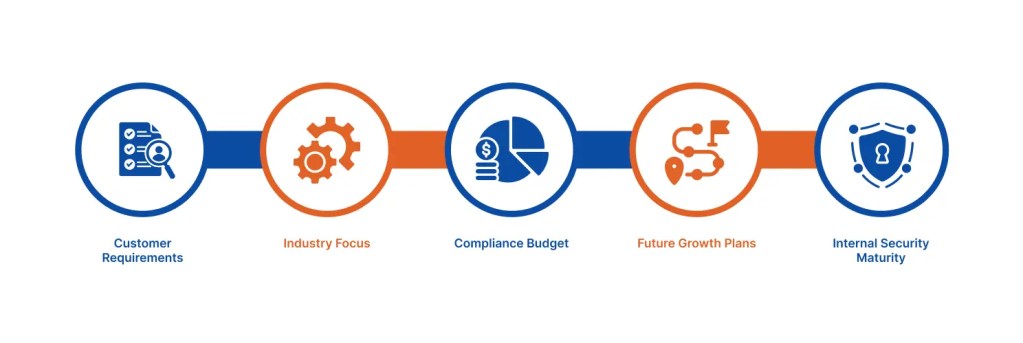
Customer Requirements
If prospective healthcare clients explicitly request HITRUST, pursuing e1 may provide a competitive advantage.
Industry Focus
Organizations serving multiple industries may benefit more from SOC 2’s broader recognition.
Compliance Budget
Both frameworks require investment in documentation, evidence collection, assessments, and ongoing maintenance. Budget should align with current business priorities.
Future Growth Plans
Consider where your business will be in the next two to three years. Choosing a scalable compliance strategy reduces future effort and supports long-term expansion.
Internal Security Maturity
Organizations with well-established policies and security controls may transition more easily into either assessment, while newer startups may need additional preparation before beginning formal audits.
Conclusion
Selecting either HITRUST e1 or SOC 2 should not be done based on which standard is definitively better but on which one can help you the most to support your startup’s business model and future goals. Healthcare-related startups tend to benefit greatly from starting with the HITRUST e1 framework as far as showcasing their specific security assurance goes. For SaaS organizations, SOC 2 is still a good choice.
As your organization grows, many of the security investments made today will support future compliance initiatives, making either framework a valuable step toward stronger cybersecurity, customer trust, and sustainable business growth. Not sure whether HITRUST e1 or SOC 2 is the right fit for your healthcare startup? ValueMentor can help you assess your security maturity, identify the most suitable compliance framework, and guide you through every stage of implementation and assessment. Contact our experts today for a personalized compliance roadmap and accelerate your journey toward trusted healthcare security.
FAQs:
HITRUST e1 is designed to validate essential cybersecurity controls for lower-risk organizations.
Is SOC 2 only for SaaS companies?
No. SOC 2 can be used by any organization that stores or processes customer data, though it is most common among SaaS providers.
Which framework is more healthcare-focused?
HITRUST e1 is specifically designed to address the security needs of the healthcare industry.
Can HITRUST e1 help win healthcare customers?
Yes. It demonstrates a strong security posture that many healthcare organizations value during vendor evaluations.
Does SOC 2 satisfy healthcare compliance requirements?
SOC 2 supports security assurance but may not meet all healthcare-specific compliance expectations on its own.
How do I choose between HITRUST e1 and SOC 2?
Consider your customer requirements, business model, compliance goals, and future growth plans.
Can a HITRUST e1 assessment prepare my organization for higher HITRUST certifications?
Yes. It serves as a solid foundation for progressing to more advanced HITRUST assessments.
Do both HITRUST e1 and SOC 2 require ongoing compliance?
Yes. Both require organizations to maintain effective security controls over time.
Which framework offers broader market recognition?
SOC 2 is widely recognized across industries, while HITRUST has stronger recognition within healthcare.
Why should startups invest in compliance early?
Early compliance improves security, builds customer confidence, and simplifies future certification efforts.