Information Security and Compliance are no longer just additional measures but mandatory requirements that businesses have to fulfill to meet customers’, partners’ and regulatory bodies’ demands. As a result, many enterprises are faced with making a decision about which framework will help secure sensitive information and prove its protection within the recognized frameworks. At times, choosing the right one may not be easy. Although all three frameworks have the same idea behind them, the approach, process, focus and cost associated with each of them are quite different. Picking up the wrong framework could turn out to be a waste of time and money and even hinder business.
In this guide, we compare HITRUST, SOC 2 and ISO 27001 by looking into their advantages, disadvantages, differences and optimal scenarios for using them.
What do you need to know about HITRUST?
HITRUST is one of the certification frameworks that are commonly used by firms dealing with health care data. This is due to the fact that the HITRUST CSF incorporates various regulatory and standard requirements from different frameworks including HIPAA, NIST, ISO, among others.
It provides a risk-based approach for addressing cybersecurity and compliance challenges.
Benefits of HITRUST
- Designed specifically for healthcare organizations and their vendors
- Integrates multiple regulatory requirements into one framework
- Demonstrates a high level of security assurance
- Reduces the need for multiple compliance assessments
- Widely recognized across the healthcare ecosystem
Best Suited For
- Healthcare providers
- Health technology companies
- Medical device manufacturers
- Healthcare SaaS providers
- Organizations dealing with protected health information (PHI)
Despite the effectiveness of its validation process, it can take much effort to obtain the HITRUST certification.
What do you need to know about SOC 2
SOC 2 (System and Organization Controls 2) is a type of cyber audit that has been created by the AICPA. It evaluates how organizations manage customer data based on five Trust Services Criteria:
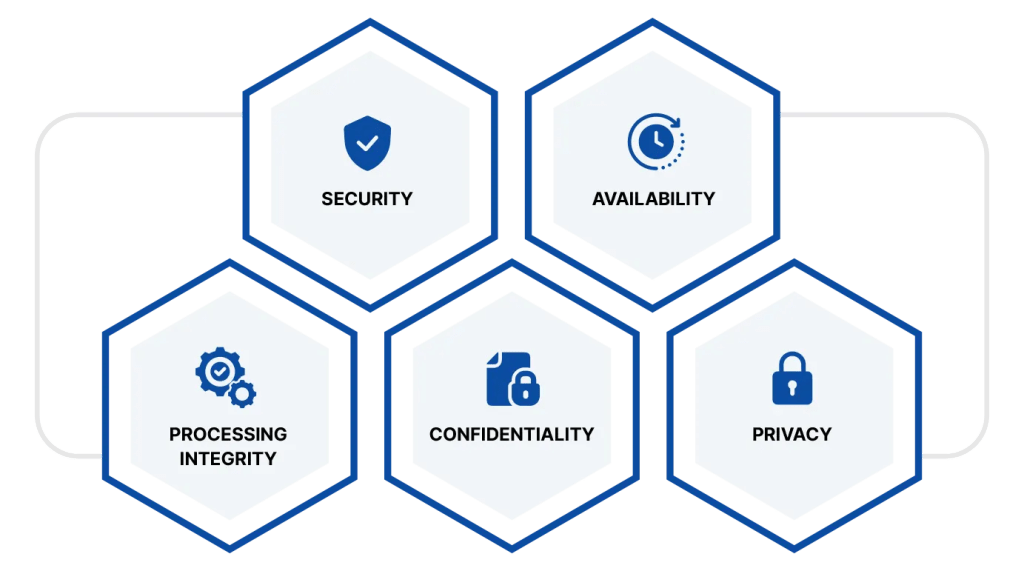
- Security
- Availability
- Processing Integrity
- Confidentiality
- Privacy
Unlike HITRUST and ISO 27001, SOC 2 is not a certification. Instead, organizations receive an independent audit report demonstrating the effectiveness of their controls.
Types of SOC 2 Reports
SOC 2 Type I
Evaluates whether controls are properly designed at a specific point in time.
SOC 2 Type II
Assesses both the design and operational effectiveness of controls over a defined period, typically 3 to 12 months.
SOC 2 Type II is generally considered the gold standard because it provides evidence that security controls consistently operate as intended.
Key Benefits of SOC 2
- Highly recognized in the SaaS and technology sectors
- Builds customer trust during vendor evaluations
- Flexible and scalable for growing businesses
- Focuses on operational effectiveness of controls
- Frequently requested by enterprise customers
Best Suited For
- SaaS companies
- Cloud service providers
- Technology startups
- Managed service providers
- Organizations serving enterprise clients
For many technology companies, SOC 2 is often the first compliance framework pursued due to strong market demand.
What do you need to know about ISO 27001
Information Security Management System ISO 27001 is a well-known standard related to the implementation of information security. It is formulated and designed by the International Organization for Standardization.
As opposed to SOC 2, ISO 27001 can be characterized by its global nature, since it concerns the establishment, implementation, maintenance, and improvement of security processes in organizations.
Key Benefits of ISO 27001
- Internationally recognized standard
- Demonstrates commitment to information security
- Establishes a risk-based security management system
- Supports regulatory and contractual requirements
- Enhances global business opportunities
Best Suited For
- Multinational organizations
- Enterprises with international customers
- Financial services companies
- Technology organizations operating globally
- Businesses seeking formal security certification
ISO 27001 is more about continuous improvement and security governance compared to validation of security controls individually.
HITRUST vs. SOC 2 vs. ISO 27001: Key Differences
Though the three certifications seek to improve information security, there are differences in the focus and target users among other factors. HITRUST targets health organizations with the intention of consolidating various compliances into one standard. SOC 2, on the other hand, is an internationally recognized standard that aims at ensuring that clients’ data is secure through effective security mechanisms. The standard that can be described as the international standard is ISO 27001, which tries to help organizations to manage and establish the ISMS.
It will depend on the kind of organization you run in relation to the above standards.
| Feature | HITRUST | SOC 2 | ISO 27001 |
| Primary Focus | Healthcare security and regulatory compliance | Customer data protection and operational controls | Information Security Management System (ISMS) |
| Best For | Healthcare providers, health tech companies, PHI handlers | SaaS companies, cloud providers, tech firms | Organizations across industries, especially global businesses |
| Assessment Type | Certification | Independent audit report | Certification |
| Key Standard Basis | HIPAA, NIST, ISO, and other regulations combined | AICPA Trust Services Criteria | International ISO standard |
| Industry Specific | Yes, healthcare-focused | No | No |
| Global Recognition | Moderate | High (especially in North America) | Very High |
| Complexity | High | Moderate | Moderate to High |
| Customer Demand | Common in healthcare contracts | Common in enterprise vendor reviews | Common in international business requirements |
| Main Benefit | Comprehensive healthcare compliance assurance | Demonstrates effective security controls | Establishes a globally recognized security management framework |
| Typical Organizations | Hospitals, healthcare SaaS, medical device companies | SaaS startups, cloud platforms, MSPs | Enterprises, financial institutions, multinational organizations |
How to choose the right framework?
Choose HITRUST If:
- You operate within the healthcare sector
- You handle protected health information (PHI)
- Healthcare clients require HITRUST certification
- You need to align with HIPAA and related regulations
Choose SOC 2 If:
- You operate internationally
- You want a globally recognized certification
- You need a structured information security management system
- Your organization prioritizes long-term security governance
Can Organizations Pursue More Than One?
Absolutely. Many organizations pursue multiple frameworks to satisfy different business requirements.
For example:
- The same healthcare software-as-a-service business may be certified with both HITRUST and SOC 2.
- A multinational software firm may attain ISO 27001 certification and get a SOC 2 Type II certification.
- Large businesses frequently use overlapping controls for meeting several different compliance requirements effectively.
- Since these standards have many common security practices, it becomes easy for companies to combine their implementation efforts.
Conclusion
HITRUST, SOC 2, and ISO 27001 all offer excellent options for achieving security maturity and compliance preparedness. Nonetheless, depending on the nature of your business, what is expected of you, and other factors such as regulations and your future aspirations, you may have different needs. For the health care industry, HITRUST is often an excellent choice to prove yourself. SOC 2 certification is usually among the most sought-after in the SaaS and technology industries. ISO 27001 is preferred by organizations that wish to gain worldwide recognition.
Instead of considering them rivals, many successful companies embrace both of them simultaneously. Ready to determine which compliance framework is right for your organization? Our security and compliance experts at ValueMentor can help you evaluate your requirements, develop a roadmap, and achieve HITRUST, SOC 2, or ISO 27001 readiness faster. Contact us today to schedule a consultation and start building a stronger, more trusted security program.
FAQs:
HITRUST includes several standards within its structure and therefore is more detailed.
2. Does SOC 2 provide certification?
SOC 2 does not provide certification, only attestation report prepared by a certified independent auditor.
3. Which one would be better for health-care related organizations?
HITRUST framework will be preferred in case of PHI storage organizations.
4. Is ISO 27001 a global standard?
ISO 27001 is known all around the globe.
5. Can a firm comply with SOC 2 and ISO 27001 together?
Yes, companies implement both to fulfill their clients’ demands and increase their security management.
6. What standard can be implemented more quickly?
SOC 2 Type 1 might be implemented more quickly depending on how many control activities are already implemented.
7. Do start-ups require HITRUST certification?
When working in the healthcare industry or having demands from clients for such certification.
8. Which framework supports vendor risk assessments?
All three frameworks will allow for vendor risk assessment, while SOC 2 reports are widely accepted.
9. Is ISO 27001 an appropriate choice for small businesses?
ISO 27001 can be used by small and medium businesses through scaling down the ISMS.
10. Can one framework satisfy all compliance requirements?
Not always. Many organizations adopt multiple frameworks to address different regulatory, customer, and business needs.