
What happens when a client asks for proof that their data is safe in your hands? For many organizations, the answer lies in SOC 2 framework that turns security promises into verifiable controls. Beyond meeting contractual requirements, SOC 2 compliance builds a track record that reassures investors, accelerates sales cycles and prevents costly cybersecurity audit surprises. This guide breaks down exactly what SOC 2 demands, how to achieve it and how to leverage compliance as a competitive advantage.
What is SOC 2 Compliance?
Systems and Organization Controls (SOC 2) compliance is a framework developed by the American Institute of Certified Public Accountants (AICPA) to ensure that service providers securely manage customer data. Unlike basic security certifications, SOC 2 is tailored for technology and cloud-based businesses that store or process client information. It requires organizations to demonstrate that their systems, policies and controls meet strict standards, verified through an independent audit.
The Five Trust Service Criteria You Must Meet
SOC 2 compliance is based on the Trust Service Criteria (TSC), which are five categories of controls defined by the AICPA. Security applies to every SOC 2 audit, while the other four, i.e., Availability, Processing Integrity, Confidentiality and Privacy, are selected according to the organization’s services, contractual requirements and regulatory obligations. Passing a SOC 2 audit requires implementing and proving effective measures for each chosen area. These criteria not only safeguard data but also demonstrate operational reliability to clients and stakeholders.
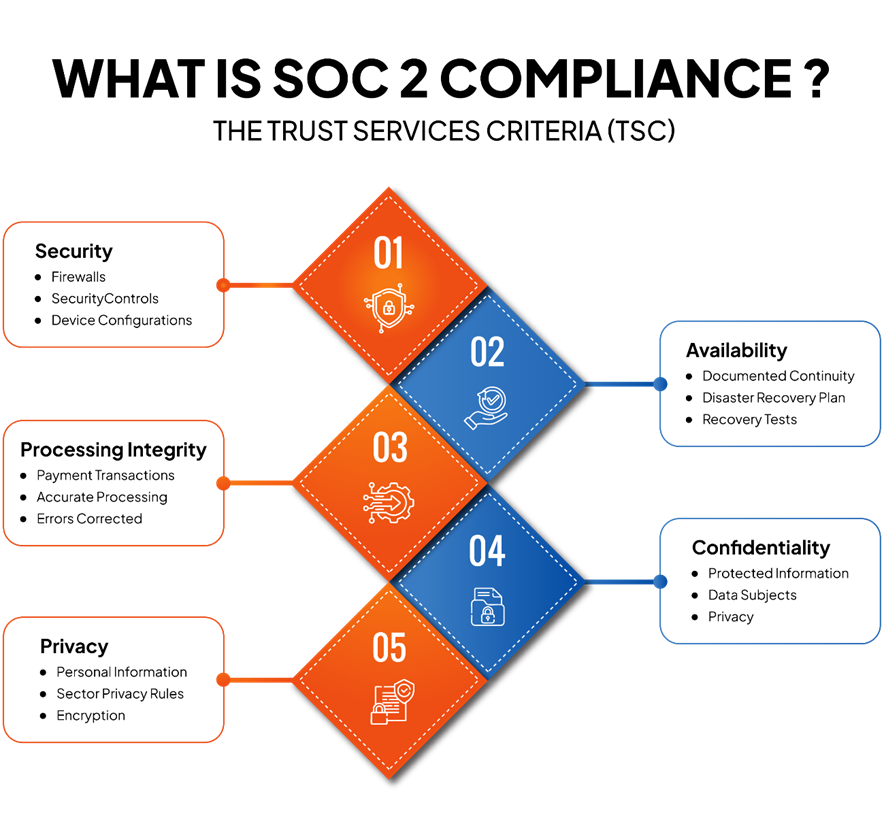
1. Security
This is a foundation of SOC 2. Requires safeguards to prevent unauthorized access to systems and data. Examples include role-based access control (RBAC), network segmentation, endpoint protection, intrusion detection systems (IDS) and vulnerability management programs. Strong security controls reduce the risk of breaches that could lead to costly downtime, reputational damage and regulatory penalties.
2. Availability
Ensures systems are accessible as promised in service-level agreements (SLAs). This involves redundant infrastructure, backup power, disaster recovery planning and regular failover testing. Reliable availability directly supports business continuity and client confidence.
3. Processing Integrity
Guarantees that system processing is accurate, complete and timely. Controls such as input validation, transaction logging and automated reconciliation help prevent data errors that can disrupt operations or erode client trust.
4. Confidentiality
Protects sensitive business and customer data through measures like encryption (TLS in transit, AES-256 at rest), access restrictions and secure disposal processes. Effective confidentiality controls are critical for maintaining contractual commitments and safeguarding intellectual property.
5. Privacy
Focuses on the proper collection, use and disclosure of personal data in line with regulations such as GDPR, HIPAA or CCPA. Measures include consent management, data anonymization and privacy impact assessments. Robust privacy practices help prevent legal exposure and maintain customer loyalty.
Step-by-Step SOC 2 Compliance Process
Achieving SOC 2 compliance is a structured effort that blends technical controls, documented policies and operational discipline. Each stage must be executed precisely to meet the Trust Service Criteria and pass an independent cybersecurity audit.
1. Define Scope and Objectives
Identify the systems, services and data to be reviewed. Decide whether to pursue Type I (design effectiveness at a specific time) or Type II (design and operational effectiveness over a set period). Clearly define boundaries and dependencies, including third-party integrations.
2. Perform a Readiness Assessment
Conduct a gap analysis against the Trust Service Criteria. Review existing controls, network architecture, access management and operational policies.
3. Implement Required Controls
Address gaps with targeted measures, such as multi-factor authentication for administrative accounts, encryption for sensitive data, change management workflows, log aggregation with automated alerts and tested incident response procedures.
4. Document Policies and Procedures
Auditors require proof that controls are backed by formal documentation. Maintain clear policies for access control, data classification, vulnerability management, recovery processes and vendor risk.
5. Conduct Internal Testing
Simulate audit procedures to confirm that controls operate as intended, e.g., verifying backup restorations, reviewing access logs and ensuring alerts trigger correctly.
6. Engage an Independent Auditor
Select a licensed Certified Public Accountant (CPA) firm for the SOC 2 audit. Provide architecture diagrams, policies and control evidence. Expect interviews, system walkthroughs and verification of control operation.
7. Review Findings and Remediate
If deficiencies arise, resolve them promptly, for example – tightening permissions or enhancing monitoring configurations.
8. Receive SOC 2 Report
A successful audit results in a report detailing the scope, controls tested and outcomes. This becomes a key asset in client negotiations, RFPs and vendor onboarding.
9. Maintain Ongoing Compliance
SOC 2 is continuous, not a one-time milestone. Schedule periodic reviews, monitor controls year-round and prepare early for annual re-audits.
Common Challenges and How to Overcome Them
Achieving SOC 2 compliance often exposes weaknesses in both technical infrastructure and organizational processes. Addressing these early can prevent costly delays during the cybersecurity audit.
1. Undefined Scope
Many organizations fail to clearly define the systems, services and data subject to SOC 2 review. This leads to incomplete control coverage.
Solution: Perform a thorough scoping exercise before the readiness assessment. Include all production systems, cloud services, APIs and third-party integrations handling customer data. Document boundaries in system architecture diagrams.
2. Incomplete or Outdated Documentation
SOC 2 audits require evidence of policies, procedures and system configurations. Missing or outdated documents can cause audit failures.
Solution: Maintain a controlled documentation repository. Assign ownership for updating policies related to access control, change management, incident response and vendor risk on a fixed schedule.
3. Weak Access Management
Over-permissioned accounts, lack of multi-factor authentication and poor role definition are frequent findings.
Solution: Enforce least privilege principles, implement RBAC, enable MFA for all administrative accounts and perform quarterly access reviews. Automated account provisioning and deprovisioning wherever possible.
4. Gaps in Monitoring and Logging
Without comprehensive logging, it is impossible to prove that security controls function as intended.
Solution: Deploy a SIEM or centralized logging platform. Ensure logs are retained for the required period, are time-synced and are regularly reviewed for anomalies. Integrate automated alerting for high-risk events.
5. Vendor Risks
Third-party services often fall outside the organization’s direct control but still impact compliance.
Solution: Establish a vendor risk management program. Collect SOC 2 reports from critical vendors, assess their controls and include vendor-related risks in your compliance strategy.
6. Unprepared Incident Response
Some organizations have incident response plans on paper but have never tested them.
Solution: Conduct regular tabletop exercises and post-incident reviews. Update playbooks with lessons learned and integrate them into operational workflows.
7. Treating SOC 2 as a One-Time Project
Compliance is often approached as a single milestone rather than a continuous requirement.
Solution: Implement ongoing compliance monitoring, schedule internal audits and keep control owners accountable for maintaining readiness throughout the year.
SOC 2 Certification vs SOC 2 Compliance
| SOC 2 Compliance | SOC 2 Certification |
| Implementation of controls that meet SOC 2 Trust Service Criteria | Formal validation by an independent CPA firm through an audit |
| Self-attested, based on internal checks | Third-party verified with documented audit results |
| Internal records, policies and control evidence | Official SOC 2 report (Type I or Type II) issued by auditor |
| Limited market recognition; may not satisfy client or regulatory requirements | Widely accepted as credible proof of security and compliance |
| No formal audit required | Requires full SOC 2 audit with evidence review, control testing and interviews |
| Achieved as soon as controls are implemented | Timeline depends on audit scope – Type I (weeks) or Type II (3–12 months) |
| Used for internal readiness and preparation for certification | Used for client assurance and fulfilling contractual or regulatory obligations |
| Lower trust from external parties due to lack of independent verification | High trust backed by independent, third-party validation |
Tools and Resources to Simplify SOC 2 Readiness
Preparing for a SOC 2 audit can be resource-intensive without the right tooling. The objective is to automate evidence collection, streamline control monitoring and maintain continuous compliance without diverting excessive operational bandwidth.
1. Compliance Management Platforms
Solutions like Drata and Secureframe offer automated control mapping against the SOC 2 Trust Service Criteria. They integrate with cloud platforms, identity providers and security tools to track compliance status in real time. Many can auto-collect evidence such as access logs, encryption settings and vulnerability scan results.
2. Security Information and Event Management (SIEM) Tools
Platforms like Splunk, Sumo Logic or Microsoft Sentinel centralize log data from servers, firewalls and applications. They enable real-time alerting, retention for audit evidence and predefined dashboards aligned with SOC 2 control requirements.
3. Access Control and Identity Governance Tools
Identity providers such as Okta, Azure AD and JumpCloud help enforce multi-factor authentication, manage least-privilege access and automate provisioning and deprovisioning. This reduces audit findings related to over-privileged accounts.
4. Vulnerability Management Solutions
Tools like Tenable and Qualys automate scanning for known security weaknesses. Reports can be mapped to SOC 2 security controls, demonstrating active risk management.
5. Documentation and Policy Management Systems
Platforms such as Confluence, SharePoint or Notion provide centralized control over policy updates, approval workflows and audit version history. Auditors often request document change logs, which these systems maintain automatically.
6. Risk and Vendor Management Tools
Solutions like OneTrust or Archer help manage vendor risk assessments, maintain SOC 2 reports from third parties and track remediation actions for high-risk suppliers.
7. Downloadable Templates and Checklists
AICPA’s Trust Service Criteria framework, SOC 2 readiness checklists and control mapping templates provide a starting point for gap analysis. Customizing these for your systems accelerates the preparation phase.
Conclusion
SOC 2 compliance is a structured framework that enforces measurable security, availability, processing integrity, confidentiality and privacy controls. Achieving certification requires disciplined planning, precise control implementation, continuous monitoring and clear evidence for auditors. Organizations that invest in readiness reduce audit risks while strengthening operational resilience and client trust. Partnering with ValueMentor ensures every stage, from scoping to certification, is handled with technical accuracy and audit readiness in mind. If your business is preparing for SOC 2 or aiming to enhance its compliance posture, connect with our team today to start your certification journey with confidence.
FAQs
1. Is SOC 2 compliance mandatory?
It is not a legal requirement in most jurisdictions, but it is often mandated in contracts, RFPs and vendor onboarding processes, making it critical for winning and retaining business in security-conscious markets.
2. How long does it take to get SOC 2 certified?
The timeline depends on audit scope and readiness. Type I audits can take several weeks, while Type II audits require continuous monitoring over months before final reporting.
3. How much does SOC 2 certification cost?
Costs vary based on the audit scope, number of systems in scope and current control maturity. Expenses typically include auditor fees, technology investments and internal resource allocation.
4. What are the common challenges in achieving SOC 2 compliance?
Challenges include undefined scope, weak access controls, insufficient documentation, inadequate logging, untested incident response plans and unmanaged vendor risks.
5. How can SOC 2 compliance improve client trust?
Certification provides independent validation that an organization follows strict data protection and operational controls, offering clients assurance that their information is handled securely and consistently.
6. Does SOC 2 compliance cover all cybersecurity requirements?
No. SOC 2 focuses on controls relevant to the Trust Service Criteria. Organizations may need to implement additional frameworks like ISO 27001 or NIST CSF to address other security or regulatory requirements.
7. How can ValueMentor help in SOC 2 readiness?
ValueMentor offers end-to-end SOC 2 services, including gap analysis, control implementation, policy creation, evidence collection automation, readiness testing and audit coordination to ensure a smooth certification process.