As enterprises accelerate cloud adoption, the risk of data breaches continues to grow. Hybrid and multi-cloud environments offer greater flexibility and resilience, but they also introduce new security challenges, including inconsistent security controls, misconfigurations, identity risks, and compliance complexities. A reactive security approach is no longer sufficient.
Cloud security enables organizations to reduce breach risks by adopting continuous monitoring, Zero Trust principles, DevSecOps, and automated threat detection across the entire cloud lifecycle. This blog explores practical strategies that help enterprises strengthen their cloud security posture, improve resilience, and minimize the financial and operational impact of data breaches.
First, let’s visit the difference in environments related to data breaches!
It is true that organizations utilizing multi-cloud deployments have the lowest average for data breach costs. Organizations relying on public and private cloud deployments get impacted severely. That means you could imagine a breach in a hybrid cloud environment would cost an average of $1.19 million less than public cloud breaches.
Now, let’s come back to the case of organizations using multi-cloud deployments. Here are the concerns that mount on their head: –
- Analyzing the shared responsibility model between cloud service providers and consuming organizations
- Knowing and transforming regulatory and compliance mandates into security policies
- Implementing the right set of technical and operational controls that run consistently across hybrid cloud
- Discovering how data gets created, migrated, accessed, processed, and secured
- Enabling ‘security by design principles throughout the lifecycle of applications produced in the organization
- Identifying and responding to threats across hybrid cloud rapidly, even with limited resources.
Hybrid cloud security requires constant updation as new cloud products and features get released. When a business adopts new and varying functionalities, the threat landscape goes parallelly stretched. To minimize risk, drive agility and achieve operational efficiency in the cloud, the following are our top recommendations: –
Top recommendations for hybrid cloud security
1. Manage risk and compliance with rigid controls
2. Assure data-centric safety with zero trust architecture
3. Have continuous detection and response strategy
4. Integrate security and privacy with DevSecOps.
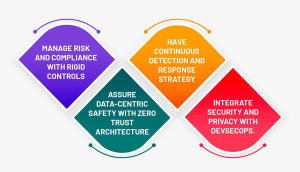
If organizations can build cloud security by tying these considerations, enterprises can develop a system that enriches hybrid cloud security. Let us traverse the 4-recommendations, on-by-one : –
Manage risk and compliance with rigid controls:
A managed risk & compliance control-driven hybrid cloud is what organizations initially require. Organizations with extensive cloud migration would cost more for a data breach than for organizations with a low level of migration. It clearly indicates that rampant cloud adoptions bring more risk to an entity’s environment.
It is significant that organizations should adhere to industry specific as well as global regulations and standards. Likewise, organizations will require implementing technical controls that drive workload security across the hybrid cloud. It will help decide if the workload resides on-premises or on public and private clouds.
Organizations require continuous compliance functions to run on top of the controls. That will help them ensure that the security controls are implemented early and managed consistently throughout. Similarly, successful control-policy mapping is also significant, especially in pre-provisioning guardrails and post-provisioning posture validation.
Assure data-centric safety with zero trust architecture:
Organizations should understand that on-premises and cloud environments remain similar while coming to the security domain. However, the method used to address issues in both varies significantly. Also, there is no fixed boundary or perimeter coming to cloud deployments. And that is where organizations should look for a more holistic approach to security. A zero-trust security strategy recognizes these issues and helps define policies invariably for both environments. Data-centric protection needs a zero-trust architecture having network security, application security, data protection, identity, and access management.
Have Continuous detection and response strategy:
Security is not a limited activity that a particular team need to focus on but rather a shared exercise. For example, organizations would have staff in DevOps who require easy and frictionless workload deployment mechanisms. On the other side, security personnel will need optimal protection and visibility by complying with regulatory and corporate security policies. Having continuous detection and response is the key to both ends.
To achieve sound collaboration between multiple units like the line-of-business team, the IT infrastructure team and the security, organizations need to perform the following in a hybrid cloud : –
- Identify and learn about security threats and events.
- Team up and cooperate to prevent such threats.
- Analyse and respond to incidents collectively.
While performing these measures, organizations embed threat management into the lifecycle of hybrid cloud operations. It helps prioritize issues fast, traverse multiple tools, reduce manual effort, and help combat security incidents quickly.
Integrate security & privacy with DevSecOps:
Finally, enabling DevSecOps can lead to more cloud security and thereby help reduce the impact of a data breach. But reaching that grade is not an easy task. Here, organizations will need to execute the change in their working practice. That means you need a change in work style among yourselves, across business developers and IT operations.
To consume the security culture to the fullest, organizations would need to have a shift – aligning strategy, governance, risk, and compliance. Perform the following course of action as a part of cloud security managed service : –
- Plan and design — conduct threat modelling, create security reference architectures.
- Code and build — protect data, applications, and infrastructure.
- Deploy and execute — fortify applications, integrate telemetry.
- Monitor and respond — manage threats and compliance.
How teams deliver these changes by driving security by means of process is what is DevSecOps is all about. All management and governance actions get tied to these changes that benefits organizations with risk and compliance. It is indeed one critical take or pillar that helps organisations succeed.
Quick Takeaways
Go Hybrid:
When the average expense of a public cloud-based breach was 1.19 million USD more than hybrid cloud breaches, go hybrid!
A hybrid cloud solution would include a full range of services that enable confidential computing, Data protection services, and an end-to-end data protection approach.
Enable mature migration:
When a less-mature migration took more time to find and contain a security breach, go with a mature migration!
It means entities should develop the ability to reach maturity securely – using End-to-end security management & Unified solutions. Higher visibility, proactive monitoring, and security intelligence should be the critical focus.
Invest in the right security:
When cloud misconfiguration marks a critical breach risk, accounting for 15% of data breaches, invest in the right security measures.
Reach out for a unified management tool, always-on compliance and up-to-date secure configurations and visibility. Enable end-to-end compliance by seamlessly integrating security, configuration governance and compliance, saving time and money.
Automate with AI:
When reliance on manual monitoring to prevent and find breaches become ineffective and potentially costly, it is worth automating with AI!
With the AI capabilities in the cloud like accuracy, speed, and real-time threat detection, fasten security and take your competitive advantage.
How to get started in Cloud Security?
The measures you need to take depend on existing conditions. If you want to build a hybrid cloud platform, consider use of such platforms. If you already have a hybrid cloud platform, listen to this podcast to learn more about how to develop a robust cloud security strategy. And if you are looking for effective and tailored cloud security services, consult with ValueMentor – the leading cloud security managed service provider with a trusted presence in UK, US, India, Egypt, UAE, and Saudi Arabia.
Conclusion
Reducing the risk of data breaches requires more than deploying workloads in the cloud—it demands a proactive, integrated security strategy. By implementing robust risk and compliance controls, adopting a Zero Trust architecture, enabling continuous threat detection and response, and embedding security into DevSecOps practices, organizations can significantly strengthen their cloud security posture.
As cloud environments continue to evolve, businesses must prioritize continuous visibility, automation, and compliance to stay ahead of emerging threats. Partnering with ValueMentor can help organizations build resilient cloud environments that protect sensitive data while enabling secure innovation and business growth.
Frequently Asked Questions (FAQs)
1. How does cloud security help reduce the risk of data breaches?
Cloud security reduces breach risks through continuous monitoring, strong identity and access controls, encryption, threat detection, secure configurations, and proactive vulnerability management.
2. Why is hybrid cloud considered more resilient against data breaches?
Hybrid cloud environments allow organizations to distribute workloads and apply layered security controls across on-premises and cloud infrastructure, reducing the potential impact of a single compromise.
3. What is the shared responsibility model in cloud security?
The shared responsibility model defines which security responsibilities belong to the cloud provider (such as infrastructure security) and which remain with the customer (such as identity management, data protection, and workload security).
4. How does Zero Trust improve cloud security?
Zero Trust continuously verifies users, devices, and workloads before granting access, minimizing unauthorized access and limiting the lateral movement of attackers within cloud environments.
5. Why is continuous monitoring important for cloud security?
Continuous monitoring enables organizations to detect suspicious activity, identify misconfigurations, respond to threats in real time, and maintain ongoing compliance across cloud environments.
6. What role does DevSecOps play in preventing cloud data breaches?
DevSecOps integrates security into every phase of the software development lifecycle, allowing vulnerabilities to be identified and remediated before applications are deployed.
7. How can AI strengthen cloud security?
AI-powered security solutions analyze large volumes of security data, detect anomalies, automate threat detection, prioritize risks, and accelerate incident response with greater accuracy.
8. What are the most common causes of cloud data breaches?
Common causes include cloud misconfigurations, weak identity and access management, insecure APIs, unpatched vulnerabilities, excessive user permissions, and human error.
9. How does cloud security support regulatory compliance?
Cloud security solutions continuously assess security controls, monitor compliance status, generate audit evidence, and help organizations meet standards such as ISO 27001, PCI DSS, HIPAA, GDPR, and SOC 2.
10. What should organizations consider when building a cloud security strategy?
An effective strategy should include risk assessments, Zero Trust architecture, continuous compliance, automated threat detection, secure cloud configurations, DevSecOps practices, and regular security testing across all cloud environments.