What if your organization’s security isn’t as strong as you think? Today’s attackers don’t just look for obvious weaknesses-they search every part of your systems for hidden gaps that could give them access to sensitive cardholder data. Just one unnoticed flaw can enable cybercriminals to work their way around firewalls, siphon data and cause extensive damage. This is where Penetration Testing PCI DSS comes in. By simulating real-world attacks, it shows where your security might fail before hackers can exploit it.
With the v4.0.1 update, VAPT is no longer just a compliance task-it’s a thorough, practical check of your defenses. In this blog, we explain Requirements 11.3 and 11.4, showing how, when, and where testing should be done to keep your systems secure.
What is PCI DSS vulnerability Assessment & penetration testing and why is it required?
A PCI DSS VAPT is a controlled security exercise where skilled testers act like real attackers and try to break into systems. The purpose is not just to find technical issues/weaknesses, but to understand how an attacker could move through the environment and reach cardholder data.
PCI DSS requires vulnerability assessment & penetration testing because firewalls, policies, and automated scans cannot fully show how secure a system really is. Vulnerability Assessment & Penetration testing shows the actual impact of weaknesses and whether security controls can stop real attacks. It helps organisations answer an important question: if a cybercriminal targeted us today, would our defences hold up? In PCI DSS v4.0.1, this approach becomes even more important. The standard now expects testing to reflect real attack behavior rather than relying only on automated tools or checklist-style testing.
In practice, this means that security teams and external testers must consider how sophisticated attackers operate today, including the use of social engineering, targeted malware, API attacks, and lateral movement through internal networks. This real-world simulation provides a more accurate picture of the organization’s security posture than vulnerability scanning alone.
What changed in PCI DSS v4.0.1 for penetration testing?
PCI DSS v4. 0 allows to offer better guidance and more concrete expectations about vulnerability assessment & penetration testing. Previous iterations often looked more at whether testing was done at all. The new version emphasizes the quality, quantity and relevance of testing. One major difference is network-layer, and application-layer testing are separated more distinctly. Now Organisations must now clearly demonstrate that both areas are tested properly. Network Layer testing tests the security of firewalls, servers and communication paths. Application Layer analysis is concerned with software that processes or stores cardholder data.
There is also more emphasis on testing after significant changes, such as new systems, major upgrades, or changes to security controls. This ensures that evolving infrastructures and new technologies do not introduce unnoticed risks. PCI DSS v4.0.1 encourages a continuous security mindset, where testing is part of ongoing operational practices rather than a last-minute compliance activity.
Additionally, the standard now highlights the importance of testing methodology and evidence. Organisations must show that testing was done systematically and results were documented in a way that proves security controls are effective. This shift aligns PCI DSS more closely with modern cybersecurity frameworks, which prioritize actionable intelligence and measurable risk reduction.
What does Requirement 11.3.1 expect from organisations?
Requirement 11.3.1 focuses on internal network vulnerability assessments (VA) only. It requires organisations to regularly identify and assess vulnerabilities within the internal network to detect weaknesses that could be exploited to compromise systems connected to the cardholder data environment. Internal network penetration testing is not covered under this requirement and is addressed separately under Requirement 11.4.2.
Under this requirement, penetration testing must be performed at least once every 12 months. In addition, testing is required whenever there is a significant change, such as new infrastructure, network reconfiguration, or major firewall updates. This ensures that any changes to the network do not introduce new vulnerabilities.
The scope of testing must cover all systems that store, process, or transmit cardholder data, along with any systems connected to them. If network segmentation is used to limit PCI scope, testing must clearly prove that the segmentation is effective. This helps demonstrate that any potential attack path is properly controlled and that isolated systems cannot be easily reached from less secure areas.
A well-defined methodology that simulates real attack paths is essential. This often includes scanning for open ports, testing firewall rules, attempting to bypass access controls, and assessing how attackers could move laterally to reach sensitive systems. Following a recognized PCI penetration testing guide ensures consistency and helps organisations meet audit expectations while addressing actual security risks.
What is covered under Requirement 11.3.2 for application testing?
Requirement 11.3.2 requires organisations to perform external vulnerability scans on internet-facing applications. This includes web applications, APIs, and payment interfaces that are accessible from outside the organisation and interact with the cardholder data environment. The focus is on identifying externally exploitable vulnerabilities rather than conducting application penetration testing, which is addressed separately under Requirement 11.4.3.
PCI DSS v4.0.1 expects this testing to include both unauthenticated attacks, where the tester acts like an external user, and authenticated attacks, where valid credentials are used to test access controls. This methodology discovers shortcomings like broken authentication, insecure authorization, misconfigured session management and logic defects – vulnerabilities that are often missed by automated scans. You need to have application penetration testing conducted on an annual basis, and each time that the application undergoes a significant change, including introduction of new functionality and real-time changes. This means security can be updated as development changes occur and new code or features are incorporated that introduce a vulnerability.
It also now stresses the significance of testing methodology and proof. Organisations must show that testing was done systematically and results were documented in a way that proves security controls are effective. This transformation brings PCI DSS into greater harmony with contemporary cybersecurity frameworks by highlighting actionable intelligence and quantifiable risk mitigation.
How often should PCI DSS penetration testing be performed?
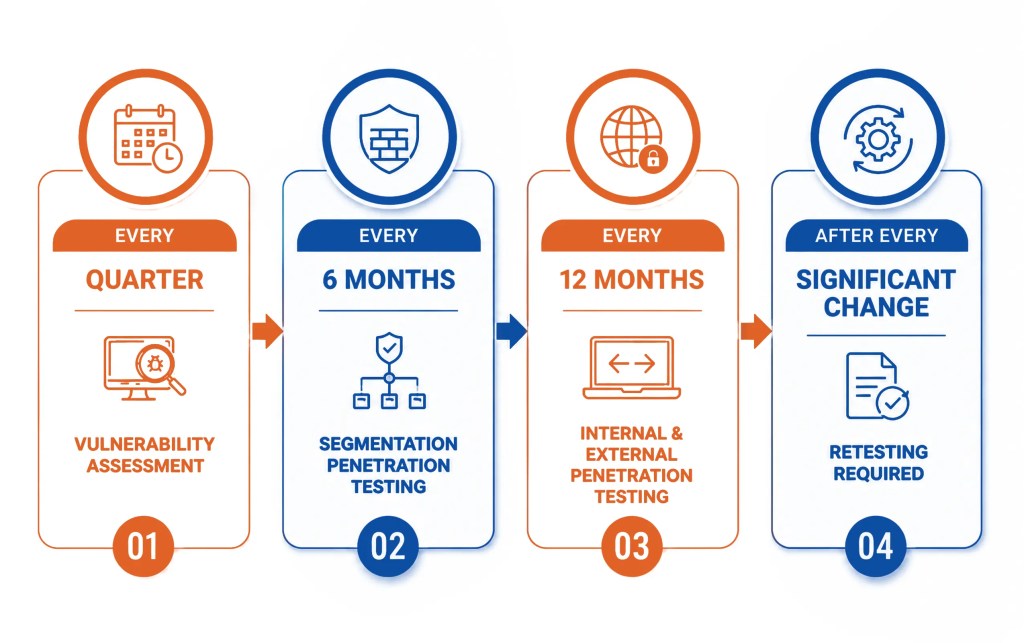
Under PCI DSS v4.0.1, vulnerability assessments are required quarterly, penetration testing must be performed annually, and segmentation penetration testing is required every six months, as well as after significant changes, to ensure ongoing security and effective isolation of the cardholder data environment.
Every time a striking modification takes place; more penetration testing is essential. Material changes could be implementing new systems, re-architecting applications, changing network topology, onboarding third party services, or making visible security control changes. Each of these changes can introduce new vulnerabilities that attackers could exploit. This testing, rather than changing requirements, encourages organizations to implement a continual security model. Rather than just aiming to clear an annual exam, companies must continuously gauge whether their security controls remain sound. Linking testing frequency to system changes, PCI DSS v4.0.1 ensures that security practices remain proactive, adaptive, and capable of handling emerging threats.
What methodology and reporting are expected under PCI DSS v4.0.1?
PCI DSS v4.0.1 expects penetration testing to follow a structured, realistic methodology. Testing should simulate the actions of real-world attackers, including reconnaissance, exploitation attempts, privilege escalation, and lateral movement within the environment.
Clear documentation is essential. Test reports must describe the scope of testing, methods used, vulnerabilities identified, and the potential impact on cardholder data. Evidence of successful exploitation, when applicable, helps auditors and stakeholders understand the real risk posed by security gaps.
Once issues are addressed, retesting is required to confirm that vulnerabilities have been effectively remediated. This ensures that the organisation meets PCI DSS requirements and that security controls operate as intended.
Is Your Organization Ready for PCI DSS v4.0.1?
Ensuring your organization is fully prepared for PCI DSS v4.0.1 is crucial to protecting sensitive cardholder data. One of the most effective ways to verify your security posture is to work with a cybersecurity company that has certified PCI DSS experts, such as a PCI QSA (Qualified Security Assessor).
At Valuementor, our team has the experience and expertise to perform a thorough gap analysis, identify potential compliance issues, and guide you to full readiness for PCI DSS v4.0.
Get Started Today! Reach out to our experts for a free consultation.
FAQS
1. What is the main purpose of PCI DSS vulnerability assessment & penetration testing?
To find real security weaknesses and test if controls can protect cardholder data.
2. How has penetration testing changed in PCI DSS v4.0.1?
It now focuses on realistic attacks, deeper testing, and evidence-based reporting.
3. What is Requirement 11.3.1 about?
Internal network vulnerability assessments (VA) to identify weaknesses that could impact the cardholder data environment
4. What does Requirement 11.3.2 cover?
External vulnerability scanning of internet-facing applications such as web apps, APIs, and portals handling cardholder data.
5. How often should Internal & External penetration testing be conducted?
At least annually and after any significant system or application changes.
6. Why is real-world attack simulation important?
It shows how attackers could actually exploit weaknesses, not just theoretical gaps.
7. What are some common examples of network-layer penetration tests?
Port scanning, firewall testing, access control checks, and lateral movement testing.
8. What are some common examples of application-layer penetration tests?
SQL injection, cross-site scripting, API abuse, and logic flaw testing.
9. How should results be documented?
Include scope, methods, vulnerabilities, impact, and proof of remediation.
10. How does PCI DSS v4.0.1 help organizations beyond compliance?
It promotes continuous security, realistic testing, and stronger defence against real threats.