
The KSA Personal Data Protection Law (PDPL) establishes a comprehensive legal framework that every fintech company, bank, and financial services organisation operating in Saudi Arabia must comply with. For institutions handling customer financial data at scale, this is not a peripheral regulatory consideration it is a foundational operational requirement that shapes how data is collected, stored, processed, and shared.
Saudi Arabia’s fintech sector has grown rapidly under Vision 2030, with the Saudi Central Bank (SAMA) actively licensing new payment, lending, and investment platforms. This expansion has brought unprecedented volumes of personal and financial data into digital ecosystems and the PDPL exists precisely to govern how that data is handled. Compliance is not simply about avoiding penalties; it is about building the kind of customer trust that sustains long-term growth in a competitive, regulated market.
For CISOs, compliance officers, and legal teams at financial institutions, understanding the PDPL’s specific requirements for fintech privacy in Saudi Arabia means working across consent architecture, data classification, cross-border transfer controls, and breach response all simultaneously. This guide maps each of those obligations clearly, so your organisation can move from awareness to action.
Fintech Privacy Saudi Arabia: Why the PDPL Changes the Compliance Landscape
Before the PDPL came into force, fintech companies in Saudi Arabia operated within a patchwork of SAMA circulars and sector-specific guidance that addressed cybersecurity and data handling inconsistently. The PDPL consolidates those obligations into a unified national framework, administered by the National Data Management Office (NDMO) and the Saudi Data and Artificial Intelligence Authority (SDAIA). For fintech compliance teams, this shift demands a re-evaluation of every data touchpoint from onboarding forms to transaction analytics pipelines.
The law applies to all entities that process the personal data of Saudi residents, regardless of whether the processing organisation is domiciled within the Kingdom. This extraterritorial scope means that a fintech company headquartered in the UAE, the UK, or the US that serves Saudi customers is fully subject to PDPL obligations. The practical implication is that fintech companies with any Saudi user base however modest cannot treat PDPL compliance as a local or regional concern to be deferred.
What makes the fintech context particularly demanding is the density of personal and financial data involved. A single customer journey from identity verification through to recurring payment authorisation may involve the processing of national ID numbers, bank account details, spending behaviour, and credit assessments. Each of these data types carries distinct obligations under the PDPL, and organisations that treat all data uniformly will find themselves in structural non-compliance.
Banking Data Protection KSA: Obligations Specific to Financial Institutions
Saudi banks and licensed financial institutions already operate under SAMA’s Cybersecurity Framework and Open Banking Framework, both of which contain data handling requirements. The PDPL layers a privacy governance dimension on top of these technical controls. Where SAMA frameworks focus on system resilience and access control, the PDPL addresses the lawfulness of data collection, the rights of data subjects, and the conditions under which data may be shared or transferred. These are complementary, but they are not interchangeable compliance with SAMA guidance does not automatically constitute PDPL compliance.
Data Classification as a Foundation
One of the most practical starting points for banks and financial services firms is a thorough data classification exercise. Under the PDPL, financial account information, transaction records, and credit data qualify as sensitive personal data, attracting stricter processing conditions. Organisations must map where this data lives, who accesses it, for what purposes, and under what legal basis. Without this foundational mapping, it is impossible to demonstrate that data minimisation and purpose limitation principles are being observed.
Aligning PDPL with SAMA Requirements
Financial institutions should approach PDPL compliance not as a parallel workstream but as an integrated component of their existing governance architecture. Data retention policies, third-party vendor assessments, and incident response procedures developed under SAMA frameworks can be extended and adapted to meet PDPL requirements, reducing duplication and strengthening overall resilience. Working across both frameworks in tandem is not only efficient — it reflects the kind of mature, joined-up governance that regulators in both the financial and data protection spheres expect.
Financial Services Privacy: Consent, Lawful Basis, and Data Subject Rights
Consent under the KSA PDPL is not a checkbox. It must be informed, specific to the purpose, freely given, and as easy to withdraw as it was to grant. For fintech companies that bundle data permissions into lengthy terms and conditions, this represents a significant re-engineering challenge. Privacy notices must be presented in plain, accessible language, and customers must understand precisely what they are agreeing to including whether their data will be shared with third parties such as credit bureaus, payment networks, or marketing partners.
Beyond consent, the PDPL recognises other lawful bases for processing, including contractual necessity and legal obligation. A bank processing transaction data to fulfil a payment instruction does not need to seek separate consent for that specific processing activity it falls within the scope of contractual performance. However, any secondary use of that transaction data for example, to build a behavioural profile for cross-selling purposes requires its own distinct lawful basis. Fintech companies frequently blur this boundary, and it is precisely this area that regulators are likely to scrutinise.
Data Subject Rights in a Financial Services Context
Customers have the right under the PDPL to access their personal data, request corrections, and in certain circumstances request deletion. For financial institutions, the deletion right intersects with regulatory retention obligations for instance, anti-money laundering (AML) regulations may require certain transaction records to be retained for defined periods regardless of a customer’s deletion request. Compliance teams must document these retention justifications clearly, so that when a deletion request is received, the institution can respond lawfully and transparently rather than simply declining without explanation.
Customer Data Protection: Security Controls and Breach Notification
Customer data protection under the PDPL is not purely a legal exercise it is inseparable from information security practice. Encryption, access controls, pseudonymisation, and regular vulnerability assessments are not merely good practice for fintech companies; they are implicit requirements under the law’s obligation to protect personal data against unauthorised access, alteration, or disclosure. Organisations that cannot demonstrate proportionate security controls will find it difficult to satisfy regulators in the event of an incident.
The PDPL’s breach notification obligation is one of its more operationally demanding requirements. When a personal data breach occurs that is likely to cause harm to data subjects, the organisation must notify SDAIA without undue delay. The notification must include details of the nature of the breach, the categories and approximate volume of data affected, the likely consequences, and the remedial measures taken. Fintech companies that lack a documented incident response plan or that have not tested it will struggle to meet this obligation in a real-world scenario where time pressure and reputational stakes are both acute.
KSA PDPL Compliance Checklist for Financial Institutions: Building a Structured Programme
Compliance with the KSA PDPL compliance for fintech is not a project with a fixed end date. It is an ongoing programme that must be embedded into the operational rhythm of the organisation. The most effective starting point is a data mapping exercise that inventories every category of personal data processed, the legal basis for each processing activity, the systems in which data is held, and the third parties to whom data is disclosed. This record of processing activities (RoPA) becomes the backbone of the compliance programme.
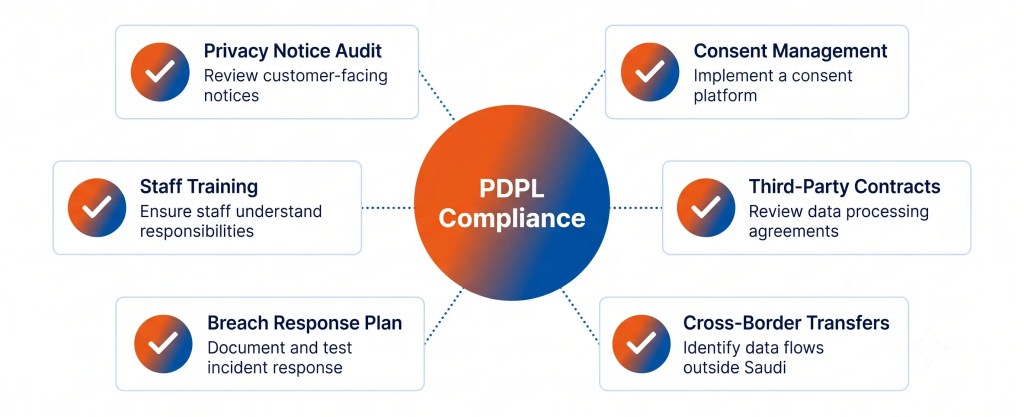
Key Checklist Components
Organisations should ensure the following elements are addressed as part of their compliance roadmap:
- Privacy Notice Audit: Review all customer-facing privacy notices for PDPL alignment, ensuring they accurately describe data use, retention periods, and data subject rights.
- Consent Management: Implement a consent management platform or process that captures, records, and enables withdrawal of consent in a manner that is auditable.
- Third-Party Contracts: Review all data processing agreements with vendors, cloud providers, and partners to ensure PDPL-compliant contractual protections are in place.
- Cross-Border Transfer Controls: Identify any data flows outside Saudi financial data privacy and assess whether they meet PDPL transfer conditions including adequacy determinations or contractual safeguards.
- Breach Response Plan: Document and test an incident response procedure specifically designed to meet the PDPL’s breach notification obligations.
- Staff Training: Ensure that customer-facing staff, compliance teams, and IT personnel understand their PDPL responsibilities and can recognise privacy risks in their day-to-day work.
Privacy Governance for Fintech Companies in KSA: Building Long-Term Accountability
Privacy governance is the organisational architecture that makes PDPL compliance audit KSA sustainable. It encompasses the policies, roles, processes, and oversight mechanisms that ensure personal data is handled lawfully and responsibly across the entire organisation. For fintech companies which tend to move fast, iterate frequently, and rely heavily on third-party technology infrastructure governance is the discipline that prevents compliance gaps from opening between product development and regulatory obligation.
Appointing a designated Data Protection Officer (DPO) or privacy lead with direct access to senior leadership is a marker of genuine governance maturity. This individual must have the authority to pause or redirect data processing activities that carry unacceptable privacy risk, and must maintain an ongoing dialogue with product, engineering, and commercial teams. Privacy-by-design the principle that data protection considerations are built into new products and processes from the outset is the practical methodology through which this governance operates on a day-to-day basis.
Fintech companies should also conduct periodic Data Protection Impact Assessments (DPIAs) for high-risk processing activities, such as automated credit scoring, behavioural analytics, or the introduction of new data-sharing partnerships. The PDPL does not mandate DPIAs in precisely the same terms as GDPR, but the underlying principle that organisations must assess and mitigate privacy risk before it materialises is entirely consistent with the law’s obligations and reflects the kind of proactive, high-performance compliance posture that regulators and customers alike expect.
Conclusion
The KSA Personal Data Protection Law (PDPL) imposes comprehensive data protection obligations on all fintech companies, banks, and financial services organisations processing the personal data of Saudi residents, including extraterritorial application to foreign entities. Key requirements encompass lawful basis and consent management, data subject rights, sensitive financial data controls, cross-border transfer restrictions, and breach notification to SDAIA. Financial institutions must integrate PDPL obligations with existing SAMA frameworks through structured compliance programmes encompassing data mapping, privacy governance, and proportionate security controls. ValueMentor’s privacy and compliance specialists work as your trusted partner helping you map your data, design consent frameworks, and achieve KSA PDPL compliance for fintech with confidence. Your customers’ data deserves the same standard of protection as their financial assets.
FAQs
The KSA PDPL is Saudi Arabia’s Personal Data Protection Law governing the collection, processing, storage and sharing of personal data. Fintech companies must implement lawful processing, data protection, security and privacy governance practices to protect customer information.
2. What are the penalties for violating the KSA PDPL?
General violations can attract fines of up to SAR 5 million, which may double for repeat offences. Certain criminal violations involving sensitive data or unlawful transfers carry separate penalties, including imprisonment and fines of up to SAR 3 million or SAR 1 million, respectively.
3. Does the KSA PDPL apply to foreign fintech companies operating in Saudi Arabia?
Yes. The PDPL applies to organisations processing personal data within Saudi Arabia and to organisations outside the Kingdom processing personal data of individuals residing in Saudi Arabia.
4. How should fintech companies obtain customer consent under the KSA PDPL?
Fintech companies must obtain valid, documented consent where consent is the applicable legal basis. Consent must be freely given, informed and linked to specific processing purposes. Explicit consent is required in certain cases, including processing sensitive and credit data.
5. Does the KSA PDPL require fintech companies to store customer data in Saudi Arabia?
The PDPL does not impose a blanket data localisation requirement. Cross-border transfers are permitted subject to Article 29, the applicable transfer regulations and required safeguards, including adequate protection and data minimisation.
6. What are the KSA PDPL’s data breach notification requirements?
Organisations must notify the competent authority within 72 hours of becoming aware of a breach that may harm personal data or data subjects or affect their rights. Affected individuals must also be notified without undue delay when the applicable harm threshold is met.
7. What types of customer information are protected under the KSA PDPL?
The PDPL protects information that can directly or indirectly identify individuals, including names, contact details, financial information, bank account numbers and identification records. Sensitive personal data receives additional protection.
8. What rights do customers have under the KSA PDPL?
Customers have rights to be informed about data processing, access their personal data, obtain copies, request corrections and request destruction where applicable. Organisations must establish processes to handle these requests within the prescribed timelines.
9. How can fintech companies ensure KSA PDPL compliance?
Fintech companies should conduct data mapping, maintain processing records, establish privacy policies, implement access controls, assess third-party risks, manage consent and establish breach response procedures. Regular compliance assessments help identify and address gaps.
10. What is the role of third-party risk management in KSA PDPL compliance?
Fintech companies must assess how vendors and data processors handle customer information. Contracts, security assessments, access restrictions and ongoing monitoring help ensure third parties meet applicable PDPL obligations.
11. How can ValueMentor help fintech companies achieve KSA PDPL compliance?
ValueMentor helps fintech companies assess their privacy and security posture, identify compliance gaps, conduct risk assessments and establish data protection governance aligned with KSA PDPL requirements.