
The UAE PDPL compliance for healthcare establishes a clear and enforceable framework for how personal data must be handled across all sectors and healthcare sits squarely at its centre. For hospitals, clinics, digital health platforms, and insurance providers operating in the UAE, PDPL compliance is not a future consideration; it is a present obligation with real regulatory consequences.
The healthcare sector processes some of the most sensitive personal information in existence: diagnostic histories, treatment records, genetic profiles, biometric identifiers, and mental health data. This information is not simply private it is protected by explicit provisions within the PDPL that impose stricter processing conditions than those applied to general personal data. CISOs, compliance officers, and healthcare administrators who understand this distinction are far better positioned to build governance programmes that hold up under scrutiny.
This blog is designed to give healthcare organisations a clear, practical understanding of their obligations under the UAE PDPL. It covers what counts as sensitive health data, how consent must be obtained and documented, what rules govern medical records and third-party sharing, and what the consequences of getting it wrong look like. The goal is clarity so that compliance becomes a manageable discipline rather than an abstract risk.
Healthcare Data Protection UAE: Why the PDPL Changes the Rules?
Before the PDPL, healthcare data protection UAE was operated under a fragmented patchwork of sector-specific guidance and Emirates-level regulations. The PDPL consolidates and elevates these obligations into a single federal framework, creating accountability structures that mirror global standards such as the GDPR. For healthcare providers, this shift is significant. It means that the casual handling of patient records, the informal sharing of health information between departments, or the reliance on broadly worded consent forms can no longer be considered acceptable practice.
The PDPL applies to any entity that processes personal data within the UAE or processes the data of UAE residents, regardless of where the entity is based. This extraterritorial reach is particularly relevant for telemedicine providers, international hospital groups, and health technology companies that handle UAE patient data from outside the country. Compliance is not a question of physical presence alone it is a question of data flow.
Healthcare organisations should treat the PDPL not as a compliance checkbox but as a governance imperative. The law requires documented policies, appointed data protection roles in certain circumstances, and demonstrable accountability across the data lifecycle. For CISOs and compliance officers, that means mapping data flows, classifying assets by sensitivity, and ensuring that internal controls align with the law’s requirements before an incident not after.
Patient Data Privacy UAE: What Patients Have the Right to Expect
UAE health data privacy is no longer a matter of professional courtesy it is a legal entitlement. The PDPL grants data subjects the right to know what data is held about them, to access that data, to request corrections where it is inaccurate, and to object to processing in certain circumstances. For healthcare providers, this creates a practical obligation: organisations must have processes in place to respond to patient data requests within the timeframes the law specifies.
The right to access is particularly consequential in healthcare. A patient may request their diagnostic history, medication records, or treatment notes and the healthcare provider must be able to retrieve and present this information clearly. This requires not just technical capability but governance readiness: data must be organised, attributable, and retrievable on demand. Organisations that have not conducted a comprehensive data mapping exercise will find this difficult to execute reliably.
There is also a transparency obligation. Healthcare providers must inform patients at the point of data collection clearly and in plain language about what data is being collected, why, how long it will be retained, and who it may be shared with. Privacy notices that are buried in lengthy terms and conditions, written in technical language, or presented after the fact do not satisfy this requirement. Patient-facing communications need to be revisited with the PDPL’s transparency standards in mind.
Medical Records Privacy: Obligations Around Storage, Retention, and Access
Medical records privacy represent one of the most concentrated repositories of sensitive personal data in any organisation. Under the PDPL, the security of this data is a legal obligation, not a discretionary control. Healthcare providers must implement technical measures encryption, access controls, audit logging and organisational measures staff training, access policies, incident response procedures that are proportionate to the sensitivity of the data held.
Retention is an area where many healthcare organisations face practical tension. Sector regulations in the UAE often mandate minimum retention periods for clinical records. The PDPL, meanwhile, requires that personal data not be kept longer than necessary for the original purpose. Where these two frameworks interact, healthcare providers need to document their retention rationale carefully, applying the longer mandatory period where legally required while ensuring that data is securely deleted or anonymised once that period has elapsed.
Access to medical records must also be governed by the principle of least privilege. Not every clinician, administrator, or support staff member needs access to every patient record. Role-based access controls, regular access reviews, and audit trails are foundational requirements. When auditing this area, we consistently find that over-permissioned access is one of the most common vulnerabilities in healthcare environments and one of the most straightforward to remediate with the right governance structure in place.
Practical Controls for Medical Records Compliance
Organisations looking to align their records management with PDPL requirements should focus on three areas:
- Classification: Ensure all health data is tagged as sensitive personal data within your data inventory and subject to corresponding controls.
- Access governance: Implement and regularly review role-based access policies that restrict records access to those with a clinical or operational need.
- Retention schedules: Document retention periods for each category of medical record, cross-referencing both PDPL obligations and sector-specific requirements.
Sensitive Personal Data UAE: Consent as the Foundation of Lawful Processing
Consent is the most consequential compliance lever in healthcare under the PDPL. When a healthcare provider collects a patient’s medical history, processes biometric data at registration, or uses genetic information for diagnosis, they are handling sensitive personal data that requires explicit, informed consent before any processing begins. The standard for explicit consent is demanding: it must be freely given, specific to the processing purpose, clearly communicated, and actively indicated not assumed.
This has direct implications for how consent is captured in practice. Digital intake forms that bundle health data consent with general terms of service do not meet the standard. Verbal consent that is not documented cannot be demonstrated to regulators. Consent obtained under conditions where the patient had no real alternative for instance, as a precondition to receiving essential care raises questions about whether it was truly freely given. Healthcare organisations need to review their consent workflows from the patient’s first point of contact through to discharge and beyond.
The PDPL also recognises lawful bases for processing beyond consent, including where processing is necessary to protect the vital interests of the data subject or is required for the performance of a legal obligation. In emergency medical care, for example, obtaining prior explicit consent may not always be practicable. Healthcare providers should document these alternative lawful bases clearly, ensuring that reliance on them is proportionate and limited to the circumstances the law contemplates not used as a convenient workaround for routine processing.
Health Information UAE: Rules for Cross-Border Data Transfers and Third-Party Sharing
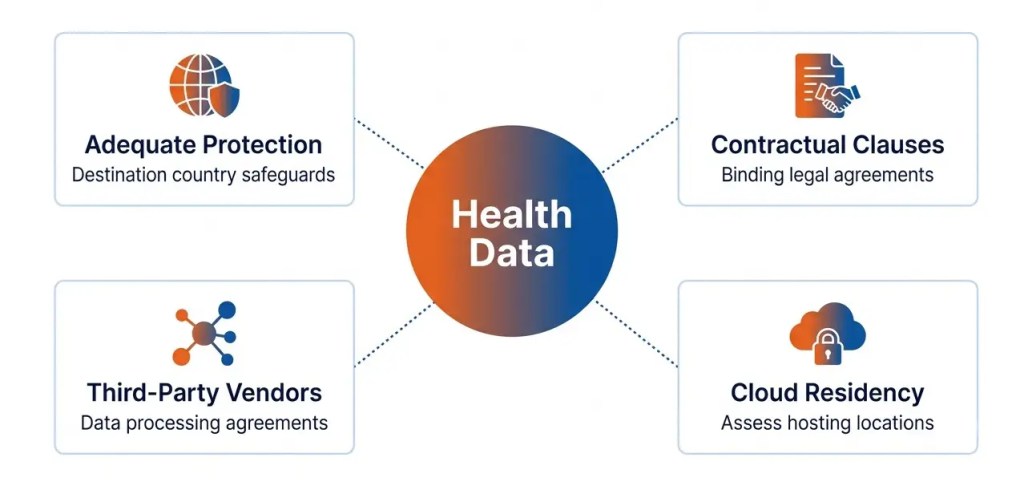
The global nature of modern healthcare telemedicine platforms, international diagnostic services, cloud-based health records systems, and multinational insurance providers means that cross-border data flows are commonplace. The PDPL addresses this directly: health data cannot simply be transferred to another country because it is operationally convenient. The destination country must offer an adequate level of data protection, or the transfer must be supported by appropriate safeguards such as binding contractual clauses.
For healthcare providers working with third-party vendors laboratory services, billing platforms, health IT providers, or clinical software companies the PDPL requires that data processing agreements are in place before any personal data is shared. These agreements must define the scope of processing, the security obligations of the processor, and the conditions under which sub-processing is permitted. Sending patient data to a vendor without a compliant data processing agreement in place is a direct breach of the law.
Cloud adoption in healthcare creates particular complexity. Where patient records are stored in cloud environments hosted outside the UAE, providers must assess the data residency implications, the contractual protections in place with the cloud provider, and whether the arrangement constitutes a cross-border transfer requiring additional regulatory steps. This is not an area where assumptions are safe it requires deliberate legal and technical analysis conducted in partnership with privacy counsel and security advisors.
Healthcare Privacy Compliance: Building a Sustainable Programme
Compliance with the PDPL is not achieved through a single audit or a policy document filed away in a shared drive. It is an ongoing discipline that requires dedicated resources, clear ownership, and regular review. For healthcare organisations, this means establishing a privacy governance structure that assigns accountability at the leadership level, defines roles and responsibilities across clinical and administrative functions, and creates feedback loops for identifying and addressing compliance gaps as they emerge.
Data mapping is the essential starting point. Organisations must understand what personal and sensitive data they hold, where it originates, how it flows through internal systems, who has access to it, and where it goes when shared externally. Without this foundation, it is not possible to apply the right controls, respond to data subject requests accurately, or assess the impact of a potential breach. In our experience advising regulated organisations, data mapping exercises frequently surface processing activities that have never been formally assessed for compliance a reality that underscores why this step cannot be skipped.
Staff training is a dimension of healthcare privacy compliance that is often underinvested. Clinical staff handle sensitive personal data daily, often under time pressure, and may not have a detailed understanding of their data protection obligations. A nurse who discusses a patient’s condition in an unsecured environment, a receptionist who emails medical records to an unverified address, or an administrator who shares login credentials to streamline workflow each of these represents a human-layer risk that training and clear policy can meaningfully reduce. Building a culture of data privacy awareness across the workforce is as important as any technical control.
Conclusion
The path forward is deliberate and structured: map your data, assess your consent mechanisms, review your vendor agreements, secure your records infrastructure, and invest in building privacy awareness across your workforce. These are not abstract ambitions they are practical steps that every healthcare organisation in the UAE can and must take. The regulatory environment is maturing rapidly, and the organisations that build resilient compliance foundations now will be the ones that navigate future developments with confidence.
The UAE Personal Data Protection Law (Federal Decree-Law No. 45 of 2021) classifies health, biometric, and genetic data as sensitive personal data subject to heightened processing obligations. Healthcare providers operating in the UAE must obtain explicit patient consent, implement robust data security controls, govern medical records retention, and ensure that any cross-border transfers or third-party sharing arrangements are supported by lawful mechanisms and contractual safeguards. Non-compliance carries escalating administrative penalties, making a structured, ongoing healthcare privacy compliance programme essential for every regulated organisation in the sector.
Understanding your PDPL obligations is the first step building a programme that meets them is where the real work begins. ValueMentor explores how our data privacy and compliance experts partner with healthcare organisations across the UAE to design and implement compliance frameworks that protect patients and strengthen organisational resilience.
Frequently Asked Questions
The UAE PDPL compliance for healthcare (Federal Decree-Law No. 45 of 2021) regulates the collection, processing, storage and sharing of personal data by healthcare organisations within its scope.
Patient medical records, diagnostic information, treatment histories, genetic data and biometric information are examples of sensitive health data requiring enhanced protection.
3. Is explicit consent required to process patient health data in the UAE?
Yes, where consent is the applicable legal basis, it must be explicit, informed and documented. Other lawful grounds may apply in specific circumstances.
4. What are patients’ data protection rights under the UAE PDPL?
Patients have rights to access their personal data, request corrections and object to certain processing activities, subject to applicable legal conditions.
5. What are the medical record retention requirements under the UAE PDPL?
Healthcare providers must not retain patient data longer than necessary, while observing mandatory medical record retention periods under applicable healthcare regulations.
6. Can hospitals transfer patient health data outside the UAE?
Yes. Cross-border transfers must comply with the PDPL’s requirements for adequate protection or applicable transfer safeguards.
7. What must healthcare providers include in third-party data processing agreements?
Agreements must define processing purposes, the processor’s responsibilities, security obligations and conditions for subcontracting.
8. What security controls protect patient records under the UAE PDPL?
Key controls include data encryption, role-based access restrictions, audit logging, periodic access reviews and documented security procedures.
9. Does the UAE PDPL apply to overseas telemedicine providers?
Yes. Overseas providers processing UAE residents’ personal data within the law’s scope may be subject to the UAE PDPL.
10. What are the key steps for UAE PDPL compliance for healthcare?
Healthcare providers must map data flows, classify sensitive data, establish lawful processing mechanisms, review vendor agreements and implement appropriate privacy and security controls.