
Saudi Arabia’s approach to data protection has shifted decisively. SDAIA is no longer accepting policy documents and good intentions as proof of compliance. Organizations must now demonstrate, with clear evidence, exactly how they handle personal data. The Record of Processing Activities sits at the heart of this accountability requirement, and understanding its role under the PDPL is essential for every business operating in the Kingdom.
The Regulatory Reality in 2026
The Personal Data Protection Law, enacted under Royal Decree No. M/19 and subsequently amended, has been in full effect since September 2024. The grace period is over. SDAIA’s enforcement activity has intensified, with the authority responding promptly to data subject complaints and requiring controllers to produce supporting documentation to justify their positions. The message is unambiguous: know your data flows, document them properly, and be prepared to present this evidence when asked.
What ROPA actually means under saudi law?
A Record of Processing Activities is a comprehensive register documenting how your organization collects, uses, stores, shares, and protects personal data. SDAIA’s implementing regulations explicitly require organizations to maintain these records, and the authority has emphasized that this applies regardless of organizational size or processing volume. The PDPL mandates specific content for ROPA entries. Organizations must document: the purposes of processing, categories of personal data and data subjects involved, recipients who receive the data, transfers outside the Kingdom with applicable protection measures, retention timeframes, and descriptions of technical and organizational security measures. This is not a flexible framework where organizations can pick and choose what to include.
Why ROPA has become non-negotiable?
Several developments in 2025 and 2026 have elevated ROPA from recommended practice to operational necessity.
1. Regulatory enforcement patterns
SDAIA’s examination approach has matured. When investigating complaints or conducting assessments, regulators typically begin with a straightforward request: demonstrate how personal data flows through your organization. Without ROPA, providing this evidence becomes nearly impossible. Organizations that cannot produce these records face not only regulatory penalties but also operational disruption as they scramble to reconstruct their data landscape under examination pressure.
2. Data controller registration requirements
SDAIA now mandates registration for public entities and organizations processing significant volumes of personal data. The registration process requires detailed information about processing activities, information that flows directly from a properly maintained ROPA. Organizations without existing records find themselves unable to complete registration efficiently, creating compliance gaps before operations even begin.
3. Cross-Border transfer scrutiny
International data flows face heightened attention. SDAIA issued approved standard contractual clauses in 2024, but October 2024 guidance introduced additional complexity: risk assessments are now required for sensitive data transfers or large-scale continuous transfers, even when appropriate safeguards exist. ROPA documentation of these transfers must be precise, current, and defensible.
4. AI and Emerging technology governance
As Saudi organizations accelerate AI adoption, ROPA has taken on expanded importance. AI systems rely heavily on personal data for training and operation. SDAIA expects organizations to document data sources used in AI models, legal bases for training data usage, automated decision-making processes, and data flows across AI systems. ROPA has become the foundational document for AI audit readiness, with organizations that established proper records in 2024 and 2025 now positioned advantageously for evolving regulatory expectations.
The Controller and Processor distinction
A point of persistent confusion involves organizational roles. The PDPL places distinct obligations on data controllers and data processors, and many Saudi businesses operate as both simultaneously without recognizing this dual status.
As a controller, your organization determines the purposes and means of processing, collecting customer information for your own business objectives, for example. As a processor, you handle data on behalf of another organization, providing payroll services, operating a software platform for client data, or managing marketing campaigns for third parties. The PDPL requires separate ROPA maintenance for each capacity. This distinction matters for legal basis determination, cross-border transfer authority, and liability allocation. SDAIA’s enforcement actions have targeted processor compliance specifically, recognizing that weak processor controls create systemic risk across multiple controller relationships.
Critical ROPA requirements often overlooked
Through SDAIA examinations and industry implementation reviews, several ROPA elements consistently emerge as under-documented:
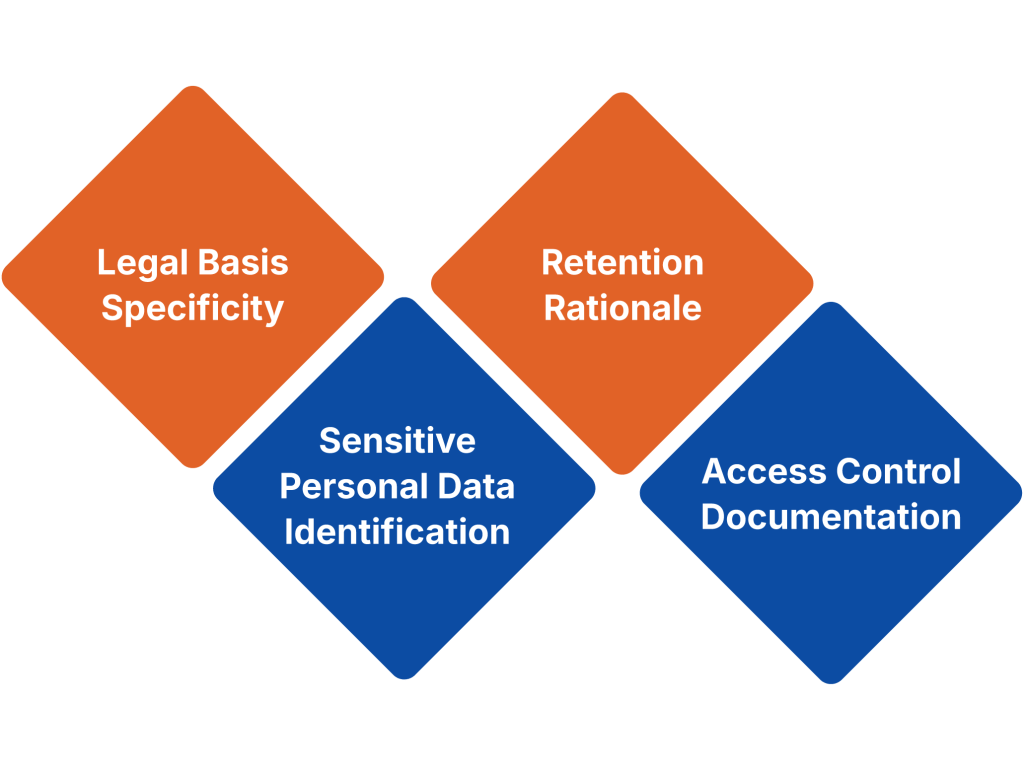
1. Legal basis specificity
The PDPL offers multiple processing grounds, consent, contractual necessity, legal obligation, protection of data subject interests, public interest, and legitimate interest. However, organizations frequently document vague or incorrect bases. Direct marketing, for instance, permits only consent as a legal basis, with strict requirements for opt-out mechanisms. ROPA entries must reflect precise legal basis assessments, not generic justifications.
2. Sensitive personal data identification
The PDPL defines sensitive personal data explicitly: racial or ethnic origin, religious or political beliefs, health data, biometric or genetic identifiers, and criminal conviction information. This definition differs from other jurisdictions, and misclassification creates compliance exposure. Sensitive data triggers stricter processing requirements, enhanced consent conditions, and mandatory DPIAs for large-scale processing.
3. Retention rationale
Data minimization is a core PDPL principle, organizations must limit retention and securely delete data once purpose is served. ROPA must specify not just retention periods but the justification for each timeframe. Legal or regulatory minimums should be documented; business-justified periods require clear rationale.
4. Access control documentation
While not always explicitly required in other jurisdictions, comprehensive access control records strengthen SDAIA defensibility. Organizations should document who can access each data category, how access is granted and revoked, and review frequencies.
Common organizational mistakes
1. Treating ROPA as static documentation
Organizations complete initial ROPA construction, achieve a compliance milestone, then fail to maintain current records. SDAIA explicitly requires regular updates reflecting processing changes. New systems, vendor relationships, business processes, and security incidents all trigger update requirements.
2. Inadequate processor oversight
Many Saudi organizations rely heavily on third-party processors without sufficient contractual protection or ROPA documentation. SDAIA expects controller ROPA entries to reflect processor activities comprehensively, with evidence of appropriate contractual safeguards.
3. Shadow IT and Informal processing
Data mapping exercises consistently reveal processing activities outside approved systems, spreadsheets on local drives, personal device usage, informal data sharing channels. ROPA must capture reality, not just officially sanctioned processes.
4. Cross-Border transfer gaps
Automatic SaaS data transfers to international servers frequently go undocumented. Organizations discover, often during examination preparation, that critical business tools route data through multiple jurisdictions without proper ROPA entries or transfer mechanism documentation.
ROPA as business infrastructure
Beyond regulatory defence, proper ROPA maintenance delivers operational value that justifies organizational investment:
- Data subject request efficiency: 30-day response deadlines are challenging without accurate data location records
- Breach response capability: 72-hour notification requirements demand rapid data impact assessment
- Vendor management optimization: ROPA maintenance forces systematic processor evaluation and contract review
- System consolidation insights: Documentation often reveals redundant platforms and overlapping data stores
- Investment and transaction readiness: Due diligence processes increasingly examine data governance maturity
For startups seeking funding, SMEs pursuing government contracts, and enterprises preparing for acquisition, ROPA demonstrates operational discipline that differentiates organizations in competitive environments.
Looking ahead: 2026 and Beyond
SDAIA’s regulatory program continues evolving. Data controller registration is expanding beyond public entities to cover significant private sector processing. AI governance requirements are crystallizing, with ROPA serving as foundational documentation for algorithmic accountability. Cross-border transfer mechanisms are undergoing refinement, with additional adequacy decisions and approved mechanisms expected.
Organizations that treated ROPA as a 2024 compliance exercise are finding themselves unprepared for 2026 requirements. Those that established robust, maintained records are positioned to adapt efficiently as regulatory expectations mature.
The essential takeaway
ROPA under Saudi PDPL is not a documentation exercise to be completed and filed. It is a living accountability mechanism that reflects organizational reality, supports multiple compliance functions, and demonstrates to SDAIA that your organization understands and controls its data processing activities.
The investment required to establish proper ROPA, governance structures, data mapping, documentation, validation, and maintenance processes, is substantial. The cost of discovering ROPA gaps during a SDAIA examination is substantially higher, involving regulatory penalties, operational disruption, reputational damage, and the compressed timeline reconstruction of records that should have existed all along.
Every organization processing personal data in Saudi Arabia needs to assess its current ROPA position honestly. Records that are incomplete, outdated, or theoretical rather than operational require immediate attention. SDAIA’s enforcement trajectory suggests that 2026 will bring increased examination activity, and organizations without defensible ROPA will face significant exposure.
The PDPL represents a fundamental shift in Saudi data protection, aligned with Vision 2030’s digital economy objectives. ROPA is the mechanism through which organizations demonstrate their alignment with this shift. Understanding its requirements, maintaining its accuracy, and recognizing its strategic importance is now essential knowledge for every Saudi organization.
FAQS
1. Is ROPA explicitly mandatory under Saudi PDPL?
Yes. SDAIA’s implementing regulations explicitly require organizations to maintain comprehensive records of processing activities, regardless of size or industry.
2. What changed in 2025-2026 to make ROPA more critical?
SDAIA intensified enforcement, introduced data controller registration, added cross-border transfer risk assessments, and expanded AI governance expectations, all requiring robust ROPA documentation.
3. What’s the difference between a controller and processor under PDPL?
Controllers determine purposes and means of processing (e.g., collecting customer data for your business). Processors handle data on behalf of others (e.g., providing payroll services). You need separate ROPA records for each role.
4. Does ROPA need to be in Arabic?
The PDPL does not specify language requirements, but SDAIA communications and examinations occur in Arabic. Maintaining Arabic or bilingual ROPA records is strongly advisable.
5. What are the penalties for inadequate ROPA?
Administrative fines up to SAR 5 million, plus potential criminal liability for serious violations involving sensitive data. Operational disruption during examinations often exceeds monetary penalties.
6. How does ROPA support AI governance?
ROPA documents data sources for AI models, legal bases for training data, automated decision-making processes, and cross-system data flows, forming the foundation for AI audit readiness.
7. What if I use international cloud services like Microsoft or Google?
Document these arrangements in your ROPA. SDAIA issued approved standard contractual clauses in 2024. Risk assessments are now required for sensitive or large-scale continuous transfers.
8. Is ROPA a one-time project or ongoing obligation?
Ongoing. SDAIA explicitly requires regular updates reflecting processing changes. Treating ROPA as static documentation is one of the most common organizational mistakes.
9. Do startups without a DPO need ROPA?
Yes. DPO appointment is mandatory only for large-scale sensitive processing or systematic monitoring. All organizations processing personal data must maintain ROPA, with or without a DPO.
10. How do I know if my current ROPA is adequate for SDAIA examination?
Honest assessment criteria: Does it reflect actual processing (not just official systems)? Is it updated within the last quarter? Can you produce it within hours of a regulatory request? If any answer is no, immediate attention is needed.