
The Kingdom of Saudi Arabia has taken a significant step toward strengthening data protection with the introduction of the Personal Data Protection Law (PDPL). This legislation establishes rules for how organizations collect, process, store and share personal data within the Kingdom and across borders. Achieving KSA PDPL Compliance is now a top priority for organizations.
The law was originally issued through Royal Decree No. M/19 dated 9/2/1443H (16 September 2021), with subsequent amendments in March 2023 to align with international best practices and to provide clearer guidelines for organizations. The Saudi Data and Artificial Intelligence Authority (SDAIA) oversee the PDPL and enforcement is expected to be strict, given the increasing importance of personal data in commerce, government services and digital platforms. The PDPL applies to all entities handling personal data in Saudi Arabia, regardless of whether they are based inside or outside the Kingdom, meaning both local businesses and international companies targeting Saudi residents must comply.
Scope and Applicability of KSA PDPL
The scope of KSA PDPL is deliberately broad, ensuring all significant data processing activities within the Kingdom are regulated.
1. Entities Covered:
- Public Sector: Ministries, government agencies and municipalities managing citizen data.
- Private Sector: Local and multinational businesses, including telecoms, retailers, healthcare providers and banks.
- Nonprofits: Charities and community organizations handle donor or beneficiary information.
- Foreign Companies: Any business outside Saudi Arabia that targets Saudi residents, whether through digital platforms, online services or international trade.
2. Data Subjects:
The PDPL protects all natural persons within Saudi Arabia, including citizens, expatriates and temporary residents. Whether a university processes student data or a hospital manages patient records, the law applies equally.
3. Data Types:
- Personal Data: Names, ID numbers, addresses and contact details.
- Sensitive Data: Financial information, health records, biometric identifiers, religious beliefs and criminal history.
- Derived Data: Behavioral profiles, analytics data or preferences generated through tracking and algorithms.
4. Extra territorial Reach:
The PDPL applies to businesses outside Saudi Arabia if they process the data of individuals in the Kingdom. For example:
- A foreign cloud provider hosting Saudi client data.
- An e-commerce site in Europe selling directly to Saudi consumers.
- A marketing company analyzing online activity of Saudi users.
This wide scope ensures that personal data is protected regardless of where or by whom it is processed. For businesses serving Saudi residents, understanding the scope is the first step toward KSA PDPL Compliance.
Key Requirements for KSA PDPL Compliance
Businesses must adapt their policies, systems and operations to comply with PDPL requirements. The obligations are extensive and demand organizational change.
Legal Basis and Consent
Under the PDPL, organizations must have a legal basis for processing personal data, meaning they should be able to justify why the data is collected, stored or used. Legal bases can include compliance with laws, fulfillment of contractual obligations, protection of public interest or the legitimate needs of the organization, provided that such processing does not harm the rights of individuals.
Consent is considered the primary legal basis under the PDPL. It requires that individuals are fully informed and voluntarily agree to the collection and use of their personal data. Consent must be explicit, specific to the purpose and freely given without coercion.
Organizations must:
- Consent needs to be explicit in some scenarios like when processing is of sensitive or credit data, its note explicit for all.
- Consent shall be given by a person who has full legal capacity.
- Ensure consent is freely given and specific to the purpose.
- Allow individuals to withdraw consent easily.
- Record and store consent to demonstrate compliance.
Exceptions exist when processing is required for public interest, contractual obligations or legal requirements. However, unlike some global regulations, the PDPL places stricter emphasis on consent as a default.
Data Subject Rights
The PDPL empowers individuals with rights that organizations must respect:
- Right to Access: Individuals can request copies of their data.
- Right to be Informed: Individuals must be clearly informed about how their personal data is collected, processed, stored and shared.
- Right to Request Correction: Inaccurate or outdated information must be updated.
- Right to Request Deletion: Data must be erased upon request unless retention is legally necessary.
- Right to Withdraw Consent: Individuals can withdraw their previously given consent at any time and organizations must stop processing their data unless another legal basis applies.
Data Retention and Storage
Organizations must adopt data minimization practices. Data should be collected only, when necessary, stored securely and deleted once no longer required. Retention periods must align with business or legal needs.
Security and Breach Notification
Companies must implement technical and organizational safeguards, including:
- Encryption and secure storage.
- Access control policies.
- Regular audits and monitoring.
- Breach notification to SDAIA within 72 hours and to affected individuals without delay.
Handling Sensitive Data
Sensitive personal data is subject to enhanced requirements. For instance, processing biometric or medical data often requires explicit consent from the data subject, prior authorization from the regulatory authority and strict adherence to approved security protocols.
Accountability and Governance
When applicable, organizations should appoint a Data Protection Officer (DPO) or an equivalent role. Internal processes should ensure that compliance in KSA is monitored, documented and reviewed regularly.
KSA PDPL Rules on Cross-Border Data Transfers
Cross-border transfers are one of the most complex parts of PDPL compliance.
The law generally prohibits the transfer of personal data outside Saudi Arabia unless specific conditions are met. Transfers may be allowed if:
- They are required to fulfill a contract with the data subject.
- They serve Saudi Arabia’s public interest.
- Adequate safeguards are in place to ensure protection equivalent to PDPL standards, such as standard contractual clauses, binding corporate rules or approved certification mechanisms.
- The Saudi Data and Artificial Intelligence Authority (SDAIA) grant explicit approval.
For example, a Saudi hospital sharing patient data with a specialized lab abroad must ensure safeguards such as contractual clauses, encryption and SDAIA authorization.
This requirement makes data localization an important compliance issue. Multinational companies using global cloud providers must confirm that storage and processing meet Saudi restrictions.
Penalties for Non-Compliance with Saudi PDPL
Non-compliance with the PDPL carries heavy consequences:
- Fines: Up to SAR 5 million for violations, with potential increases for repeat offenses.
- Criminal Liability: Unauthorized disclosure of sensitive data can lead to imprisonment of up to two years and/or fine of up to SAR 3 million.
- Business Impact: Suspension of licenses or business activities in severe cases.
- Civil Liability: Individuals can claim damages for harm caused by data misuse.
These penalties highlight the importance of proactive KSA PDPL Compliance programs that integrate monitoring, training and governance into daily operations.
KSA PDPL Compliance Roadmap for Businesses
Compliance with the PDPL requires a structured, phased approach.
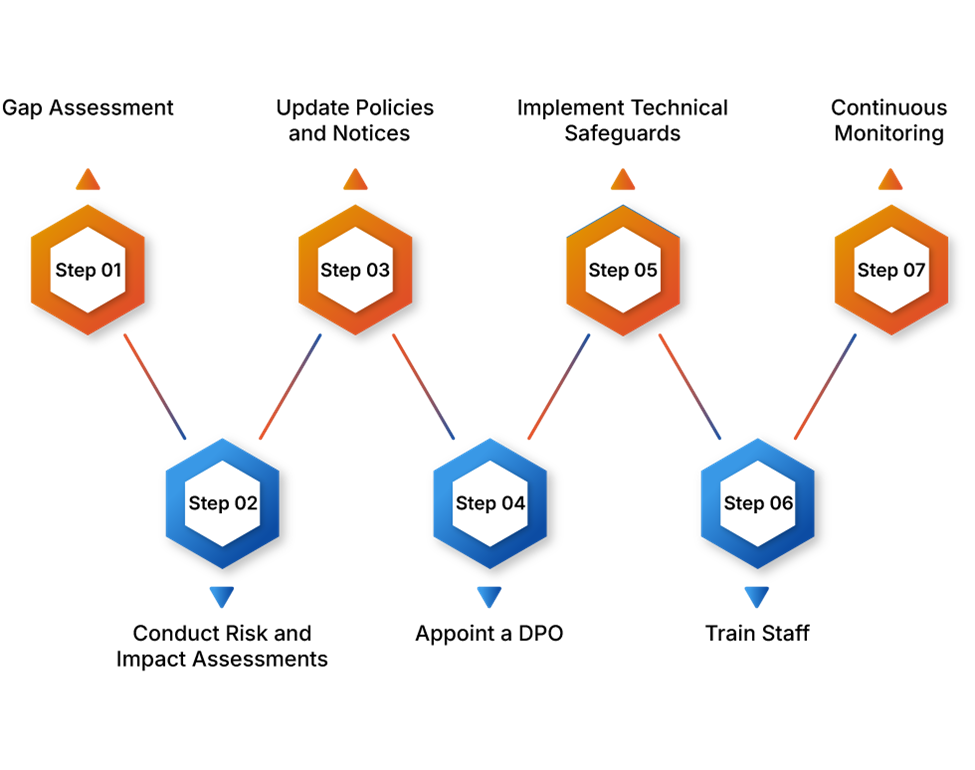
Step 1: Gap Assessment
- Review current data practices against PDPL requirements.
- Perform data discovery sessions to locate, classify and map personal data across systems.
- Identify risks in consent management, storage and cross-border transfers.
Step 2: Conduct Risk and Impact Assessments
- Carry out risk assessments to identify vulnerabilities in data handling processes.
- Perform Data Protection Impact Assessments (DPIAs) for high-risk processing activities, such as handling sensitive personal data or large-scale cross-border transfers.
Step 3: Update Policies and Notices
- Revise privacy policies to reflect PDPL obligations.
- Update contracts with vendors and partners to include compliance clauses.
Step 4: Appoint a DPO
- Assign a Data Protection Officer to oversee compliance and liaise with SDAIA.
Step 5: Implement Technical Safeguards
- Apply encryption, monitoring and access controls.
- Develop breach response procedures.
Step 6: Train Staff
- Educate employees on their responsibilities under PDPL.
- Conduct regular workshops and awareness programs.
Step 7: Continuous Monitoring
- Carry out regular compliance audits.
- Track changes in regulations and SDAIA guidelines.
By following this roadmap, organizations can build a culture of accountability and establish measurable steps toward sustainable KSA PDPL Compliance.
KSA PDPL vs. UAE PDPL
While both Saudi Arabia and the UAE have introduced personal data protection laws aligned with global standards, their regulatory approaches differ significantly. The key distinctions between the KSA PDPL and UAE PDPL are outlined below:
| KSA PDPL | UAE PDPL |
|---|---|
| Strong emphasis on consent as the primary legal basis for processing | Allows broader grounds for processing beyond consent (e.g., legitimate interest, contractual necessity). |
| Data localization required by default; cross-border transfers allowed only under strict conditions. | More flexible approach to international transfers with fewer restrictions compared to KSA. |
| Includes strict penalties, including potential imprisonment for violations involving sensitive data. | Penalties are primarily financial, without imprisonment provisions. |
| Enforcement centralized under the Saudi Data & Artificial Intelligence Authority (SDAIA). | Enforcement overseen by the UAE Data Office. |
| More restrictive, prioritizing national data sovereignty and security. | Balances alignment with international standards while allowing business-friendly flexibility. |
Conclusion
The KSA PDPL establishes a comprehensive framework for safeguarding personal data in Saudi Arabia, with strict requirements on consent, data processing, retention and cross-border transfers backed by significant penalties for violations. Organizations that proactively review their practices, address compliance gaps and strengthen data governance can reduce risk while gaining the trust of regulators and customers. To achieve this effectively, businesses should not delay building a clear compliance roadmap. ValueMentor’s data privacy and compliance experts can help you assess risks, align policies and implement controls to ensure your organization meets PDPL obligations while maintaining operational efficiency-partner with us today to secure your compliance journey.
FAQs
1. What entity enforces the KSA PDPL?
Primarily, law enforcement is done through Saudi Data and Artificial Intelligence Authority (SDAIA). They check for compliance with regulations, provide advice and resolve any matters.
2. Does the PDPL extend to small businesses?
Yes. All organizations, regardless of size, must comply if they process personal data of individuals in Saudi Arabia.
3. Do overseas businesses have to comply with PDPL?
Certainly. Any company outside Saudi Arabia who sells products or offers services to Saudi nationals or views their activity, must comply with the PDPL.
4. What is sensitive personal data?
Sensitive data includes financial records, health data, religious affiliation, genetic and biometric information and criminal history.
5. How Long Do Companies Keep Personal Information?
Information must only be kept for as long as it is needed for the identified purpose or as the law requires. It is not allowable to keep information for ever.
6. What are the penalties for non-compliance?
Fines of up to SAR 5 million are possible, up to two years in prison for distributing sensitive data without authority and possible suspension of business license.
7. Can data be sent outside of Saudi Arabia?
Yes, but only under strict conditions such as fulfilling a contract, serving Saudi Arabia’s public interest, implementing adequate safeguards (e.g., standard contractual clauses, binding corporate rules) and obtaining SDAIA approval.
8. Must you appoint a Data Protection Officer (DPO)?
Although not always explicitly required, the PDPL recommends appointing a responsible individual or unit to oversee compliance, especially when handling large volumes of data or sensitive information.
9. Do businesses have to inform authorities in case of a data breach?
Yes. Organizations need to notify SDAIA within 72 hours and notify the data subjects without undue delay in the event of a data breach, along with details of the associated risks and remedial actions.
10. How is PDPL different from the EU’s GDPR?
Both are comparable in principles such as consent, transparency and rights of individuals. While PDPL is more stringent in requirements for cross-border data transfers and imposes criminal sanctions for certain violations, hence being stricter in certain aspects compared to the GDPR.