The Digital Personal Data Protection Act (DPDPA) has introduced a new era of data privacy regulation in India. Under this law, DPDPA penalties and DPDP Act fines are not minor regulatory costs-they are serious financial risks that can reach hundreds of crores. For many Indian businesses, a single compliance failure can result in massive penalties, legal scrutiny, and long-term reputational damage.
What makes the DPDP Act especially dangerous for unprepared companies is that it applies across industries. Startups, e-commerce platforms, SaaS companies, healthcare providers, fintech firms, and even traditional businesses using digital records are all covered. Businesses that delay compliance or underestimate the law are exposing themselves to severe enforcement action. In this blog, we explain the major penalties under the DPDP Act, how the penalty structure works, and the common compliance mistakes that lead to heavy fines. You will also learn about data breach penalties, enforcement risks, and practical reasons why ignoring DPDPA requirements can seriously harm Indian businesses.
What Is the DPDP Act and Why Does It Matter to Every Business?
The DPDP Act regulates the way an individual’s personal data is collected, stored, processed and shared in India. Any organization that determines the reason and method for processing data becomes a Data Fiduciary and must abide by several rules and regulations.
This law is intended to protect individuals against the misuse of their own personal data. In addition, a business has an obligation to act transparently, predictably, securely and fairly in accordance with the law. The government has deliberately imposed heavy penalties for non-compliance in order to achieve accountability.
One cannot afford to ignore the DPDP Act. There is increasing public interest around privacy rights, and the number of digital transactions is on the rise. As such, the enforcement of the DPDP Act will only continue to increase.
What Is the Maximum Penalty a Company Can Face Under DPDPA?
One of the biggest concerns for businesses is understanding the maximum penalties under DPDPA. The Act allows penalties of up to ₹250 crore per violation, depending on the severity of non-compliance.
Some examples include:
- Failure to implement reasonable security safeguards to protect personal data
- Serious data breaches caused by negligence
- Processing personal data without valid or informed consent
- Violations related to children’s personal data
- Repeated failures to follow instructions from the Data Protection Board
These penalties are not theoretical. Once enforcement begins in full force, businesses with weak data practices will be at high risk of facing these fines.
How Does the DPDP Act Decide Penalty Amounts?
To understand the DPDP Act penalty structure explained, it helps to know that penalties are not automatic or fixed. The Data Protection Board evaluates each case carefully. Key factors considered include:
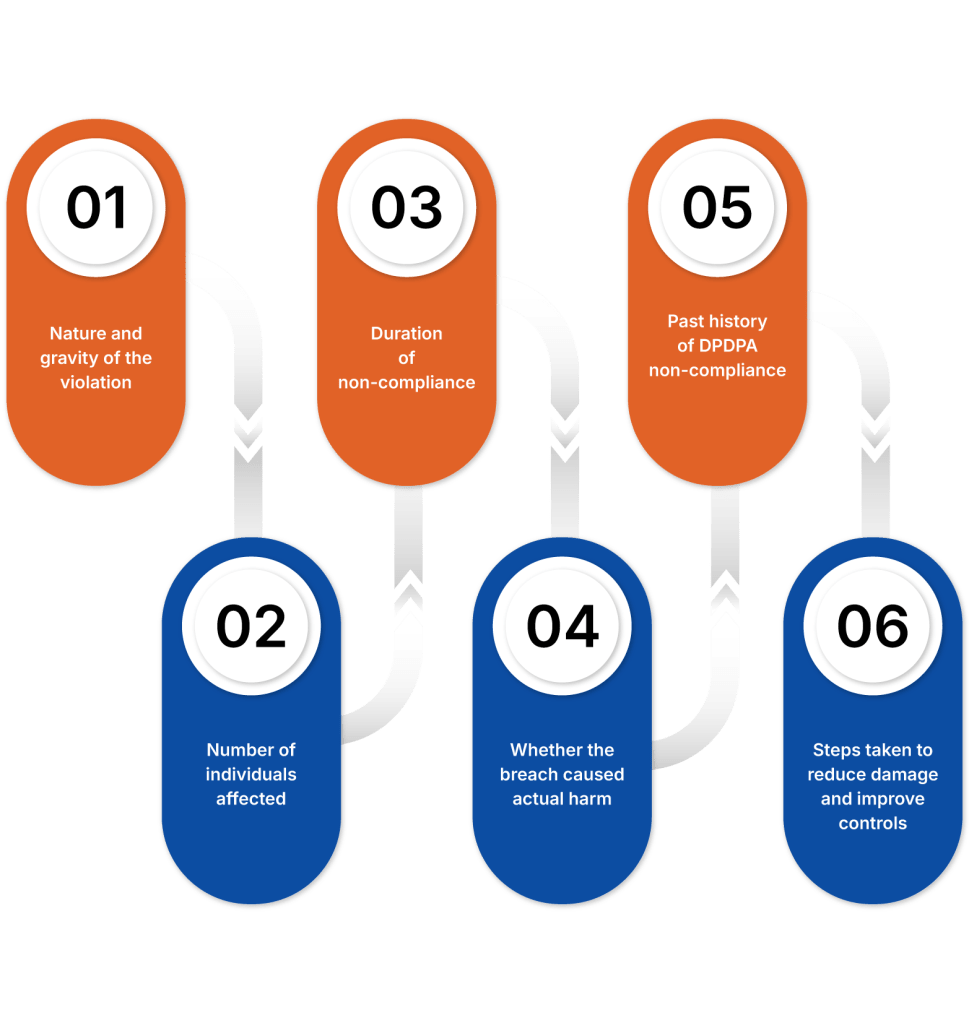
- Nature and gravity of the violation
- Number of individuals affected
- Duration of non-compliance
- Whether the breach caused actual harm
- Past history of DPDPA non-compliance
- Steps taken to reduce damage and improve controls
This structure means even small mistakes can become costly if they affect many people or show repeated negligence. On the other hand, businesses that demonstrate good compliance efforts may face reduced penalties.
Common Compliance Failures Leading to DPDPA Fines
Many compliance failures leading to DPDPA fines happen because businesses underestimate basic requirements.
Common mistakes include:
- Collecting excessive personal data without a clear purpose
- Using unclear or invalid consent mechanisms
- Not maintaining proper consent records
- Weak data access controls within teams
- Poor oversight of vendors and third-party processors
- No documented data protection policies
- Employees unaware of data privacy responsibilities
These failures increase DPDPA enforcement risks because regulators see them as systemic weaknesses, not one-time errors.
Data Breach Penalties India: Why Response Speed Is Critical?
Under the DPDP Act, data breach penalties India are among the most serious enforcement actions. While a breach itself is not always punishable, poor handling almost always is.
Businesses must:
- Detect breaches quickly
- Investigate the cause
- Notify the Data Protection Board promptly
- Inform affected individuals when required
- Take corrective actions to prevent repeat incidents
Delayed reporting, hiding incidents, or incomplete disclosures significantly increase penalty exposure. Having a clear breach response plan is one of the most effective ways to reduce DPDP Act fines.
DPDP Enforcement Risks for Indian Businesses
DPDP enforcement will not be random. Authorities are expected to focus on high-risk sectors and high-impact violations.
Enforcement may increase for:
- Businesses handling large volumes of personal data
- Companies processing sensitive or children’s data
- Digital platforms and mobile apps
- Organizations with repeated complaints
- Companies with poor security controls
As enforcement becomes more active, businesses without compliance frameworks will face higher DPDPA enforcement risks.
Penalty Exposure under DPDP Act Goes Beyond Money
Understanding penalty exposure under DPDP Act is not only about fines. Non-compliance can lead to:
- Loss of customer trust
- Damage to brand reputation
- Legal disputes and compensation claims
- Business disruptions during investigations
- Reduced investor and partner confidence
In many cases, the indirect costs of non-compliance are higher than the penalties themselves.
Conclusion
The DPDP Act has fundamentally changed how Indian businesses must handle personal data. With strict DPDPA penalties, rising DPDP Act fines, and increasing regulatory oversight, data protection can no longer be treated as a secondary issue. Businesses that act early by improving governance, training employees, and strengthening security-can significantly reduce risk. Those that ignore compliance are exposing themselves to serious financial and operational damage. In today’s digital economy, data protection is not optional; it is a business necessity.
Now is the right time to assess your data protection readiness. With expert guidance from ValueMentor, you can identify compliance gaps, strengthen security controls, and align your processes with the DPDP Act. Taking proactive steps today will help protect your business from heavy penalties, regulatory action, and long-term reputational damage. Partner with ValueMentor to build a strong, sustainable DPDPA compliance framework before enforcement risks turn into costly consequences.
FAQS
1. Why are DPDPA penalties considered a major risk for Indian businesses?
DPDPA penalties are high because the law is designed to strongly protect personal data. Even a single serious mistake can result in heavy fines and regulatory action.
2. What kind of mistakes attract the highest DPDP Act fines?
The highest fines usually come from weak security controls, misuse of personal data, failure to report breaches, and repeated non-compliance.
3. Is consent really that important under the DPDP Act?
Yes. Consent is the foundation of the DPDP Act. Using personal data without clear, valid consent is one of the most common reasons for penalties.
4. How quickly must a business act after discovering a data breach?
Businesses are expected to act immediately. Delays in investigation, reporting, or user notification can increase penalty exposure.
5. Can third-party vendors cause DPDPA penalties for my company?
Yes. Businesses are responsible for how their vendors handle personal data. Poor vendor controls are a common compliance failure.
6. What role does documentation play in DPDP enforcement?
Strong documentation helps improve compliance. Missing policies, consent records, or incident logs can weaken a company’s defense during enforcement.
7. Will DPDP enforcement focus only on large tech companies?
No. While large companies may have high-priority targets, any business processing personal data can be investigated if complaints or violations arise.
8. How does repeated non-compliance affect penalty amounts?
Repeated violations signal negligence and can lead to higher fines, closer monitoring, and stricter regulatory actions.
9. Can early compliance efforts lower DPDP Act penalty risks?
Yes. Proactive compliance, employee training, and regular reviews significantly reduce the chances of serious penalties.
10. When should a business seek expert help for DPDPA compliance?
Businesses should seek expert guidance before enforcement begins-ideally while setting up policies, controls, and compliance frameworks.