
Saudi Arabia’s National Cybersecurity Authority has established a mandatory registration regime for cybersecurity service providers operating within the Kingdom and adherence to this framework is not optional. Any organisation seeking to deliver cybersecurity services commercially in Saudi Arabia must obtain NCA authorisation before engaging clients, making registration a foundational business requirement rather than an administrative formality.
The Saudi cybersecurity market is expanding rapidly, driven by Vision 2030’s digital transformation agenda and the Kingdom’s increasing focus on protecting critical national infrastructure. This growth has attracted a significant number of domestic and international cybersecurity consultancies, managed security service providers, and technology vendors seeking to establish or expand their presence in the region. For CISOs evaluating vendor partnerships, and for compliance officers responsible for procurement decisions, understanding which providers hold valid NCA registration is now a standard element of due diligence.
This blog sets out the core requirements for NCA cybersecurity service provider registration, explains the role of the Haseen platform in the licensing process, and identifies the key business considerations that organisations must address before and after submitting an application. The objective is to provide a clear, structured reference for both organisations entering the Saudi cybersecurity market and those already operating within it who are reviewing their compliance posture.
Understanding the Haseen Registration Platform
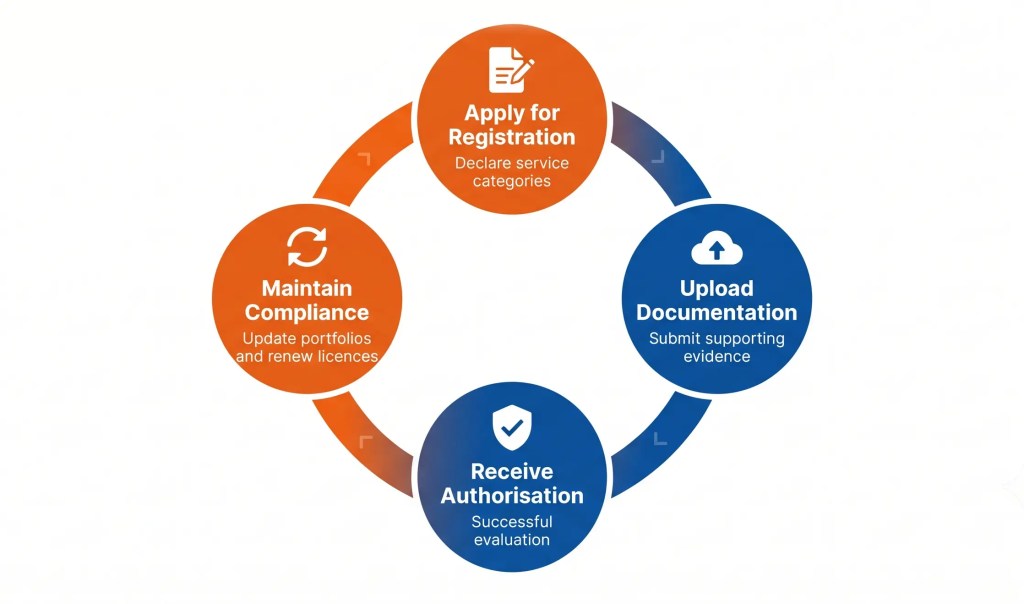
Haseen functions as the central point of interaction between the NCA and the cybersecurity industry. Organisations apply for registration through the platform, declare the categories of services they intend to offer, upload supporting documentation, and receive their authorisation status upon successful evaluation. The platform also supports ongoing compliance management, enabling registered providers to update their service portfolios, renew licences, and respond to regulatory enquiries within a structured digital environment.
Understanding how Haseen is structured is essential before beginning the registration process. The platform categorises cybersecurity services into defined groups, and an applicant’s eligibility in terms of required personnel qualifications, technical capabilities, and governance standards depends on the specific categories selected. Organisations that attempt to apply without first mapping their service offerings to the correct Haseen categories frequently encounter delays, incomplete evaluations, or the need to revise and resubmit their applications.
Practically, preparation for Haseen registration should begin well before the application is initiated. This means conducting an internal review of the services the organisation intends to offer, identifying the corresponding Haseen categories, and assessing the gap between current organisational capabilities and the requirements attached to those categories. CISOs and compliance officers within cybersecurity firms should treat this preparatory phase as a structured project with clear milestones, rather than an ad hoc administrative task.
Navigating the Saudi Cybersecurity Market as a Service Provider
Saudi Arabia’s investment in national cybersecurity infrastructure has grown considerably in line with Vision 2030. The government has prioritised the development of a robust domestic cybersecurity ecosystem while simultaneously welcoming qualified international providers who can contribute expertise and capacity. However, this openness is balanced by rigorous regulatory oversight. The NCA maintains clear authority over who may operate in the market, and operating without valid registration exposes organisations to significant legal and reputational risk.
For international cybersecurity consultancies considering Saudi Arabia as a growth market, the registration requirement has direct implications for business structure. Foreign entities cannot simply offer services remotely or through informal arrangements without regulatory standing. In most cases, establishing a legal entity within the Kingdom — whether a branch office, a wholly owned subsidiary, or a joint venture — is a prerequisite for registration eligibility. This requirement reflects the NCA’s commitment to ensuring accountability and local oversight of service providers operating in critical sectors.
Market Segmentation and Service Categories
The Saudi cybersecurity market encompasses a broad range of service types, from operational security monitoring and incident response to governance, risk and compliance (GRC) advisory and security awareness training. The NCA’s categorisation within Haseen reflects this diversity, and registered providers are authorised only within the specific service categories for which they have demonstrated competence. This segmentation has practical consequences: organisations wishing to expand their service offering after initial registration must apply for additional category authorisations, maintaining compliance as their business evolves.
NCA Licensing Requirements for Cybersecurity Consultancy in Saudi Arabia
The licensing requirements are neither superficial nor purely procedural. The NCA evaluates applicants across several substantive dimensions to ensure that registered providers are genuinely capable of delivering the services they declare. Personnel qualifications are among the most closely scrutinised elements: the NCA expects cybersecurity service providers to employ professionals holding recognised industry certifications such as CISSP, CISM, CEH, or equivalent credentials relevant to the services being offered. The number and seniority of qualified personnel required will vary depending on the scope and category of services being applied for.
Documentation is another area that demands careful attention. Applicants must submit organisational documents confirming legal registration in Saudi Arabia, in addition to service capability documentation that maps the organisation’s offerings to the Haseen categories selected. Internal policies, procedural frameworks, and evidence of quality management systems may also be required, depending on the service categories involved. Organisations that approach the documentation phase without a structured review process frequently find that gaps in internal governance rather than technical capability are the primary obstacle to approval.
Alignment with NCA Frameworks
A central expectation across all NCA licensing categories is that service providers have implemented and can demonstrate compliance with the NCA’s own regulatory frameworks. The Essential Cybersecurity Controls represent the baseline, but providers operating in higher-risk or more specialised categories may also need to demonstrate alignment with the Cloud Cybersecurity Controls (CCC), the Operational Technology Cybersecurity Controls (OTCC), or other domain-specific frameworks published by the Authority. This requirement is particularly relevant for cybersecurity consultancies advising clients in regulated sectors such as financial services, energy, or government sectors where the NCA’s oversight is most intensive.
Ongoing compliance obligations follow initial registration. Licensed providers are expected to maintain their qualifications, update their documentation as services evolve, and respond to periodic NCA reviews. Treating registration as a one-time event rather than a continuous compliance obligation is a common misconception and one that can result in licence suspension or non-renewal.
Key Business Considerations for Cybersecurity Service Providers
For organisations planning to serve Saudi government entities or critical national infrastructure operators, NCA registration is frequently a contractual requirement. Procurement processes in these sectors routinely specify that vendors must hold valid NCA authorisation, and without it, organisations are disqualified regardless of their technical merit. This reality makes registration not merely a compliance exercise but a business development prerequisite one that must be completed before meaningful pipeline development can begin.
The reputational dimension of NCA registration should not be underestimated. In a market where trust is paramount, holding valid NCA authorisation signals to prospective clients that an organisation has met a rigorous, government-validated standard. Conversely, the absence of registration or the discovery that a provider’s registration has lapsed can rapidly undermine client confidence and disrupt existing engagements. CISOs and procurement officers conducting vendor due diligence are increasingly treating NCA registration status as a baseline qualification filter.
Resourcing and Timeline Planning
Organisations entering the NCA registration process for the first time should approach it with realistic expectations regarding timelines. The process can extend over several weeks to several months, depending on the completeness of documentation, the responsiveness of the applicant to NCA queries, and the complexity of the service categories applied for. Building adequate lead time into market entry planning and assigning dedicated internal resource to manage the registration project significantly improves the probability of a smooth and timely outcome.
Engaging experienced regulatory advisory support is a practical consideration for organisations unfamiliar with Saudi regulatory processes. Advisors with established knowledge of the NCA’s expectations, Haseen’s functional requirements, and the documentation standards applied during evaluation can materially reduce the risk of delays caused by incomplete or non-compliant submissions. This is particularly relevant for international cybersecurity consultancies for whom the Saudi regulatory environment represents genuinely new terrain.
Conclusion
NCA cybersecurity service provider registration is a mandatory regulatory requirement administered by Saudi Arabia’s National Cybersecurity Authority, applicable to all organisations offering cybersecurity services commercially within the Kingdom. Registration is conducted through the Haseen platform and requires legal establishment in Saudi Arabia, qualified personnel, a defined service catalogue aligned to NCA categories and demonstrated compliance with frameworks including the Essential Cybersecurity Controls. Valid registration is a prerequisite for client engagement, government procurement, and sustainable market participation in the Saudi cybersecurity sector. If your organisation is preparing to enter the Saudi cybersecurity market or needs to review its current NCA registration status, ValueMentor is ready to support you. Our team has the regulatory expertise and regional experience to guide you through the Haseen registration process efficiently and accurately so you can focus on delivering value to your clients with confidence.
FAQs
It is a mandatory registration process administered by Saudi Arabia’s National Cybersecurity Authority (NCA) through the Haseen platform for entities providing cybersecurity services, products or solutions in the Kingdom.
2. Who needs to register with the NCA?
Any organisation providing cybersecurity services, products or solutions in Saudi Arabia must register. This includes cybersecurity consultancies, penetration testing firms, managed security providers and cybersecurity product vendors.
3. How long does NCA registration take?
The NCA specifies a service completion period of 20 working days, subject to receiving complete application information and any required clarifications.
4. What are the requirements for NCA registration?
Applicants must submit a registration request through Haseen. Supporting documents include a valid commercial registration, authorised representative details, ownership information, proof of national address and a website describing the cybersecurity offerings.
5. Is NCA registration mandatory?
Yes. Registration has been a regulatory requirement since 1 August 2022 for entities providing cybersecurity services to national organisations in Saudi Arabia. NCA has also reiterated the registration requirement for cybersecurity service, product and solution providers operating in the Kingdom.
6. Is NCA registration the same as NCA licensing?
No. Registration and licensing are separate processes. Registration records the provider with the NCA, while licensing grants authorisation for activities subject to specific licensing requirements, such as Managed Security Operations Centre (MSOC) services.
7. Is there a fee for NCA registration?
No. NCA cybersecurity service provider registration is free. Separate licensing processes may involve applicable fees.
8. Can foreign companies register with the NCA?
Foreign companies intending to provide cybersecurity services in Saudi Arabia must meet the applicable local establishment and regulatory requirements. The NCA’s investor guidance lists a valid Saudi commercial registration among the supporting documents.
9. Do registered providers need to update their registration details?
Yes. Registered providers must update their information when significant changes occur in their organisation or the cybersecurity services, products or solutions they offer.