
PCI DSS (Payment Card Industry Data Security Standard) is an essential set of security standards for any organization that deals with credit and debit card transactions, that accepts, processes, stores, or transmits card data. In the process of obtaining the PCI DSS certification, the first step for any organization is to determine its transaction volume to gain a clear understanding of its PCI level. After this, performing the gap analysis and risk assessment to detect security weaknesses is a crucial task. Once these steps are completed, organizations can obtain Attestation of Compliance (AOC) and a Report on Compliance (ROC) to confirm their compliance status. Ongoing compliance is maintained through continuous monitoring and regular security testing, both of which are vital to safeguarding cardholder data.
In this blog, let’s understand the roadmap for PCI DSS certification, what it takes, and how to get there.
Why PCI DSS Certification?
PCI DSS is a fundamental requirement for any business that handles cardholder data. It ensures that payment systems meet stringent security standards designed to protect customer information from potential data breaches and financial fraud. This certification acts as a sign of authenticity, which builds customer trust and brand reputation while assuring the essential requirements from leading card networks like Visa and Mastercard. Moreover, maintaining PCI DSS compliance helps organizations avoid penalties, fines, and operational disruptions associated with non-compliance. Being PCI DSS certified shows the strong commitment of the organization towards data protection and a safe environment for handling electronic payments with confidentiality and integrity.
Understanding PCI DSS Requirements
PCI DSS (Payment Card Industry Data Security Standard) defines 12 core requirements across six key areas to protect cardholder data. These include building secure networks, protecting stored data, managing vulnerabilities, enforcing strong access controls, continuously monitoring and testing systems, and maintaining a comprehensive security policy. Each requirement involves controls such as firewalls, encryption, antivirus maintenance, and regular system testing which helps to identify gaps, strengthen defenses, and ensure compliance with global payment security standards.
The PCI DSS Certification Process
The PCI DSS certification process follows clear steps. Let’s explore them in detail:
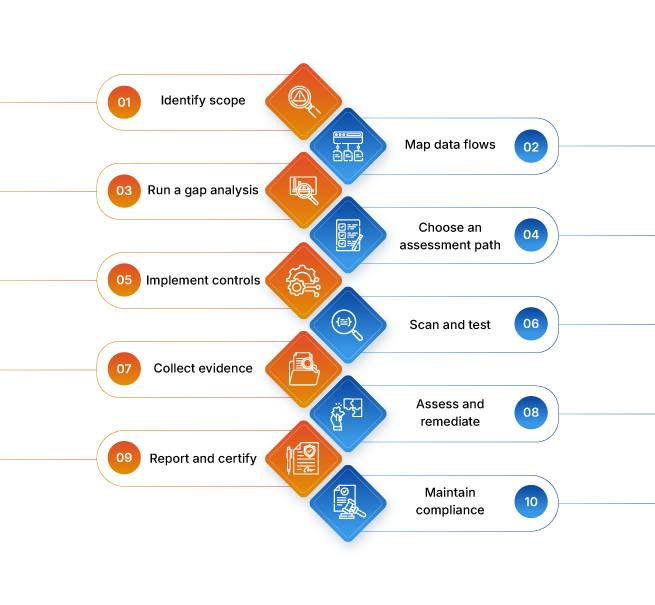
Step 1: Identify scope
List all systems, devices, applications, and third-party services involved in storing, processing, or transmitting cardholder data. Be sure to include POS systems, payment gateways, cloud platforms, and data backup locations.
Step 2: Map data flows
Create a clear visualization of how card data enters, moves through, and is stored within your environment. Use flow diagrams or spreadsheets to document every point of interaction.
Step 3: Run a gap analysis
Compare your existing controls with the PCI DSS requirements, use the appropriate SAQ form, or draft a scope for a QSA-led ROC.
Step 4: Choose an assessment path
Choose the right SAQ in case your environment is limited. You can hire a QSA for full environments as per the requirements of your acquirer.
Step 5: Implement controls
This step involves firewall installation, proper network segmentation, strong encryption, MFA, least privilege, logging, patch management, and endpoint protection etc.
Step 6: Scan and test
Schedule external ASV scans and authenticated Internal network VA every quarter. Perform network and application penetration testing at least once a year or whenever there is any major change.
Step 7: Collect evidence
Document all compliance activities, including security policies, configuration snapshots, scan results, access logs, and change management records. Maintain at least one year of logs, with the most recent three months readily accessible.
Step 8: Assess and remediate
Fix any failed controls and retest until all requirements are successfully met. Once compliance is achieved, complete the SAQ or have the QSA prepare the ROC.
Step 9: Report and certify
Submit the attestation and all required documents to the acquirer or card brand. If applicable, obtain the certificate of compliance.
Step 10: Maintain compliance
Continuously monitor and maintain your PCI DSS compliance through quarterly scans, reviews after major changes, and annual reassessments to ensure sustained card data protection.
Cost Breakdown and Timeline for PCI DSS Certification
The PCI DSS certification cost is determined by the size of the business, system complexity, and the type of assessment. For a small business, using SAQs may require spending between $1000 and $10,000 for the self-assessment and scans. Mid-sized firms working with a seasoned QSA may spend $15,000 to $50,000. Large enterprises with a highly complex card data environment can spend up to $100,000 or even more, which will include audits, tools, and remediation.
The timeline is usually from 3 to 6 months. This includes 2-4 weeks for scoping and gap analysis, 1-3 months spent on implementing and testing security controls, and 2-4 weeks will be required for the final QSA assessment and report submission. Timelines can change based on the system readiness and level of internal coordination. Regular maintenance and quarterly scans are essential to maintain compliance year-round.
PCI DSS Compliance Checklist and tips while working with a QSA
Here is the essential checklist for PCI DSS compliance and some important tips for working with QSA:
Checklist:
- Define the scope of your cardholder data environment.
- Identify all data flows and connected systems.
- Conduct a gap analysis against PCI DSS requirements.
- Implement network security controls, firewalls, and encryption.
- Restrict access using role-based permissions and MFA.
- Maintain up-to-date antivirus and patch management.
- Regularly test systems through vulnerability scans and penetration tests.
- Log and monitor all access to cardholder data.
- Create and maintain an information security policy.
- Document all procedures, controls, and changes.
- Complete the SAQ or QSA-led Report on Compliance (ROC).
- Submit attestation of compliance to your acquirer.
Tips for Working with a QSA:
- Choose a QSA with proven industry experience in your business type.
- Prepare detailed network diagrams, policies, and system inventories in advance.
- Be transparent about risks, legacy systems, and control gaps.
- Clarify timelines, deliverables, and remediation responsibilities early.
- Use the QSA’s feedback as guidance for long-term security improvement, not just certification.
Final Thoughts
In conclusion, PCI DSS ensures the secure handling of cardholder data in compliance with global security standards. The process involves defining scope, identifying gaps, implementing controls, performing scans and tests, and maintaining ongoing compliance. Costs can range from around $1,000 to over $100,000, depending on business size and system complexity, with timelines typically spanning 3 to 6 months. Utilizing a detailed checklist and partnering with a Qualified Security Assessor (QSA) helps streamline validation, remediation, and continuous data protection. With extensive industry experience and a skilled team of experts, ValueMentor stands as a trusted leader in delivering effective PCI DSS compliance solutions.
FAQS
1. What are the 4 levels of PCI DSS?
PCI DSS levels are based on annual transaction volume. Level 1 is over 6 million, Level 2 is 1-6 million, Level 3 is 20,000-1 million, and Level 4 is under 20,000 transactions.
2. How long is PCI DSS certification valid for?
PCI DSS certification is valid for one year. Businesses must renew it annually and maintain compliance through quarterly scans.
3. What happens if you fail PCI DSS?
You may face fines, higher transaction fees, loss of card processing rights, and reputational damage. Immediate remediation is required.
4. Do small businesses need to be PCI compliant?
Yes. Every business that processes, stores, or transmits card data must comply, regardless of size or transaction volume.
5. What 4 things does PCI DSS cover?
It covers network security, data protection, access control, and continuous monitoring and testing.
6. What happens if a merchant is not PCI DSS compliant?
Non-compliance can lead to penalties from $5,000 to $100,000 per month and possible termination of merchant accounts.
7. What are the 12 requirements of PCI DSS?
They include securing networks, protecting data, managing vulnerabilities, controlling access, monitoring systems, and maintaining security policies.
8. What is the difference between PCI and PCI DSS?
PCI is the Payment Card Industry, while PCI DSS is the specific data security standard created by PCI to protect cardholder information.
9. How do I know if my business is PCI DSS compliant?
You’ll receive an Attestation of Compliance (AOC) or Report on Compliance (ROC) after a successful assessment or self-assessment questionnaire (SAQ).
10. How to apply for PCI DSS certification?
Define your card data scope, complete a gap analysis, and implement required controls. Then, hire a Qualified Security Assessor (QSA) or complete the correct Self-Assessment Questionnaire (SAQ) to validate and submit compliance for certification.