Cyberattacks today aren’t waiting for your annual audit. They are probing APIs, exploiting SaaS misconfigurations, slipping through source code vulnerabilities, and targeting your cloud stack in ways automated scanners can’t keep up with. Yet, many businesses stumble by prioritizing cost over quality, selecting vendors who deliver one-size-fits-all reports with little context or remediation support. We have seen clients share past experiences where assessments were rushed, findings lacked technical depth, or there was no follow-up to validate fixes.
In this guide, we will walk you through the competencies, certifications and deliverables to look for in a penetration testing company. We will also explore how expert reporting, hands-on remediation guidance and ongoing support can drive real, measurable security outcomes for your organization not just checkboxes.
What to expect from a reliable penetration testing company?
Engaging a penetration testing company is a critical decision that directly impacts your organization’s security maturity. A credible provider offers more than vulnerability detection they deliver strategic insight, technical precision, and risk-aligned guidance. The following are key attributes you should expect from a competent and dependable testing partner.
1. Proven Competence Across Complex Environments
A reliable penetration testing company demonstrates extensive experience in assessing a wide range of digital environments. This includes modern web and mobile applications, APIs and microservices, cloud platforms such as AWS, Azure, and GCP, enterprise networks, and internal IT systems. Their scope often extends to Internet of Things (IoT) and operational technology (OT), reflecting the increasingly interconnected nature of modern business infrastructure. The depth of this experience enables them to simulate realistic attack scenarios and uncover vulnerabilities that less experienced providers may overlook.
2. Certified Professionals with Recognized Credentials
Beyond practical experience, trusted companies maintain high standards through certified professionals. These certifications validate both technical competence and ethical conduct-both of which are critical in sensitive security assessments. Look for credentials such as OSCP (Offensive Security Certified Professional), CEH (Certified Ethical Hacker), CISSP, or accreditations from CREST and SANS GIAC. These are not just badges they reflect the tester’s ability to think like an adversary while adhering to industry-accepted best practices.
3. Tailored Testing That Aligns with Your Risk Profile
One of the most important traits of a reliable testing partner is their ability to customize assessments based on your specific needs. A professional company doesn’t rely on generic templates or automated scripts. Instead, they take time to understand your business model, risk appetite, technology stack, compliance obligations, and operational realities. Based on this understanding, they craft a scoped engagement that reflects actual threat vectors relevant to your environment. The result is a more focused, meaningful test that prioritizes real-world risks over theoretical ones.
What to expect from a professional penetration testing report?
Understanding what a reputable penetration testing company delivers is essential to evaluating the effectiveness of the engagement. The right partner won’t just perform technical checks-they will provide comprehensive deliverables that translate findings into actionable outcomes. Below are the four core deliverables you should expect from a trusted provider.
1. Defined scope and rules of engagement
The first and most critical deliverable is a clearly documented scope and set of rules of engagement. This document outlines the testing objectives, systems in scope, authorized IP addresses, timelines, and escalation procedures. It establishes expectations and boundaries to ensure that testing is conducted safely without disrupting production systems. A well-defined scope also helps ensure that testing focuses on relevant assets and real-world risks.
2. Realistic attack simulation and exploitation
Once the scope is approved, the penetration testing team begins simulating attacks using a combination of manual and automated techniques. These may include reconnaissance, enumeration, exploitation of known vulnerabilities, injection attacks, broken authentication, insecure configurations, and-where permitted-privilege escalation or lateral movement. The objective is not to cause damage but to ethically demonstrate how an attacker could exploit weaknesses in your environment. This stage provides practical evidence of the risks your organization faces.
3. Comprehensive and business-aligned reporting
The final report is one of the most important deliverables, yet it’s often overlooked in terms of quality. A strong penetration testing report goes beyond technical findings and includes an executive summary, a detailed breakdown of each vulnerability, screenshots, proof-of-concept exploits, risk severity ratings, and remediation recommendations. It should also map each issue to frameworks such as OWASP Top 10, MITRE ATT&CK, or NIST. Most importantly, the report must be understandable to both technical teams and business stakeholders, providing clarity on what’s at risk and how to fix it.
4. Post-engagement remediation support
A professional penetration testing company doesn’t disappear after delivering the report. They provide support to help your teams interpret the findings, prioritize fixes based on risk, and implement appropriate remediation strategies. Many also offer a retest phase-validating whether identified vulnerabilities have been successfully closed. This additional step ensures your organization isn’t just aware of its weaknesses but is actively resolving them and improving its security posture.
Why ongoing security support matters after penetration testing?
A truly valuable penetration testing company doesn’t disappear after delivering a report. Instead, they support your growth through:
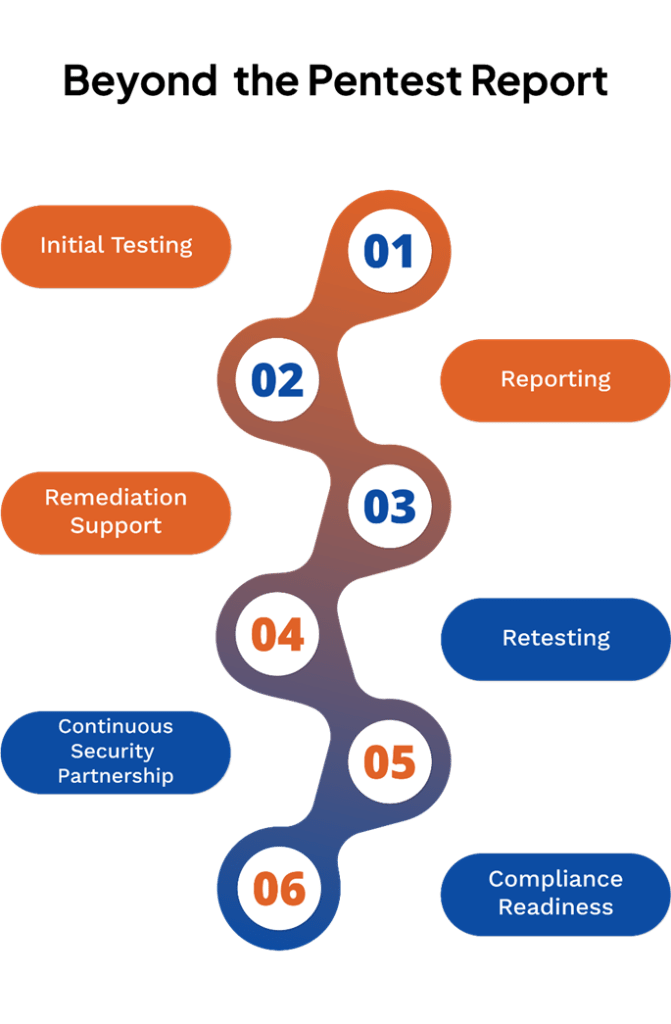
Continuous security partnership
Some businesses run tests annually or bi-annually. Others shift toward continuous security testing models that integrate testing throughout the development lifecycle.
Your security partner can offer:
- Periodic risk assessments
- Application security consulting
- DevSecOps integration
- Threat modeling workshops
Compliance and regulatory alignment
Whether you’re pursuing SOC 2, ISO 27001, PCI DSS, HIPAA or GDPR readiness a reputable partner aligns testing with your compliance goals and audit timelines.
How to spot a bad penetration testing vendor: Red flags to watch?
Not every provider is trustworthy. Be wary of companies that:
- Deliver generic, automated reports without context
- Don’t offer re-testing after remediation
- Lack clarity on scope and methodology
- Avoid documentation or legal agreements
- Can’t speak to business impact or risk alignment
Cybersecurity is not about ticking boxes it is about reducing real threats. Don’t settle for a company that can’t help you do that.
How to choose the right penetration testing company?
The selection of a penetration testing firm is a high-impact business decision. The right partner will go beyond technical checks to deliver strategic insights, operational alignment, and long-term risk reduction. Here’s a practical step-by-step guide to help you choose the right partner for your cybersecurity needs:
Step 1: Evaluate Industry Knowledge and Threat Intelligence
Not all threats are created equal and neither are industries. A reliable penetration testing company must understand the specific risks, compliance standards, and attack surfaces relevant to your sector. Whether you’re in finance, healthcare, e-commerce, or manufacturing, your threat landscape will differ. A firm with proven experience in your industry will be better equipped to simulate realistic attacks and offer insights that are both technically and contextually relevant.
Step 2: Verify certifications and real-world experience
Technical skills matter. Look for certifications like OSCP, eWPTX, GPEN or CREST— these prove foundational knowledge. But beyond credentials, ask about the team’s hands-on experience. Have they worked on large-scale enterprise systems? Are they familiar with cloud, APIs, or legacy systems? Real-world experience ensures that testers can adapt, think creatively, and uncover vulnerabilities that automated tools often miss.
Step 3: Check for customized, not cookie-cutter testing
Your infrastructure, applications, and workflows are unique so your penetration test should be too. Avoid companies that run the same test scripts for every client. The right provider will first understand your environment and objectives, then tailor their testing scope accordingly. This ensures a deeper assessment and reduces the risk of missing critical issues that wouldn’t show up in a one-size-fits-all scan.
Step 4: Understand their methodology and transparency
A professional testing company should be able to clearly explain their methodology-how they approach reconnaissance, exploitation, privilege escalation, and post-exploitation phases. Transparency is key. Ask whether they follow established frameworks like OWASP Testing Guide, NIST SP 800-115, or PTES. Understanding their process gives you confidence in the validity and ethical boundaries of the test.
Step 5: Assess reporting quality and business relevance
The value of a penetration test lies in its report. A high-quality report should not only highlight technical flaws but also explain the potential business impact, provide step-by-step remediation guidance, and help prioritize vulnerabilities based on risk. Executive summaries, visual risk scoring, and clear next steps make reports useful for both technical teams and decision-makers.
Step 6: Look for Post-Test Support and Retesting
Penetration testing shouldn’t end at delivery. The best companies offer post-engagement support, including debrief calls, remediation guidance, and optional retesting. Retesting is crucial-it verifies whether fixes are effective and confirms that vulnerabilities have been properly addressed. This support ensures your investment translates into real security improvement.
Step 7: Seek long-term partnership potential
Security isn’t a one-time job. Look for a company that wants to grow with you, not just send a report and walk away. Can they support continuous testing models? Will they help with threat modeling, DevSecOps integration, or compliance audits down the line? A long-term partner becomes a trusted advisor who helps evolve your security posture as your business grows.
Why businesses need a trusted penetration testing company?
Modern digital environments never sit still. New apps get deployed, systems integrate faster than ever, and infrastructure constantly shifts especially with the rise of cloud and agile development. In this kind of dynamic ecosystem, vulnerabilities aren’t occasional missteps they are inevitable byproducts of innovation. This is where a penetration testing company comes in not just to find flaws but to help you stay ahead of them.
Still, not every company will treat your systems with the care and context they deserve. Some run a few tools, export a generic PDF, and call it a day. Their reports may flag issues but fail to explain what those issues mean to your business. A true security partner takes a different path. They look beyond the checklist and think like an attacker. They don’t just test your defenses they pressure-test your assumptions. The difference? One leaves you with more questions than answers. The other leaves you better prepared.
Conclusion
A successful penetration test is measured not only by what it uncovers, but by the clarity it brings and the progress it enables. It’s about having confidence that risks have been thoroughly assessed that remediation is well-guided, and that your organization is better prepared for what is ahead. This kind of outcome is rarely achieved through a transactional approach. It requires a provider who brings both technical depth and business alignment, combining industry experience with a collaborative mindset. With a focus on helping clients meet regulatory demands, strengthen operational resilience, and build long-term security maturity, ValueMentor supports organizations across sectors with tailored penetration testing services and ongoing security advisory. As security challenges continue to evolve, choosing the right partner can make all the difference not just for your systems, but for your entire business.
FAQs
1. What does a penetration testing company actually do?
A penetration testing company simulates real-world cyberattacks to identify vulnerabilities in your systems be it web apps, APIs, cloud, or networks. They ethically exploit weaknesses to show how attackers might gain access and help you fix them before someone malicious does.
2. How do I know if a penetration testing company is trustworthy?
Look for companies with industry-recognized certifications (like OSCP, eWPTX, or CREST), proven experience in your sector, customized testing methodologies, and strong post-test support. ValueMentor is a CREST-certified provider with a proven global track record, offering specialized penetration testing aligned with PCI DSS, HIPAA, ISO 27001, and more.
3. Are all penetration tests the same?
Not at all. A good penetration test is tailored to your business needs, tech stack, and risk profile. While some firms may offer cookie-cutter scans, trusted partners design unique testing strategies that align with your actual threat landscape.
4. Why are certifications like OSCP or eWPTX2 important for penetration testers?
These certifications validate that testers have the hands-on skills and ethical mindset required for effective, responsible testing. They also ensure your provider follows global security best practices.
5. How often should I conduct penetration testing?
At a minimum, penetration testing should be conducted annually. However, if you regularly deploy new apps, move to the cloud compliance requirement is to conduct annually or after any change in the app or infrastructure.
6. What kind of report should I expect after a penetration test?
A quality report should include an executive summary, technical findings, risk ratings, mapped standards (like OWASP or MITRE ATT&CK), proof-of-concepts, and prioritized remediation steps. It should make sense to both technical teams and business leaders.
7. What’s the difference between automated vulnerability scanning and penetration testing?
Automated scans identify common vulnerabilities based on signatures. Penetration testing goes deeper-leveraging manual techniques, creative attack chains, and logic-based exploitation that automated tools often miss.
8. What is a “scope of engagement” in a pen test?
This document outlines what systems will be tested, how testing will be conducted, what’s off-limits, and who to contact in case of incidents. A clear scope ensures the test is safe, compliant, and aligned with your objectives.
9. Can penetration be testing help with compliance requirements?
Yes. Penetration testing is often a critical component for achieving compliance with standards like PCI DSS, ISO 27001, SOC 2, HIPAA, and GDPR. It demonstrates that your systems are tested against real-world threats.
10. Should I expect remediation support after the test?
Absolutely. A responsible penetration testing company won’t just hand over a repor-they’ll help you understand vulnerabilities, prioritize based on risk, and validate fixes through optional retesting.
11. What industries benefit most from penetration testing?
While all businesses benefit, industries like finance, healthcare, e-commerce, SaaS, and critical infrastructure face higher risk due to sensitive data and compliance mandates-making regular pen testing essential.
12. How do I differentiate between a good and bad penetration testing vendor?
Bad vendors deliver generic reports, avoid re-testing, and offer minimal business context. Good vendors provide tailored testing, strategic insight, clear documentation, and long-term support-not just a checklist. ValueMentor is a CREST accredited, DESC approved and holds Singapore penetration testing license ensuring trusted, compliant and regionally recognized penetration testing services.
13. How long does a typical penetration test take?
It depends on the complexity and scope. Small-scale tests may take a few days, while enterprise-level assessments across multiple systems can take weeks. Always ask your vendor for a time estimate based on your environment.
14. Is penetration testing risky for my live systems?
When done by professionals, penetration testing is controlled and minimally disruptive. A clear rules-of-engagement document ensures that testing is conducted ethically and safely, often in staging or during off-peak hours.
15. Can penetration testing be integrated into DevSecOps workflows?
Yes. Many modern security partners offer continuous testing services that integrate into your CI/CD pipelines. This helps catch vulnerabilities early in development rather than after deployment.