In the early days of a startup, speed, innovation, and customer acquisition take priority. Founders are focused on product development, validating their ideas and getting large amounts of customers to use their products. Data protection is an area that many new companies don’t give much thought to in the early days but need to because once they begin to sign up users, process payments, record employee data and analyze marketing data, they will find that they are handling personal data much sooner than they thought possible. This is why many new businesses are now finding that having a Virtual DPO for startups is a requirement, rather than an added cost. With data protection laws becoming stricter in places such as India (Digital Personal Data Protection Act – DPDPA) and continued growth of global awareness about privacy, startups are expected to take data protection very seriously from the start of their business operations. The hardest thing for a startup is knowing when compliance with international data protection laws becomes critical, and how to manage those requirements in the most cost-effective and efficient way.
This blog will explain when startups may require a DPO, the warning signs that will identify a need for a DPO and the advantages of using a virtual or outsourced DPO in order to achieve those business goals as quickly as possible.
What does a DPO do for a startup?
A Data Protection Officer (DPO) is responsible for overseeing how an organization collects, processes, stores, and protects personal data. In a startup environment, the DPO’s role is both strategic and operational.
For startup data protection, a DPO helps:
- Identify what personal data is being collected and why
- Ensure compliance with applicable data protection laws
- Design privacy policies, notices, and consent mechanisms
- Monitor internal processes and third-party vendors
- Act as a point of contact for regulators and data principals
Unlike large enterprises with dedicated legal and compliance teams, startups benefit from a DPO who can simplify regulations and translate them into practical, business-friendly actions.
Clear signs that indicate when startups need a DPO
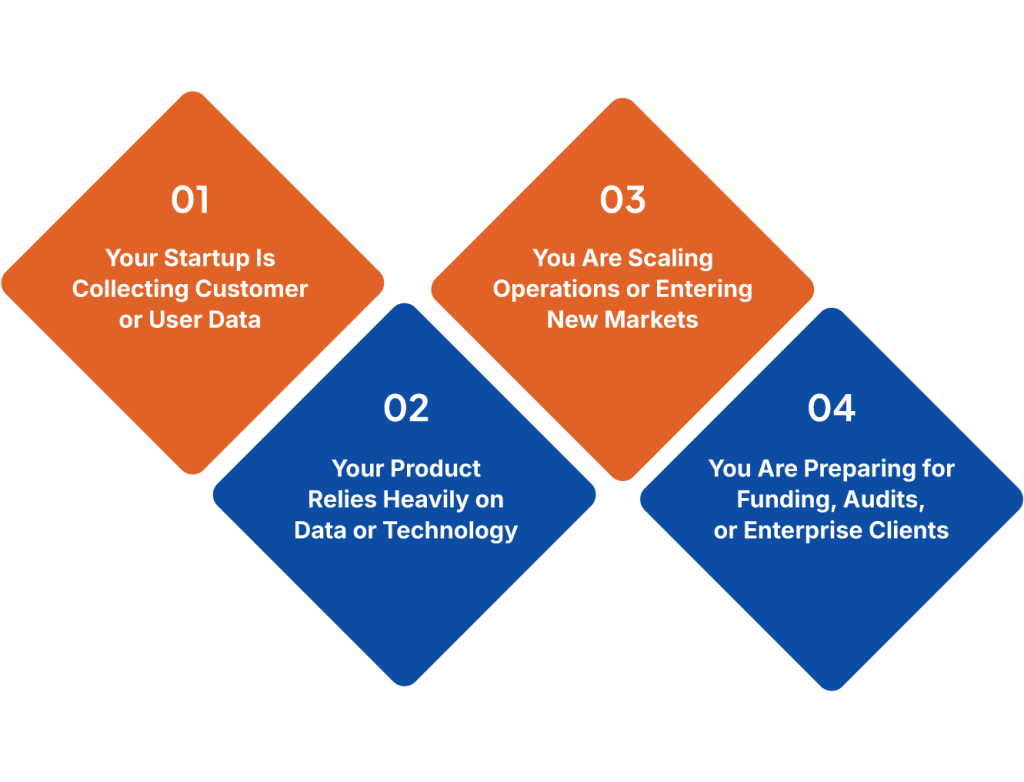
1. Your startup is collecting customer or user data
The moment your startup starts collecting names, email addresses, phone numbers, payment details, or behavioral data, compliance obligations begin. Many founders underestimate this stage, assuming compliance only applies to large companies.
In reality, this is often the earliest point when startups need a DPO-to ensure that data is collected lawfully, stored securely, and used only for defined purposes.
2. Your product relies heavily on data or technology
Business models that operate through SaaS, FinTech, HealthTech, EdTech, Artificial Intelligence, or e-commerce are inherently reliant on data. These sectors constantly process large amounts of personal and in some cases sensitive data. The use of a Virtual Data Privacy Officer is crucial to assisting start-ups in reducing the risks associated with continuing to do business in a data-centric manner, ensuring compliance with privacy-by-design principles, and helping to prevent compliance gaps and resulting penalties or reputational harm.
3. You are scaling operations or entering new markets
As startups expand into new regions or serve international customers, data protection requirements multiply. Serving users in India, the GCC, or Europe means aligning with multiple regulatory frameworks.
This is where startup compliance under DPDPA and other global laws becomes complex. A Virtual DPO provides centralized oversight, helping startups remain compliant without slowing down expansion.
4. You are preparing for funding, audits, or enterprise clients
Strong Data Governance Practices Are Required by Investors, Accelerators, and Business Customers More Than Ever; During Due Diligence if there are any Gaps with Privacy Will Delay or Possibly Ruin Deal Closing. Start-Ups that have outsourced or contract an external DPO for early-stage compliance will have improved indications of: Readiness, Less Risk, and Confidence by Stakeholders.
Virtual DPO vs consultant for startups: Understanding the difference
Startups often debate between hiring a compliance consultant or engaging a Virtual DPO. While both options offer expertise, their scope and value differ significantly.
| Aspect | Virtual DPO for Startups | Consultant for Startups |
|---|---|---|
| Engagement Model | Ongoing, long-term compliance partnership | Short-term or one-time engagement |
| Scope of Support | Continuous data protection oversight and guidance | Limited to specific tasks or assessments |
| Compliance Monitoring | Regular monitoring and reporting | No ongoing monitoring after delivery |
| Regulatory Updates | Proactively tracks and applies regulatory changes | Usually not responsible after project completion |
| Incident & Breach Support | Actively supports incident response and reporting | Limited or advisory support only |
| Interaction with Regulators | Acts as a point of contact when required | Typically does not engage with regulators |
| Accountability | Assigned responsibility for compliance management | No long-term accountability |
| Suitability for Startups | Ideal for growing and scaling startups | Best for isolated compliance needs |
| Cost Structure | Cost-effective monthly or flexible pricing | Project-based or hourly fees |
| Long-Term Value | Builds sustainable compliance frameworks | Focuses on immediate requirements |
Why virtual DPOs are ideal for early-stage startups?
Hiring a full-time, in-house DPO is often impractical for startups due to high costs and limited need for constant on-site presence. This is where a cost effective DPO for startups offers real value.
Key advantages include:
- Access to experienced data protection professionals
- Flexible engagement based on business size and risk
- Lower costs compared to full-time hiring
- Faster compliance implementation
- Ability to scale services as the startup grows
For startups focused on efficiency, a virtual model delivers expert compliance without straining budgets or resources.
The importance of early-stage compliance
Many startups delay compliance until a legal notice, client requirement, or regulatory mandate forces action. Unfortunately, this reactive approach often results in rushed implementations and higher long-term costs.
Adopting early-stage compliance helps startups:
- Build privacy into products from day one
- Avoid costly redesigns and rework
- Reduce legal and operational risks
- Establish trust with users and partners
An outsourced DPO for startups ensures that compliance evolves alongside the business rather than becoming an afterthought.
Understanding startup compliance under DPDPA
India’s Digital Personal Data Protection Act applies to organizations of all sizes, including startups. It introduces clear responsibilities around consent, data minimization, purpose limitation, and user rights.
A Virtual DPO for startups supports startup compliance under DPDPA by:
- Interpreting legal obligations in a practical manner
- Implementing consent and notice frameworks
- Managing data principal rights requests
- Preparing breach response and reporting processes
- Ensuring accountability across teams and vendors
This proactive approach helps startups avoid penalties while strengthening their data governance framework.
Conclusion
The decision of when to engage the services of a DPO can determine the future success of your startup. If you are collecting and processing large volumes of personal data; scaling quickly; operating in an industry that has specific regulations or compliance requirements; and/or are looking for investor confidence; this is a good time to begin considering outsourcing your DPO role to a Virtual DPO for Startups. By embracing an outsourced, scalable compliance solution, your startup will benefit from the oversight of a team of experts responsible for minimizing your compliance risk, maintaining alignment with compliance regulations without compromising speed and/or innovation, and using data protection as an enabler of business growth rather than a hurdle to overcome.
Your startup’s success depends on trust-and trust starts with data protection.
Choose ValueMentor as your Virtual DPO partner and ensure seamless compliance as you scale. With tailored guidance and a cost-effective approach, ValueMentor supports startups at every stage of their compliance journey. Talk to us today and build a privacy-first startup with confidence.
FAQS
1. What does a Virtual DPO do for startups?
A Virtual DPO provides remote, ongoing data protection and compliance support for startups.
2. When do startups need a DPO?
Startups need a DPO as soon as they begin collecting, processing, or scaling the use of personal data.
3. Is a DPO mandatory for all startups?
Not all startups are required by law to appoint a DPO, but many benefit from having one for risk management and compliance.
4. How is a Virtual DPO different from a consultant?
A Virtual DPO provides ongoing compliance support, while consultants usually offer one-time advisory services.
5. Why is early-stage compliance important for startups?
Early-stage compliance helps startups reduce future risks, avoid rework, and build privacy into products from day one.
6. How does a Virtual DPO help with DPDPA compliance?
A Virtual DPO helps startups interpret DPDPA requirements, implement controls, and manage user rights effectively.
7. Is an outsourced DPO for startups cost-effective?
Yes, an outsourced DPO offers expert compliance support at a lower cost than hiring a full-time DPO.
8. Can a Virtual DPO support audits and investor reviews?
Yes, a Virtual DPO prepares documentation and processes needed for audits and investor due diligence.
9. Which startups benefit most from a Virtual DPO?
Data-driven startups such as fintech, SaaS, healthtech, and e-commerce benefit the most.
10. When should startups partner with ValueMentor for Virtual DPO services?
Startups should partner with ValueMentor when they want scalable, proactive, and cost-effective data protection support.