When it comes to strengthening data protection strategy, many organizations struggle with one key question: Virtual DPO vs In-House DPO – which option is right for our business? As privacy regulations such as GDPR, DPDP Act (India), and other global frameworks become stricter, appointing a Data Protection Officer is no longer optional for many companies. The real challenge lies in making the right structural and financial decision.
Choosing between an outsourced and internal model impacts cost, compliance efficiency, scalability, and long-term governance. This blog offers a practical Virtual DPO vs in-house DPO comparison to help you evaluate risks, benefits, and business suitability before making a final DPO hiring decision.
Understanding the role of a DPO
Before comparing the outsourced vs internal DPO models, it’s important to understand what a DPO actually does. A Data Protection Officer plays a central role in ensuring regulatory compliance and fostering a privacy-first culture within an organization.
Core responsibilities typically include:
- Advising leadership on data protection obligations
- Monitoring compliance with applicable laws
- Conducting Data Protection Impact Assessments (DPIAs)
- Managing data breach response procedures
- Training employees on privacy practices
- Acting as the primary contact point for regulators
- Overseeing data subject rights requests
Depending on your industry and the volume of personal data processed, the DPO role can range from strategic advisory to operational oversight. This is why the DPO hiring decision must align with your risk profile and business goals.
Who is an In-House DPO?
An in-house DPO is a full-time employee embedded within the organization, often reporting to senior management. This individual is responsible for designing, implementing, and monitoring the company’s privacy framework.
Advantages of an In-House DPO
1. Deep Organizational Knowledge: An internal DPO develops a strong understanding of internal systems, workflows, products, and company culture. This helps identify privacy risks early and implement tailored solutions.
2. Immediate Accessibility: Being available full-time ensures quick internal consultations and faster response during audits or breach incidents.
3. Long-Term Strategic Integration: An in-house DPO can embed privacy into business strategy, procurement processes, product development, and vendor management. Over time, this strengthens internal compliance maturity.
Challenges of an In-House DPO
1. Higher Financial Commitment
A major factor in any DPO cost comparison is expense. The cost of hiring in-house DPO India includes:
- Annual salary
- Benefits and bonuses
- Certifications and training
- Compliance software tools
- Administrative and infrastructure costs
For startups and mid-sized companies, these fixed costs can be substantial.
2. Limited Cross-Industry Exposure
An internal DPO may have strong company knowledge but limited exposure to regulatory challenges across sectors.
3. Scalability Constraints
As business operations expand across jurisdictions, one internal DPO may not be enough leading to additional hiring costs.
Who is a virtual DPO?
A Virtual DPO (vDPO) is an outsourced professional or specialized firm that provides DPO services under a contractual arrangement. This outsourced vs internal DPO model is growing in popularity due to its flexibility and cost efficiency.
Advantages of a virtual DPO
1. Cost efficiency
In most DPO cost comparison analyses, virtual DPOs are significantly more affordable. Instead of fixed HR costs, businesses pay a predictable retainer or project-based fee.
This is particularly relevant when evaluating the cost of hiring in-house DPO India, where experienced professionals command competitive compensation packages.
2. Broad regulatory expertise
Virtual DPOs typically serve multiple clients, providing cross-industry insight and exposure to diverse compliance scenarios.
3. Scalability of virtual DPO model
The scalability of virtual DPO model allows companies to increase or reduce services as needed especially useful during audits, expansion, or funding rounds.
4. Greater independence
An outsourced DPO often maintains stronger regulatory independence, minimizing potential conflicts of interest within management structures.
Challenges of a virtual DPO
1. Limited On-Site presence: While highly accessible virtually, they may not always be physically present in the organization.
2. Shared client portfolio: Since virtual DPOs manage multiple clients, clearly defined service-level agreements are essential.
Virtual DPO vs In-House DPO comparison: Key decision factors
Below is a structured Virtual DPO vs in-house DPO comparison to simplify your evaluation:
| Key Factor | In-House DPO | Virtual DPO | Practical Insight |
|---|---|---|---|
| Cost structure | Fixed annual salary, benefits, training, and overhead costs. | Monthly retainer or contract-based pricing. | Virtual model typically reduces fixed HR burden in DPO cost comparison. |
| Initial investment | High recruitment and onboarding expense. | Low upfront commitment. | Important when reviewing the cost of hiring in-house DPO India. |
| Expertise exposure | Deep internal knowledge, limited cross-industry exposure. | Diverse regulatory experience across sectors. | Virtual DPOs often bring broader compliance insights. |
| Availability | Full-time internal presence. | Availability defined by SLA and engagement scope. | Clear expectations are critical in outsourced vs internal DPO contracts. |
| Scalability | Requires additional hiring as business grows. | Easily scalable service levels. | Demonstrates the scalability of virtual DPO model. |
| Regulatory independence | Possible internal conflict of interest. | Higher independence from management. | Beneficial where laws require objective oversight. |
| Business size fit | Best for large enterprises with complex operations. | Ideal for startups and growing SMEs. | Supports a more informed DPO hiring decision. |
| Strategic integration | Strong long-term cultural integration. | Advisory-focused with structured involvement. | In-house may be preferable for deeply embedded privacy strategy. |
Hybrid approach: A practical middle ground
Some organizations combine both models appointing an internal compliance manager while engaging a virtual DPO for strategic oversight.
In many Virtual DPO vs in-house DPO comparison discussions, this hybrid approach offers:
- Operational accessibility
- External expertise
- Cost control
- Regulatory independence
This model works particularly well for mid-sized companies transitioning toward enterprise-level governance.
Which DPO model is better for your business?
The answer to which DPO model is better depends on your company’s data processing volume, regulatory exposure, and growth trajectory.
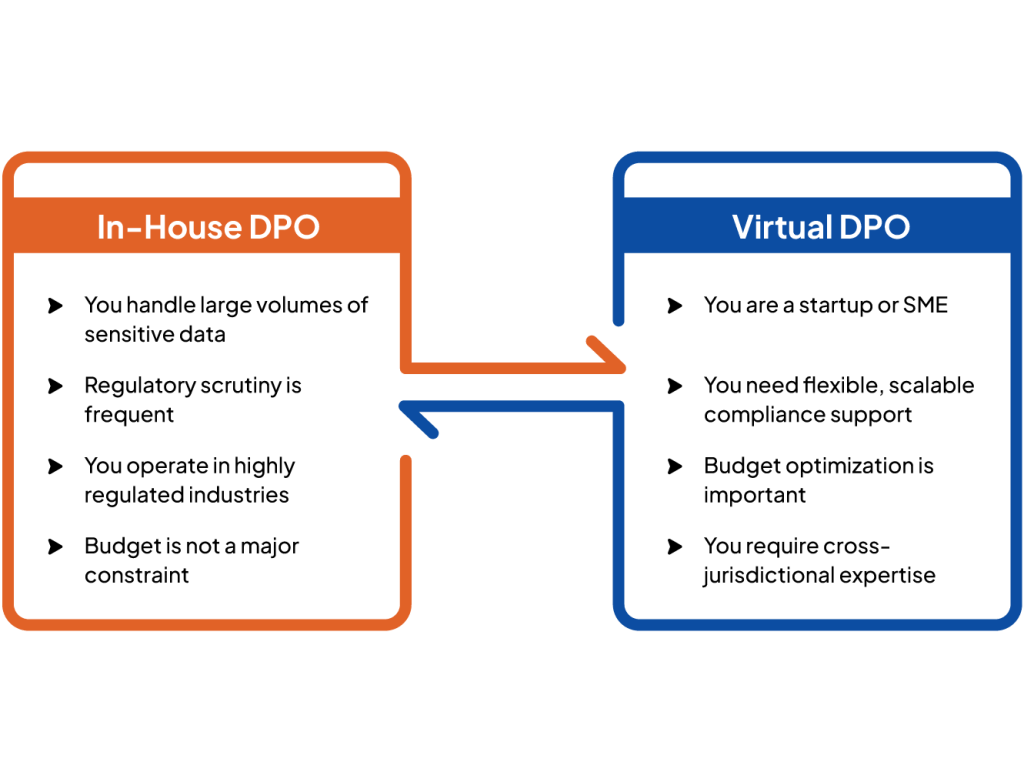
Choose an In-House DPO if:
- You handle large volumes of sensitive data
- Regulatory scrutiny is frequent
- You operate in highly regulated industries
- Budget is not a major constraint
Choose a Virtual DPO if:
- You are a startup or SME
- You need flexible, scalable compliance support
- Budget optimization is important
- You require cross-jurisdictional expertise
Your final DPO hiring decision should align with both compliance requirements and long-term business objectives.
Conclusion
The decision to choose either an Inside Data privacy officer (DPO) or Virtual DPO is not just about finding the best overall fit; it is more about finding what works best for your business needs. An Inside DPO can provide you with more direct involvement and oversight than a Virtual DPO, but they also provide more flexibility and scalability than an Inside DPO can offer. To determine the best overall choice on the basis of costs associated with hiring Inside DPO India, as well as whether any particular Inside DPO would assist you with supporting and protecting your company or whether you will receive added benefits from using a Virtual DPO model, will be greatly aided by giving both DPO models a thorough evaluation regarding your business’ operational complexity and future growth objectives. Ultimately, whichever model you decide to utilize will enhance the compliance framework already in place and protect your business from ever-changing laws and regulations.
Choosing between a virtual and internal DPO is a strategic move that can shape your organization’s compliance future. Let ValueMentor help you navigate the Virtual DPO vs In-House DPO decision with clarity and confidence. Our experts provide a tailored DPO cost comparison, evaluate the cost of hiring in-house DPO India, and assess the scalability of virtual DPO model based on your business goals. Connect with us today to make an informed, risk-aware, and future-ready DPO hiring decision.
FAQS
1. What is the main difference between a Virtual DPO and an In-House DPO?
A Virtual DPO is an outsourced privacy expert, while an In-House DPO is a full-time internal employee.
2. Is a virtual DPO legally valid?
Yes, most regulations allow organizations to appoint an external DPO if qualification and independence requirements are met.
3. Which option is more cost-effective?
In most DPO cost comparison cases, a virtual DPO is more budget-friendly than hiring internally.
4. What is the cost of hiring in-house DPO India?
It includes salary, benefits, compliance tools, and training-making it a significant long-term investment.
5. Who should choose a virtual DPO?
Startups, SMEs, and growing businesses often benefit from the scalability of virtual DPO model.
6. When is an in-house DPO preferable?
Large enterprises with complex or high-risk data processing may require a dedicated internal DPO.
7. How does scalability differ between the two models?
An in-house DPO requires team expansion to scale, while a virtual DPO service can adjust support levels easily.
8. Is independence better with an outsourced DPO?
Yes, outsourced vs internal DPO models often provide stronger regulatory independence.
9. Can companies switch from virtual to in-house later?
Yes, businesses can transition models as compliance needs and budgets evolve
10. How do I make the right DPO hiring decision?
Assess your risk exposure, budget, and growth plans before choosing which DPO model is better for your organization.