
The mistake most organizations make is treating quantum threat like climate change—real, but distant. It’s not. The window for migration is closing.
Here’s why urgency is justified. In November 2025, the UAE Cybersecurity Council announced the formal rollout of its National Encryption Policy. This is not advisory. Government entities must develop documented transition plans from traditional RSA and elliptic curve cryptography to post-quantum standards. Entities that wait until 2029 will face a supply-chain crunch: vendors racing to update products, token allocation delays, and auditors rejecting incomplete migrations.
Saudi Arabia moved first with regulatory teeth. The NCA issued draft AI Cybersecurity Guidelines that explicitly address quantum threat alongside agentic AI risks. The message: organizations deploying autonomous AI agents that process encrypted data must ensure both the AI system’s security AND the cryptographic resistance of data it handles or produces.
But there’s another angle that catches teams off guard: agentic AI. Sixty-nine percent of enterprises in the GCC have deployed AI agents that autonomously execute tasks. If the underlying cryptography breaks, attackers can forge agent commands, intercept communications, or replay historical transactions. Migration isn’t just about protecting stored data; it’s about securing tomorrow’s autonomous workflows.
The Regulatory Deadline
NIST finalized its first three post-quantum standards in August 2024. Most organizations have not yet started migration.
The effective deadline is 2030. That’s five years away. Subtract one year for vendor product updates, one year for pilot testing, one year for staff training, and you’re down to two years of actual migration runway. Organizations starting today will finish by 2030. Organizations that wait until 2028 will hit a wall.
Financial services are being pressured faster. Regulators in the GCC expect banking customers to be compliant with “cryptographically agile” systems by 2028. That means the ability to swap algorithms on demand without replacing entire infrastructure.
How Agentic AI Changes the Game?
Agentic AI systems introduce a new threat that traditional migration frameworks miss: autonomous systems that generate, consume, and rely on cryptographic operations.
An agent might sign financial transactions autonomously, encrypt API keys, generate digital signatures, or store encrypted conversation history. If the underlying cryptography is weak, attackers can forge agent-generated signatures, replay agent-signed commands, decrypt archived communications, or manipulate audit logs retroactively.
The catch: you can’t simply migrate agentic systems in a maintenance window. The agent’s behavior is tied to its operating environment. This is why both the UAE and Saudi Arabia now demand visibility into AI agent behavior AND cryptographic strength.
What’s Actually Holding Teams Back?
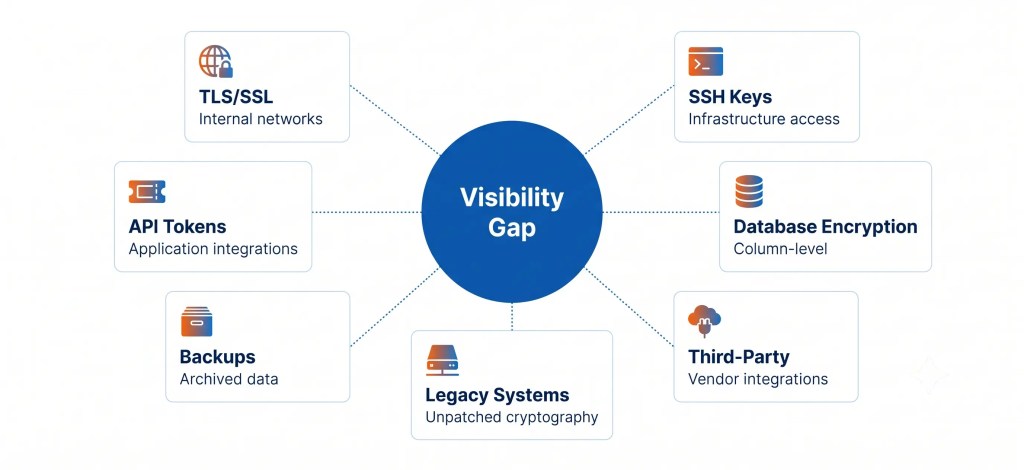
Most organizations don’t struggle with understanding quantum threat. They struggle with inventory and vendor coordination. Encryption hides in TLS/SSL on internal networks, SSH keys for infrastructure, API tokens, database column-level encryption, backups, legacy systems, and third-party integrations. You can’t migrate until you know where your cryptography lives.
Then you hit the vendor problem. Your payment processor says they’re “evaluating PQC” with no timeline. Your backup service has no roadmap. You’re blocked not by your own team’s capability but by vendors who haven’t prioritized quantum safety.
One mitigation emerging is cryptographic agility: abstracting the cryptographic algorithm behind an interface. When a vendor releases ML-KEM support, swapping it in is a configuration change, not a re-architecture. It’s more work upfront but saves months of chaos during migration.
The GCC Advantage
The GCC is not leading globally on quantum-threat preparation. But it’s ahead of most regions outside the US, Europe, and Australia.
Regulatory pressure comes early in centralized markets. The UAE’s National Encryption Policy and Saudi Arabia’s NCA guidelines set a unified target. That compliance cascades to vendors and integrators globally.
But this advantage disappears if you spend 2026–2027 debating whether quantum threat is real. Competitors who start migrations now will absorb talent and operational knowledge. By 2028, skilled teams will be booked solid.
FAQs
A: Quantum computers capable of breaking RSA-2048 are not theoretical—they’re engineering timelines. Experts forecast this between 2030 and 2045. NIST, the NSA, and security agencies in the GCC are not hedging: they’re publishing mandatory migration guidelines.
Q: I’m not in financial services. Why does this affect me?
A: The UAE PDPL and Saudi NCA guidelines apply to any organization processing personal data or operating critical systems. If your data has value for more than 10 years, it’s a target for harvest-now attacks.
Q: Can I just wait for vendors to push updates?
A: No. Vendors will prioritize large customers in 2026–2027. If you haven’t engaged vendors and negotiated timelines, you’ll discover migration is impossible when you finally need it. Start vendor conversations in 2026 to lock in timeline commitments.
Q: How do I know if my agentic AI system is quantum-safe?
A: It’s not, unless the underlying cryptographic libraries have been updated to use ML-KEM or ML-DSA. Most AI frameworks still default to RSA or elliptic curve cryptography. You must audit the cryptographic dependencies of your AI stack, not just the AI model itself.
Q: If I start migration now, won’t I need to do it again?
A: Unlikely. NIST spent 10 years vetting the current three standards. ML-KEM and ML-DSA are expected to remain standard for 20+ years. That’s why NIST published multiple standards—to hedge the risk of algorithmic flaw discovery.
Q: How much will migration cost?
A: A well-architected organization with crypto-agile design might spend 5–15% of security budget over 3–5 years. An organization with hardcoded cryptography might spend 30–50% or more. The earlier you start, the lower the cost.