
SAMA Circular 482021280 establishes a formal regulatory obligation for financial institutions in the Kingdom of Saudi Arabia to identify, assess, and begin remediating the risks that quantum computing poses to current cryptographic protections. This is not a speculative, future-facing advisory it is an active supervisory requirement with evidence expectations attached.
The broader context matters here. SAMA Quantum computing risks for financial institutions is advancing at a pace that regulators worldwide can no longer treat as a distant concern. Cryptographic algorithms underpinning online banking, payment systems, digital identity verification, and secure communications particularly those based on RSA and elliptic curve cryptography are considered vulnerable to sufficiently powerful quantum machines. For financial institutions, the implications are substantial. The confidentiality, integrity, and authenticity of transactions, customer data, and interbank communications could all be compromised if cryptographic defences are not modernised in time.
For CISOs and compliance officers operating within SAMA’s supervisory perimeter, Circular 482021280 represents a clear signal: quantum risk is now a governance matter, not merely a research interest. Understanding what the circular requires, what evidence it demands, and how to structure a credible compliance response is essential for any institution aiming to meet SAMA’s expectations — and for sustaining the trust of customers, counterparties, and regulators alike.
Understanding SAMA Circular 482021280
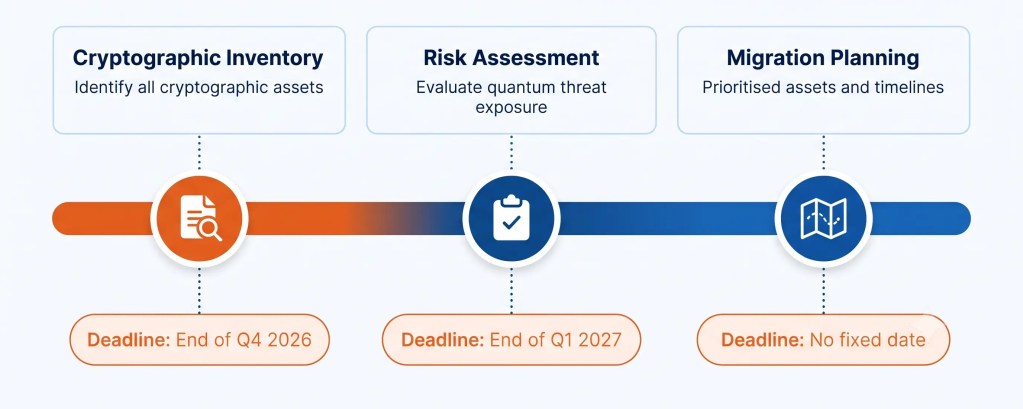
Issued by the Saudi Arabian Monetary Authority, Circular 482021280 positions quantum risk as an institutional governance responsibility rather than a technical curiosity. The circular places an obligation on financial institutions to understand their exposure, document it, and demonstrate to SAMA that they are taking proportionate and timely action. This is consistent with SAMA’s broader regulatory philosophy, which expects supervised entities to be proactive in identifying emerging risks rather than reactive once threats materialise.
What distinguishes this circular from general cybersecurity guidance is its specificity around cryptographic risk. SAMA is not asking institutions to prepare for quantum computing in the abstract. It is directing them to look at the actual cryptographic algorithms currently in use across their technology environment, evaluate whether those algorithms are quantum-vulnerable, and produce a credible plan to address identified gaps. For compliance officers, this means the work starts with an audit of what cryptographic tools are already deployed not with an abstract policy statement about future intentions.
The circular also signals that SAMA will expect evidence during supervisory engagements. Institutions that cannot demonstrate a completed cryptographic inventory, a documented risk assessment, or a governance-approved migration roadmap will be in a materially weaker position when inspectors review their quantum risk posture. Adherence to Circular 482021280, in practical terms, means building a paper trail that reflects genuine institutional effort not simply acknowledging the circular’s existence.
SAMA Quantum Computing Risk Requirements in Detail
SAMA Cryptographic Inventory
The cryptographic inventory is the foundational requirement from which everything else flows. Institutions must catalogue every system, application, protocol, and third-party integration that relies on cryptographic functions. This includes identifying the specific algorithms in use such as RSA, Diffie-Hellman, or elliptic curve variants their key lengths, certificate lifecycles, and the criticality of the systems they protect. Without this inventory, it is not possible to conduct a meaningful risk assessment, and SAMA’s supervisory reviewers will look for it as a baseline artefact.
Building a cryptographic inventory at scale is non-trivial. Many financial institutions have accumulated cryptographic dependencies across legacy systems, vendor-managed platforms, and third-party integrations that are not always visible to internal security teams. A thorough inventory exercise requires coordination between IT, information security, procurement, and business operations. It is also a living document algorithms and certificates change, new systems are onboarded, and the inventory must be maintained accordingly.
Risk Assessment Against Quantum Threat Scenarios
Once the inventory is complete, institutions must assess the risk each cryptographic asset presents in the context of quantum advancement. This involves evaluating which algorithms are considered quantum-vulnerable, the sensitivity and longevity of data they protect, and the realistic timeline to migrate away from them. The Harvest Now, Decrypt Later threat model is particularly relevant here: data encrypted today using RSA or ECC may already be at risk if adversaries are storing it for future decryption using quantum capabilities.
SAMA expects this assessment to be structured and documented. It should identify high-priority systems those protecting the most sensitive data or most critical functions and assign remediation timelines accordingly. Risk assessments must be signed off at an appropriate governance level, typically by the CISO or a designated risk committee, to demonstrate that quantum risk is embedded within the institution’s formal risk management framework.
Post-Quantum Migration Planning
The final component of SAMA’s requirements is a migration plan that maps the path from current quantum-vulnerable cryptography to post-quantum cryptography alternatives. NIST has made significant progress in standardising PQC algorithms, and SAMA’s circular expects institutions to align their migration planning with these emerging standards. The plan should include prioritised asset migration, vendor engagement timelines, testing schedules, and resource allocation all documented in a format that can be reviewed during a SAMA supervisory engagement.
SAMA Cryptographic Inventory: Why It Is the Compliance Foundation
A SAMA cryptographic inventory is not simply a list of SSL certificates or VPN configurations. It encompasses every point in an organisation’s technology architecture where cryptographic functions are performed data at rest, data in transit, authentication mechanisms, digital signatures, key management systems, and hardware security modules. For a mid-market financial institution, this can represent hundreds of discrete cryptographic touchpoints across multiple environments, including on-premises infrastructure, cloud platforms, and third-party-managed services.
Common Gaps in Cryptographic Inventory Exercises
In our experience working with financial institutions on regulatory compliance, the most frequently overlooked areas include application-layer cryptography embedded in legacy banking software, cryptographic functions within vendor-supplied APIs, and certificates managed outside of a centralised PKI. These gaps are not the result of negligence they are the natural consequence of technology environments that have evolved over years without centralised cryptographic governance. Circular 482021280 creates the regulatory impetus to address them systematically.
Institutions should approach the inventory exercise with a defined methodology, ideally supported by automated discovery tooling that can scan environments for cryptographic dependencies rather than relying solely on manual documentation. The output should be a structured register categorised by system criticality, algorithm type, key length, and expiry that is maintained under change management controls. This register becomes the primary evidence artefact for demonstrating compliance with SAMA’s inventory requirement.
This evidence of Cryptographic Bill of Materials directly support PCI DSS v4.0.1 requirement 12.3.3 which requires businesses to discover and document the cipher suites and protocols with the purpose and where used. Entities are also required to actively monitoring of industry trends regarding continued viability of all cryptographic cipher suites and protocols in use and documentation of a plan, to respond to anticipated changes in cryptographic vulnerabilities.
Quantum Computing Risks for Financial Institutions
The financial sector’s reliance on cryptography is pervasive and deeply embedded. Payment authorisation, interbank settlement, customer authentication, digital contracts, and regulatory reporting all depend on cryptographic protections that were designed to withstand classical computing attacks. Quantum computing does not simply make these protections weaker at sufficient scale it renders specific classes of algorithms entirely ineffective. This is a qualitative shift in the threat landscape, not merely an incremental one.
The Harvest Now, Decrypt Later Threat
The HNDL threat model is particularly acute for financial institutions. Sensitive data including transaction records, customer identity information, interbank communications, and contractual documentation is often subject to long-term confidentiality obligations. Adversaries with the capability and motivation to intercept encrypted data today, and the patience to wait for a CRQC to decrypt it, represent a credible threat to institutions that have not yet begun their quantum migration journey. This is not a theoretical risk; it is a scenario that intelligence agencies and financial regulators have explicitly acknowledged.
Third-Party and Supply Chain Cryptographic Exposure
Financial institutions rarely operate in cryptographic isolation. Core banking platforms, payment processors, cloud service providers, and regulatory reporting systems all introduce cryptographic dependencies that may not be under the institution’s direct control. SAMA’s circular implicitly extends to these dependencies: institutions must understand the quantum risk posture of the systems and vendors they rely on and engage those vendors on their own PQC migration timelines. This supply chain dimension adds complexity to the inventory and risk assessment process, but it is not optional third-party cryptographic exposure is part of the institution’s overall risk profile.
Resilience in the face of quantum computing risks in financial institutions requires institutions to treat this not as a one-time compliance exercise but as an ongoing risk management discipline. The cryptographic landscape will continue to evolve as NIST finalises PQC standards and as quantum hardware advances. Institutions that build durable governance structures around cryptographic risk management rather than treating Circular 482021280 as a checkbox exercise will be better positioned to adapt as the environment changes.
Conclusion
Looking ahead, the convergence of regulatory pressure and technological advancement will only accelerate. NIST’s post-quantum cryptography standards are maturing, and peer regulators across the GCC and globally are tracking SAMA’s approach with interest. Financial institutions that invest in cryptographic governance now establishing the internal capabilities, vendor relationships, and evidence structures that Circular 482021280 demands are not simply achieving compliance. They are building the cryptographic resilience that will underpin long-term operational integrity and customer trust in a quantum-influenced financial environment.
SAMA Circular 482021280 is a formal regulatory requirement from the Saudi Arabian Monetary Authority directing all supervised financial institutions to assess, document, and remediate quantum computing risks to their cryptographic infrastructure. Core obligations include the development of a comprehensive cryptographic inventory, a structured risk assessment covering quantum threat scenarios including Harvest Now, Decrypt Later attacks, and a post-quantum mia
Navigating SAMA Circular 482021280 requires more than policy acknowledgement it demands a structured compliance programme built on rigorous cryptographic inventory, documented risk assessment, and defensible migration planning. ValueMentor’s compliance specialists work alongside financial institutions as a trusted partner at every stage of that post quantum migration journey, from discovery through to supervisory evidence preparation. Visit us to learn how we can support your quantum reslience for financial institutions programme and help your organisation achieve the regulatory resilience SAMA expects.
FAQs
The end of the fourth quarter of 2026 for the procedures for identifying and classifying all cryptographic assets, and the end of the first quarter of 2027 for the enterprise quantum risk assessment. The plans for priority assets carry no date.
Is a cryptographic inventory required by 31 December 2026?
The circular requires accurate and comprehensive procedures for identifying and classifying all cryptographic assets by then. It does not use the word inventory. In practice, the output of a working procedure is an inventory, and it is the evidence a supervisor is most likely to ask for.
Who does the circular apply to?
“Financial institutions”. The text does not list types. Confirm applicability with SAMA’s Executive Department of Operational Resilience Control at CFC@SAMA.GOV.SA and keep the reply.
Do we have to submit anything to SAMA?
The text does not ask for a submission. Keep the procedure, the inventory output, the assessment and the plans ready in case of a supervisory request.
Must we migrate to post-quantum cryptography?
The circular asks for plans to reach the required level of cryptographic resilience or appropriate alternative solutions for priority assets. It sets no migration date and does not require migration for every asset.
What counts as a priority asset?
An asset classified as a priority for migration to quantum-resistant solutions, based on sensitivity and priority. The text gives no threshold, so define a rule, have it approved and apply it consistently.
Which committees must monitor quantum risk?
The Information Security Supervisory Committee and the Risk Committee emanating from the Board of Directors, where applicable. Challenges and recommendations go to the Board or its equivalent.
Does the circular name any algorithm or standard?
No. NIST’s FIPS 203, 204 and 205 are the most widely referenced post-quantum standards, but the circular does not mention them. Confirm algorithm expectations with SAMA and your vendors.
How should an institution that cannot finish by 31 December proceed?
State the coverage achieved, list the gaps, assign owners and dates to close them, and record the procedure as approved. Raise the position with your compliance function and, where appropriate, SAMA.
Does ValueMentor help with SAMA quantum circular readiness?
ValueMentor’s Quantum Business Resilience and Cyber Readiness Services include discovering cryptographic assets and help regulated entities plan quantum transition and comply with regulatory mandates to prepare a migration roadmap. The institution keeps ownership of its risk assessment, its definition of priority assets and its committee reporting.