
AI is increasingly integrated into hiring practices, lending decisions, healthcare services, marketing strategies, and customer service operations. Organizations are adopting these technologies rapidly, but the pace of innovation often outstrips the development of proper oversight and governance. Responsible AI compliance is therefore no longer optional it has become a critical business requirement.
The truth is simple: the cost of not addressing AI governance is increasing exponentially. From multi-million-dollar fines to stock value erosion and reputational damage, businesses are rapidly discovering that irresponsible AI is a threat to their very existence. This blog will discuss the financial, legal, and reputational impact of irresponsible AI oversight and why responsible investment is a sound business strategy.
Why are AI regulations becoming a serious business risk?
Governments around the world are making rules for Artificial Intelligence really fast. They are creating rules like the EU Artificial Intelligence Act and proposals for accountability in the United States. There are also rules for industries that companies have to follow. All of these rules are telling us one thing: companies have to be fair, open and honest about how they use Artificial Intelligence and they have to manage the risks.
If companies do not follow these rules, they will get in trouble. They might get fines for not following Artificial Intelligence rules. They might even have to stop selling some products. The government might also make them do audits, which means they have to show everything they are doing. People will find out about it, which can be really bad, for the company’s reputation. Artificial Intelligence rules are serious. Companies have to take them seriously. Regulators are focusing on:
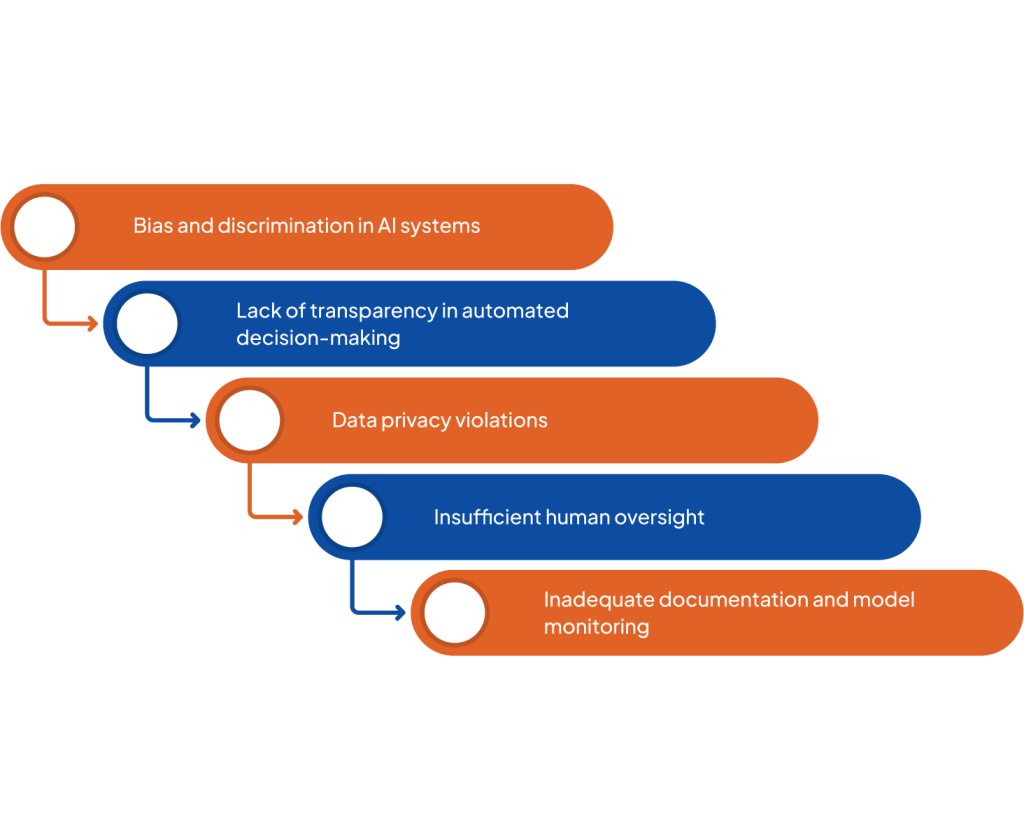
- Bias and discrimination in AI systems
- Lack of transparency in automated decision-making
- Data privacy violations
- Insufficient human oversight
- Inadequate documentation and model monitoring
The AI business risk is no longer hypothetical. Enforcement is accelerating.
Case Study 1: Algorithmic bias in hiring
Amazon and its experimental hiring AI
Several years ago, Amazon discontinued an internal AI recruiting tool after discovering that it showed bias against women. While the tool was never widely deployed, the public disclosure created reputational damage and raised serious questions about governance controls.
Business impact
Even without regulatory fines, the costs included:
- Significant internal R&D loss (millions invested in development)
- Reputational harm affecting employer brand perception
- Increased regulatory scrutiny on future AI initiatives
- Internal compliance overhaul and auditing costs
Had the tool been deployed at scale, the consequences could have included discrimination lawsuits, regulatory penalties, and long-term trust erosion. This illustrates a critical lesson: the business impact of irresponsible AI often begins before enforcement actions even occur. Brand perception and stakeholder confidence can erode quickly.
Case study 2: Facial recognition and privacy enforcement
Clearview AI and data privacy violations
Clearview AI faced multiple enforcement actions globally for scraping billions of images without consent. Regulators in Europe and other jurisdictions imposed heavy penalties and ordered data deletion.
Quantified consequences
- Millions in cumulative AI regulatory fines across jurisdictions
- Bans or restrictions in multiple countries
- Ongoing legal costs and appeals
- Severe reputational damage and public distrust
Beyond fines, the company faced operational constraints that limited market expansion. This demonstrates how AI compliance failures can restrict growth opportunities-a hidden but critical element of AI risk impact.
Case study 3: Lending algorithms and discrimination risk
Financial institutions have faced investigations when automated lending tools disproportionately affected minority applicants. Even when unintentional, algorithmic bias can trigger fair lending violations.
Potential financial exposure
- Regulatory fines reaching tens or hundreds of millions
- Mandatory customer remediation payments
- Costly third-party audits
- Increased capital reserves due to compliance risk
- Market capitalization declines following public enforcement
For large banks, compliance failures can materially affect quarterly earnings and stock prices. The cost of ignoring AI governance here extends beyond penalties-it influences investor confidence and valuation.
The hidden costs of poor AI governance
While fines make headlines, they are only part of the total exposure. The broader AI business risk includes:
1. Remediation and rebuild costs
Fixing a flawed AI system after public exposure is far more expensive than building responsibly from the start. Organizations often must:
- Suspend system operations
- Rebuild models from scratch
- Implement emergency oversight programs
- Hire compliance consultants
Remediation costs can exceed the original system investment.
2. Litigation and class-action exposure
When AI harms consumers through discrimination, misinformation, or faulty decisions class-action lawsuits follow. Legal defense costs alone can reach millions, even before settlements.
3. Lost customer trust
Trust, once lost, is difficult to rebuild. Surveys consistently show consumers are less likely to engage with companies perceived as misusing AI. Lost trust directly translates into reduced revenue, higher churn, and lower lifetime customer value.
4. Talent retention and recruitment challenges
Employees increasingly evaluate employers on ethical technology practices. AI scandals can reduce a company’s attractiveness to top-tier talent, particularly in technical fields.
How much does ignoring AI governance actually cost?
Consider a hypothetical mid-sized organization generating $500 million in annual revenue that deploys AI without structured compliance:
- Regulatory fine: $20 million
- Legal settlements: $10 million
- Remediation and consulting costs: $5 million
- 5% revenue loss due to reputational damage: $25 million
- Operational disruption and system rebuild: $8 million
Total potential exposure: $68 million.
By comparison, implementing proactive responsible AI compliance might require:
- Governance framework development: $1-2 million
- Ongoing monitoring and audits: $2-3 million annually
- Employee training and documentation systems: $500,000-$1 million
The ROI of responsible AI compliance becomes evident when prevention costs are a fraction of crisis recovery expenses.
1. Long-term strategic business consequences
However, the lack of AI governance does not just bring short-term financial discomfort; it can also affect long-term competitiveness.
2. Limited market access
Countries with robust AI regulations can restrict market access to non-compliant AI technologies.
3. Investor scrutiny
Investors with ESG criteria consider the ethics and risk controls of AI. Poor AI governance can increase funding costs or limit funding opportunities.
4. Competitive disadvantage
Businesses with advanced responsible AI compliance can accelerate AI adoption with regulator and customer trust. Governance is no longer an inhibitor but an accelerator.
Why proactive governance creates competitive advantage?
Responsible AI compliance is not merely about avoiding fines-it is about building sustainable AI advantage.
Proactive programs deliver:
- Early bias detection and mitigation
- Stronger documentation and explainability
- Reduced litigation risk
- Improved regulator relationships
- Higher customer trust
- Faster AI deployment approvals
When compliance is embedded into AI lifecycle management-from design to deployment to monitoring-the cost of ignoring AI governance becomes an avoidable scenario. Organizations that treat governance as an afterthought often pay exponentially more later.
How businesses can build a strong responsible AI compliance strategy?
To justify investment, leaders should quantify:
- Potential AI regulatory fines in their jurisdiction
- Sector-specific enforcement history
- Revenue exposure linked to AI-driven decisions
- Reputational risk modeling
- Cost of crisis remediation
By translating abstract AI business risk into concrete financial projections, boards and executives can understand the true AI risk impact. Governance should be viewed as risk mitigation plus brand enhancement not as a compliance tax.
Conclusion
Ignoring responsible AI compliance is a risk business can no longer afford to take. From algorithmic bias and privacy violations to regulatory fines and declining customer trust, the consequences of weak AI governance are growing every year. Organizations that embed governance, transparency, and accountability into their AI lifecycle are better positioned to innovate confidently while minimizing regulatory and operational risks.
Responsible AI is not a barrier to innovation; it is the foundation for safe and scalable AI adoption. Take the first step toward secure and compliant AI deployment. Schedule a Responsible AI risk assessment with ValueMentor today.
FAQS
1. What triggers AI regulatory investigations?
Lack of transparency, biased outcomes, privacy violations, or customer complaints can trigger regulatory scrutiny.
2. How does AI governance reduce legal risk?
It ensures proper documentation, fairness testing, and regulatory alignment, lowering the chance of lawsuits and penalties.
3. What types of AI systems are considered high-risk?
These are the types of systems used in hiring, lending, healthcare, law enforcement, and infrastructure.
4. How does AI compliance protect investors?
Governance structures minimize investors’ uncertainties, litigation risks, and stock price fluctuations resulting from AI system failures.
5. Can small businesses ignore AI compliance?
No. Even small businesses face the challenge of compliance whenever a failure occurs.
6. How does AI bias affect the top-line revenue?
Bias leads to the loss of customers, backlash, and ultimately the loss of customer lifetime value.
7. What remediation costs are associated with AI failures?
Remediation costs involve audits, redesigning the system, legal costs, regulatory reporting, and downtime.
8. How often should AI systems be audited?
AI systems should be audited frequently, although periodically based on regulatory requirements.
9. Does responsible AI slow innovation?
No. Structured governance actually enables safer and faster scaling of AI solutions.
10. What is the long-term business impact of irresponsible AI?
It can lead to sustained revenue decline, weakened brand trust, investor skepticism, and competitive disadvantages.