For software-as-a-service businesses, cloud service providers, fintech companies, and other companies dealing with customers’ information, the SOC 2 certification has turned out to be a vital process of earning trust and securing the contracts from potential clients. The latter require the company’s SOC 2 report to make sure that their information will be secure and managed following certain requirements.
At the same time, many organizations wonder about what type of SOC 2 report to start with: SOC 2 Type 1 vs Type 2. While both SOC 2 reports involve the application of the same Trust Services Criteria, they differ in their essence and level of guarantee. Let us discuss in our blog post how SOC 2 Type 1 and SOC 2 Type 2 differ from each other and which one is better to start with for your organization.
What is SOC 2 Type 1?
Type 1 SOC 2 is an audit which evaluates the suitability of controls on the security of an organization at a certain point in time.
In performing Type 1 SOC 2 Audit process, the main job of the auditor will be to investigate the controls of the organization and ascertain whether such controls comply with Trust Services Criteria. The SOC 2 report will answer the following question:
“Is there suitable control design at a certain point in time?”
SOC 2 Type 1 is an evaluation of design and suitability of controls rather than their operational effectiveness. The following scenario is an example of what will fall under this kind of SOC 2 report: Where the controls in question include access controls, incident response controls, encryption controls and security monitoring controls. This is much simpler and faster compared to SOC 2 Type 2 Audit.
What is SOC 2 Type 2?
Type SOC 2 Type 2 is an evaluation not only of control design, but control operating effectiveness within a defined period, usually lasting from three to twelve months.
The report seeks to answer the following critical questions:
- Are the controls properly designed?
- Have the controls operated effectively throughout the audit period?
In place of performing control testing for a particular date, auditors obtain information during a period of time to test the reliability of security operations. If a firm states that its access reviews are done every month, then the auditor checks whether the stated reviews were indeed made every month. Thus, SOC 2 Type 2 report offers better reassurance to customers, business partners, and interested parties compared to SOC 2 Type 1 report.
Key differences between Type 1 and Type 2
Understanding the difference between SOC 2 Type 1 and Type 2 is essential, as although both reports assess the same control framework, several important differences distinguish them. A SOC 2 audit comparison between Type 1 and Type 2 can help organizations better understand the scope, timing, and reporting requirements of each audit type before making a decision.
| Feature | SOC 2 Type 1 | SOC 2 Type 2 |
| Assessment Focus | Control design | Control design and operating effectiveness |
| Timeframe | Specific point in time | Period of 3–12 months |
| Audit Duration | Shorter | Longer |
| Level of Assurance | Moderate | High |
| Evidence Required | Policies and procedures | Policies, procedures, and operational evidence |
| Customer Confidence | Good | Stronger |
| Preparation Time | Less | More |
In simple terms, Type 1 confirms that controls exist, while Type 2 proves that those controls work consistently over time.
Which one should You Do First?
For most organizations that are new to SOC 2 compliance, starting with SOC 2 Type 1 is often the most practical approach to understanding and meeting SOC 2 compliance requirements.
A Type 1 audit allows companies to validate that their controls are properly designed before committing to a longer observation period required for Type 2.
Organizations commonly choose Type 1 first when:
- They are pursuing SOC 2 compliance for the first time.
- Their security program is still maturing.
- Customers require immediate evidence of compliance efforts.
This would help them to find and address control gaps prior to conducting the more comprehensive audit. However, some firms might opt to go straight into SOC 2 Type 2 audit where they have already been successfully running their controls for several months, and the request comes from the customers themselves. Understanding the different SOC 2 certification types can help organizations determine the most appropriate audit path based on their level of preparedness and compliance objectives.
Ultimately, it boils down to the objectives of the company and the requirements of its customers.
Benefits of Starting with Type 1
Beginning with a SOC 2 Type 1 audit offers several advantages, especially when used as part of a SOC 2 readiness assessment.
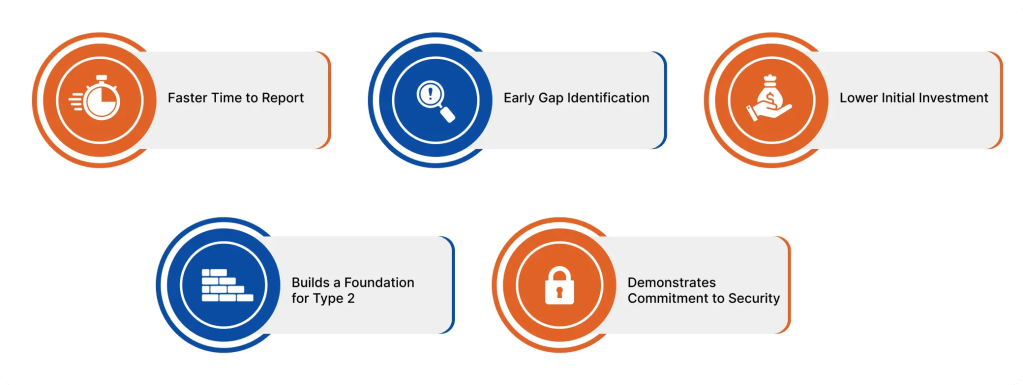
1. Faster Time to Report
Since the audit evaluates controls at a single point in time, organizations can obtain a report much faster than a Type 2 engagement.
2. Early Gap Identification
The audit helps uncover weaknesses in policies, procedures, and control design before a longer audit period begins.
3. Lower Initial Investment
Type 1 audits generally require less effort, documentation, and audit time, making them more affordable for organizations starting their compliance journey.
4. Builds a Foundation for Type 2
A successful Type 1 report provides confidence that controls are properly structured before measuring operational effectiveness over time.
5. Demonstrates Commitment to Security
Even though it offers less assurance than Type 2, a Type 1 report shows customers that the organization takes security and compliance seriously.
Benefits of Starting with Type 2
In some situations, organizations may benefit from going directly to SOC 2 Type 2.
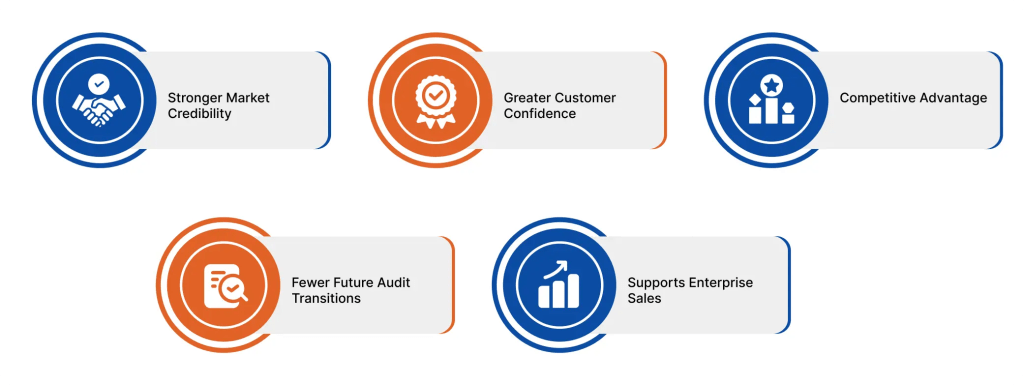
1. Stronger Market Credibility
Many enterprise customers view Type 2 as the gold standard because it demonstrates real-world control performance over time.
2. Greater Customer Confidence
A Type 2 report provides stronger evidence that security controls are consistently followed, reducing concerns during vendor assessments.
3. Competitive Advantage
Organizations with a Type 2 report often stand out during procurement processes and security reviews.
4. Fewer Future Audit Transitions
Skipping directly to Type 2 may eliminate the need for an additional Type 1 audit if the organization is already mature enough.
5. Supports Enterprise Sales
Large enterprises and regulated industries frequently prefer or require Type 2 reports from vendors handling sensitive information.
Conclusion
Both SOC 2 Type 1 and SOC 2 Type 2 are equally important milestones for compliance, yet there is some distinction between the two. Type 1 certification ensures that the control processes you have are designed correctly at a certain point in time, while Type 2 certification proves the effectiveness of such control processes throughout a longer period of time. For many businesses that start their SOC 2 certification journey, Type 1 certification might be a natural start because it can help create a compliance base and discover any deficiencies in order to prepare for a bigger audit. On the other hand, Type 2 certification is more suitable for mature businesses.
Being ready for SOC 2 certification may be tough without the necessary expertise. No matter if you decide on SOC 2 Type 1 certification or need to prepare for SOC 2 Type 2 audit, ValueMentor can assist you in becoming ready for SOC 2 and optimizing your processes. Reach out to our compliance specialists now and get the SOC 2 certification that is most suitable for you.
FAQ:
Yes. SOC 2 Type 1 evaluates controls at a specific point in time, while Type 2 assesses their effectiveness over several months.
2. Can I get a SOC 2 Type 2 report without a Type 1 report?
Yes. Organizations with mature controls can proceed directly to a SOC 2 Type 2 audit.
3. How long does a SOC 2 Type 1 audit take?
Most SOC 2 Type 1 audits can be completed within a few weeks, depending on readiness and scope.
4. How long is the observation period for SOC 2 Type 2?
The observation period typically ranges from 3 to 12 months, with 6 months being common.
5. Which SOC 2 report do customers prefer?
Most enterprise customers prefer SOC 2 Type 2 because it provides stronger assurance of ongoing control effectiveness.
6. Does SOC 2 Type 1 show compliance?
It proves proper design and operation of control but not its continued effectiveness over time.
7. Does SOC 2 Type 2 cost more than Type 1?
Yes, because SOC 2 Type 2 involves more testing, evidence gathering, and audit work.
8. Is it possible for a startup to do SOC 2 Type 2 right away?
Yes, if the startup has developed strong controls and evidence for them.
9. What comes after SOC 2 Type 1?
A company can continue to develop its controls and collect evidence before going for SOC 2 Type 2.
10. Does SOC 2 certification expire?
SOC 2 is not a certification, but reports are usually renewed annually to maintain customer confidence and compliance.