For many startups, the real test comes not during product launch but when the first enterprise customer or investor asks – “Do you have SOC 2 compliance?” In 2025, this question defines whether your company can access bigger markets. SOC 2 or System and Organization Controls is the gold standard for proving data security, availability and confidentiality. Without it, even strong technology can lose trust and deals. For founders, this moment marks the shift from building a product to building a secure, compliant organization where processes, controls and evidence matter as much as code.
What is SOC 2?
SOC 2 or System and Organization Controls. is a framework created by the American Institute of Certified Public Accountants (AICPA). It sets standards for how organizations should manage customer data, focusing on five areas called the Trust Services Criteria: security, availability, processing integrity, confidentiality and privacy. A SOC 2 report is produced after an independent audit and is widely recognized as proof that a service provider follows established practices for safeguarding information.
What is SOC 2 Compliance?
SOC 2 compliance means an organization has successfully undergone the audit process and demonstrated that its controls meet the COSO framework requirements. COSO provides the foundation for internal controls, and SOC 2 builds on it by applying the Trust Services Criteria, which focus on security, availability, processing integrity, confidentiality and privacy.
Depending on the scope of the audit, SOC 2 can result in either a Type I report, which confirms that controls exist at a specific point in time, or a Type II report, which validates that these controls were effective over a period such as 3, 6 or 12 months.
Trust Services Criteria Explained
The Trust Services Criteria (TSC) are the foundation of SOC 2. They define the specific areas an auditor evaluates to determine whether an organization is managing and protecting data properly. Each criterion addresses a distinct aspect of information security and system reliability:
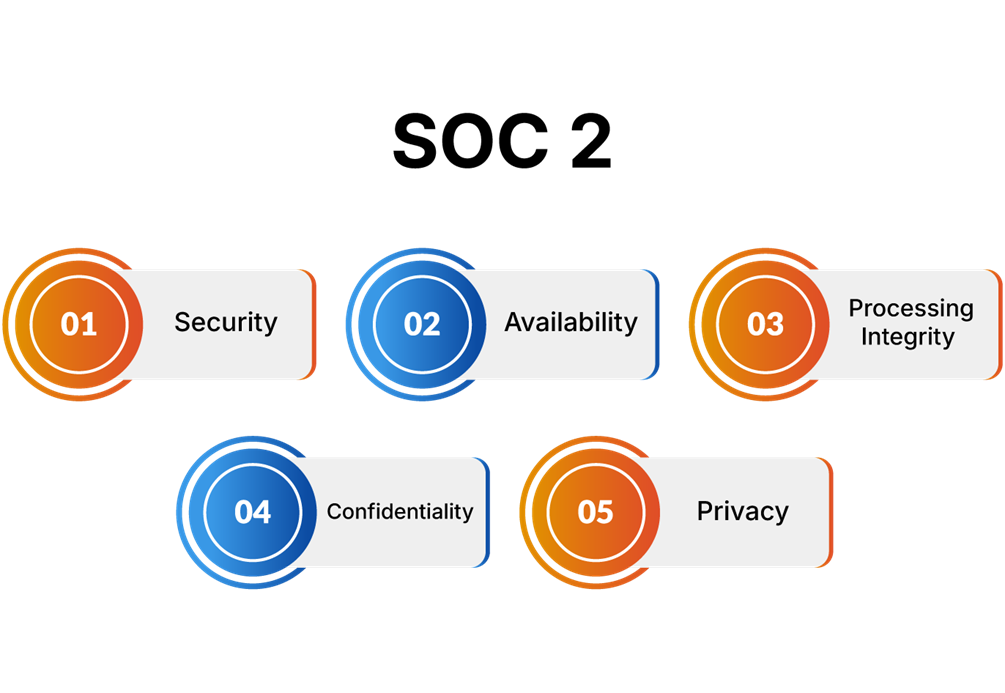
- Security – The baseline requirement for all SOC 2 audits. It ensures that systems are protected against unauthorized access, both physical and digital. Controls typically include identity and access management, firewalls, intrusion detection and security monitoring.
- Availability – Focuses on whether systems are accessible as committed in service agreements. This includes monitoring uptime, implementing redundancy, maintaining disaster recovery plans and ensuring resilience against outages.
- Processing Integrity – Confirms that system processing is complete, valid, accurate and timely. This is especially important for SaaS platforms, payment processors and data analytics providers, where errors in processing could disrupt customer trust or business operations.
- Confidentiality – Addresses how sensitive information such as intellectual property, financial data or business plans is secured. Controls involve encryption, access restrictions, secure file transfers and proper data disposal methods.
- Privacy – Evaluates how personal information is collected, used, retained, disclosed and disposed of in accordance with stated privacy policies and legal requirements. This aligns closely with data protection regulations such as GDPR or CCPA.
Not every SOC 2 audit covers all five criteria. Security is mandatory, while the others are included based on the services provided and customer requirements. For example, a SaaS platform may prioritize Security, Availability and Confidentiality, while a healthcare company handling personal data would also need Privacy.
What Does SOC 2 Stand for in Security Practice?
In practical security terms, SOC 2 stands for more than just “System and Organization Controls.” It represents a structured and independently validated approach to operational security within service organizations. Instead of vague claims of being “secure,” SOC 2 requires organizations to demonstrate that their controls are designed, implemented and continuously enforced in daily operations.
From a security practice standpoint, SOC 2 covers several critical areas:
- Access Control and Identity Management
- Ensures only authorized personnel can access systems and data.
- Auditors review user provisioning, role-based access, MFA enforcement and periodic access reviews.
- Change Management
- Confirms that all code and infrastructure changes follow documented procedures.
- This prevents unauthorized modifications and ensures traceability through version control, approvals and automated CI/CD pipelines.
- System Monitoring and Incident Response
- Requires continuous monitoring of systems for unauthorized activity.
- Organizations must define incident response plans, log collection, alerting mechanisms and evidence of past incident handling.
- Data Protection
- Applies encryption in transit (TLS, VPN) and at rest (AES-256, KMS).
- Includes secure key management, backups and policies for protecting sensitive and confidential data.
- Vendor and Third-Party Risk Management
- Evaluates how external services are assessed and monitored.
- Organizations must review vendor SOC 2 or ISO 27001 reports, define data-sharing agreements and maintain a supplier risk register.
- Policy Enforcement and Documentation
- Policies must not exist only on paper. Auditors look for technical evidence-such as logs, tickets and automated controls that prove policies are actively followed.
In essence, SOC 2 in security practice transforms high-level principles into measurable, testable controls. It shifts security from being subjective (“we think we are secure”) to being objective (“here is the evidence that we are secure”). This evidence-based approach is why enterprise buyers, regulators and investors increasingly treat SOC 2 as a baseline requirement in 2025.
SOC 2 Compliance Checklist
The SOC 2 checklist below breaks down the key areas of focus and the types of documentation or proof you will need to present during an audit:
| Area | Key Requirements | Example Evidence |
|---|---|---|
| Scope Definition | Define in-scope systems, services and data flows | System architecture diagrams, data flow maps |
| Policies & Procedures | Formal security, access, incident response, vendor policies and risk management policies | Policy documents with version history and employee sign offs |
| Access Control | Access control, MFA, periodic access reviews | Access control lists, MFA screenshots, approval logs |
| Change Management | Documented and approved code or system changes | Tickets from JIRA/GitHub, peer review records, CI/CD logs |
| System Monitoring | Centralized logging, alerts, incident response handling | SIEM dashboards, incident reports, root cause analysis |
| Data Protection | Encryption at rest and in transit, key management | Database encryption settings, TLS configuration, key rotation logs |
| Vendor Risk Management | Assess and monitor third-party providers | Vendor SOC 2/ISO reports, supplier risk register, vendor assessment forms |
| Business Continuity | Backup and disaster recovery plans with testing | Backup schedules, DR test results, uptime reports |
| Employee Training | Security and compliance awareness programs | Training attendance records, phishing test reports |
| Audit Readiness | Centralized evidence repository, readiness assessment | Evidence tracker, gap assessment reports, control owner assignments |
Building the SOC 2 Engine Inside Your Product Team
To pass, your product team must embed security, availability and confidentiality practices into everyday development workflows. This is less about paperwork and more about building an internal “SOC 2 engine” that consistently generates evidence and enforces controls without disrupting delivery speed.
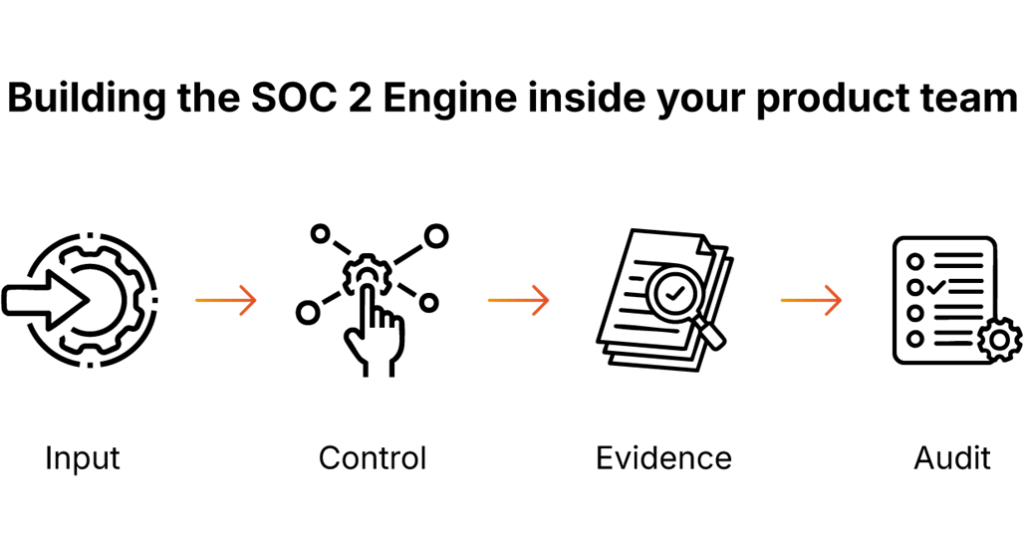
A well-structured SOC 2 engine inside a product team typically involves:
- Security by Design
Product architecture should reflect SOC 2’s Trust Services Criteria. This includes designing secure authentication, encrypted data flows and clear segregation of environments (dev, staging, production). - Automated Evidence Collection
Relying on manual screenshots or spreadsheets will not scale. Integrating compliance automation tools with version control, CI/CD pipelines and infrastructure monitoring ensures audit trails are continuously collected. - Change Management Integration
Every code commit, infrastructure update or configuration change should automatically generate logs tied to approval workflows. This aligns with SOC 2’s requirements for traceability and accountability. - Access and Identity Controls
Access control must be strictly enforced across repositories, cloud resources and SaaS tools. Integrating with SSO and enforcing MFA reduces gaps that auditor’s flag as high risk. - Continuous Monitoring and Alerting
Real-time logging and anomaly detection tools (e.g., SIEMs) should feed into the compliance stack. SOC 2 requires evidence that security events are not only logged but also actively reviewed and escalated. - Audit-Ready Documentation
Technical controls must map to clear policies and procedures. Embedding documentation within the development lifecycle such as ADRs (Architecture Decision Records) which ensures that auditors can trace intent to implementation.
By operationalizing these elements, your product team transforms SOC 2 from a one-off project into a repeatable process. Instead of scrambling before every audit, you create a compliance culture where security and delivery run in parallel.
Audit Journey from First Call to Final Report
The SOC 2 audit journey is a structured process that validates how an organization implements and enforces the Trust Services Criteria. It begins long before the auditor reviews controls and ends with a formal attestation report that clients and partners rely on. Each stage demands technical rigor and disciplined coordination between product, security and compliance teams.
1. Scoping and Readiness Call
The process starts with a scoping call between the organization and the audit firm. Here, the system boundary is defined-covering infrastructure, SaaS applications, third-party integrations and business processes. The auditor also determines whether the engagement is Type I (point-in-time) or Type II (operational effectiveness over a monitoring period, typically 3-12 months). At this stage, gaps are identified through a readiness assessment.
2. Control Mapping and Evidence Preparation
The internal team maps SOC 2 Trust Services Criteria to existing technical and operational controls. For example, change management is linked to Git-based workflows and logical access is tied to IAM policies. Evidence collection is automated wherever possible using compliance platforms that integrate with CI/CD pipelines, cloud environments and monitoring tools.
3. Fieldwork and Testing
During fieldwork, auditors test the design and operating effectiveness of controls. For Type II, they sample transactions and logs over the defined review window. Examples include verifying Information Security training records, role-based training records patch history. Evidence must be consistent, timestamped and traceable.
4. Auditor Review and Clarifications
Auditors validate the submitted evidence and may request clarifications. This step often requires close collaboration between engineering and compliance teams to provide deeper technical documentation, such as architecture diagrams, API security configurations or vulnerability management reports.
5. Draft Report Preparation
Once testing is complete, the auditor prepares a draft SOC 2 report. This includes the auditor’s opinion, system description, controls tested and exceptions found. The internal team reviews the draft for accuracy, ensuring the system description reflects the actual environment and no confidential details are inadvertently disclosed.
6. Final Report Issuance
The final attestation report is delivered, carrying the auditor’s formal opinion on whether controls meet SOC 2 criteria. A “clean” opinion signals strong operational maturity, while exceptions indicate areas for remediation. This report becomes a critical asset in vendor due diligence processes, enterprise sales and contractual negotiations.
Tools and Automation That Save Time
Achieving and maintaining SOC 2 compliance is a resource-intensive process if handled manually. Automation reduces audit fatigue, eliminates human error and provides continuous visibility into control effectiveness. The following categories of tools play a crucial role in streamlining the compliance lifecycle:
1. Continuous Control Monitoring (CCM) Platforms
Platforms such as Data, Vanta and Secure frame automate evidence collection by connecting directly to cloud environments, IAM systems, ticketing tools and code repositories. They continuously validate configurations against SOC 2 requirements-such as encryption at rest, MFA enforcement and least-privilege access-removing the need for one-off, screenshot-based evidence.
2. Identity and Access Management (IAM) Integrations
Automation in IAM reduces manual provisioning and audit exceptions. Tools like Okta, Azure AD and AWS IAM provide system-generated reports showing user access, role assignments and session logs. Automated de-provisioning workflows ensure access is revoked immediately when employees leave or roles change, a key SOC 2 requirement.
3. Change Management and CI/CD Pipelines
Audit evidence around change approvals can be automated through integrations with GitHub, GitLab or Jira. CI/CD pipelines enforce code review policies, test coverage and security scans before deployment. This eliminates manual change tracking and ensures every deployment has an immutable audit trail.
4. Security Information and Event Management (SIEM)
SIEM platforms such as Splunk, Sumo Logic and Elastic provide automated log ingestion, correlation and alerting. For SOC 2, this ensures continuous monitoring of anomalous activity, alert coverage validation and proof that security incidents are detected and escalated within defined SLAs.
5. Cloud Security Posture Management (CSPM)
Tools like Prisma Cloud or AWS Security Hub automate compliance posture checks across multi-cloud environments. They identify misconfigurations-unencrypted storage, open ports, non-rotated keys-before they become findings in an audit. Automated remediation scripts further reduce manual workload.
6. Ticketing and Evidence Workflow Automation
Ticketing systems such as Jira or ServiceNow can be integrated with compliance platforms to automatically generate and close evidence tickets. For example, a vulnerability scan result can automatically create a remediation task, link it to a sprint and provide closure evidence to auditors once resolved.
7. Policy and Documentation Management
Automation extends to policy versioning and attestations. Platforms can enforce automated reminders for annual reviews, employee acknowledgments and secure distribution, ensuring auditors see traceable policy governance without manual tracking.
Common Mistakes and How to Avoid Them
SOC 2 compliance failures often stem not from a lack of intent but from structural or operational missteps during implementation. Understanding these pitfalls and applying corrective practices ensures smoother audits and more resilient security operations.
1. Treating SOC 2 as a One-Time Project
- Mistake: Many organizations approach SOC 2 as a checklist activity to be completed once for client demands. This results in temporary fixes and controls that degrade over time.
- How to Avoid: Implement SOC 2 as a continuous governance program. Use Continuous Control Monitoring (CCM) platforms to validate controls year-round. Establish quarterly internal reviews to catch drift in security posture before the next audit cycle.
2. Incomplete Scope Definition
- Mistake: Over-scoping by including non-critical systems increases cost and audit complexity, while under-scoping leaves critical assets unprotected.
- How to Avoid: Conduct a system boundary analysis. Define which cloud services, SaaS platforms and data flows handle customer data. Use data mapping tools to ensure the defined scope aligns precisely with Trust Services Criteria (TSC) requirements.
3. Manual Evidence Collection
- Mistake: Teams waste weeks gathering screenshots, logs and spreadsheets, which often results in outdated or inconsistent evidence.
- How to Avoid: Automate evidence gathering with integrations to IAM, CI/CD, SIEM and ticketing platforms. This ensures auditors receive timestamped, immutable evidence tied directly to system configurations and workflows.
4. Neglecting Vendor Management Controls
- Mistake: Third-party risks are overlooked, especially when using SaaS services without vendor SOC 2 reports or security attestations.
- How to Avoid: Maintain a vendor risk management program. Collect SOC 2 or ISO 27001 reports from critical providers, review them for exceptions and document risk acceptance or remediation steps.
5. Weak Incident Response Testing
- Mistake: Organizations document an incident response plan but rarely test it, leading to confusion during actual incidents.
- How to Avoid: Conduct tabletop exercises and simulated attack drills. Document detection, escalation and communication timelines. Provide auditors with logs of testing outcomes to prove operational readiness.
6. Ignoring Change Management Controls
- Mistake: Code changes pushed directly into production without peer review or approval trails lead to audit exceptions.
- How to Avoid: Enforce change approval workflows in GitHub, GitLab or Jira. Require pull request reviews, automated test coverage and deployment logs. These artifacts serve as automated audit evidence.
7. Lack of Employee Security Training Evidence
- Mistake: Teams may run training but fail to record completion metrics, leaving gaps in audit evidence.
- How to Avoid: Use Learning Management Systems (LMS) that track participation, send reminders and generate compliance reports auditors can verify.
8. Overlooking Data Retention and Disposal Policies
- Mistake: Retaining customer data indefinitely increases exposure risk and fails SOC 2 privacy requirements.
- How to Avoid: Define clear data lifecycle policies. Implement automated data deletion scripts and document periodic data retention reviews.
Conclusion
SOC 2 compliance is a disciplined audit exercise that validates how effectively an organization has implemented and maintained controls aligned with the Trust Services Criteria. Achieving it requires well-defined scope boundaries, rigorous evidence collection, automation to reduce audit overhead and continuous integration of security practices within the product team. Treating SOC 2 as a repeatable audit lifecycle rather than a single engagement builds lasting control maturity and ensures smooth re-attestation. To prepare efficiently and demonstrate audit readiness with confidence, partner with ValueMentor’s SOC 2 experts, who provide end-to-end guidance from readiness assessments to final auditor sign-off.
FAQs
1. What is the difference between SOC 2 Type I and Type II reports?
A SOC 2 Type I report evaluates whether security controls are properly designed at a specific point in time, while SOC 2 Type II assesses the operating effectiveness of those controls over a defined observation period (usually 6-12 months).
2. How long does it usually take to achieve SOC 2 compliance?
The timeline depends on an organization’s control maturity. A Type I audit can be completed in 2-3 months, while Type II typically requires 6-12 months of control monitoring before the audit period ends.
3. What are the Trust Services Criteria (TSC) used in SOC 2?
The TSC consists of five categories: Security, Availability, Processing Integrity, Confidentiality and Privacy. Every SOC 2 report must include Security, while the others are optional based on business needs.
4. Is SOC 2 compliance mandatory by law?
SOC 2 is not a regulatory mandate but a voluntary attestation. However, many enterprises require SOC 2 compliance from vendors as part of their procurement and risk management process.
5. Who issues a SOC 2 report?
Only licensed CPA firms or accredited audit organizations registered with the AICPA are authorized to conduct SOC 2 audits and issue reports.
6. What kind of evidence is typically required during a SOC 2 audit?
Evidence includes access logs, change management records, encryption policies, vulnerability scans, incident response documentation and HR onboarding/offboarding procedures, depending on the selected TSCs.
7. How much does a SOC 2 audit typically cost?
Costs vary widely based on company size, scope and readiness. A Type I audit for a startup can start at $15,000–$25,000, while a full Type II engagement for a larger enterprise may exceed $50,000.
8. Can automation tools replace manual audit preparation?
Automation platforms streamline evidence collection, policy tracking and monitoring, but human oversight is still required to validate control effectiveness and ensure proper interpretation of auditor requests.
9. How often should SOC 2 audits be performed?
Most organizations undergo a SOC 2 Type II audit annually to maintain continuous assurance for customers and stakeholders.
10. What happens if an organization fails a SOC 2 audit?
SOC 2 reports do not use pass/fail language. Instead, they disclose exceptions and gaps. However, significant deficiencies can undermine customer trust and require remediation before re-attestation.