The growing use of AI applications beyond Formal IT and security governance continues to drive rising costs for businesses and organisations. To many user’s consumer solutions may appear benign and beneficial; they also have the potential to expose confidential, sensitive data, compromise the security of the AI itself, and subject the business to substantial risk. Increasingly, users on many teams are using AI to assist them in tasks such as writing emails, analyzing data or even writing code, with little awareness of the data being utilized in the process, or how their businesses are impacted.
Shadow AI is any type of artificial intelligence system or application that is being used by an employee, department or group in an organization that has not been reviewed and approved by formal IT or security controls. Examples of shadow AI include public chatbots, browser extensions, user-friendly design tools and coding assistants. This blog will define shadow AI and the reasons that have contributed to its rapid proliferation, as well as the primary risks to data privacy, intellectual property, and compliance that shadow AI creates, and how companies can implement strong AI governance, sufficient security controls, and employee education to control shadow AI within their organizations.
What Is Shadow AI and Why It Is Spreading?
Shadow AI is similar to “shadow IT,” but more dangerous. It occurs when employees use unmanaged AI tools to complete work tasks without permission or oversight. These tools are easy to access, low-cost, and often free, making them very attractive for daily use.
In most cases, there is no bad intent. Employees simply want to work faster and more efficiently. However, when AI tools operate outside company control, organizations lose visibility into what data is being shared, stored, or reused. This lack of oversight creates serious AI security gaps. Remote work, cloud-based applications, and rapid AI innovation have further accelerated the spread of shadow AI. Without clear AI governance, it can quietly grow across teams and departments.
Key Shadow AI Risks to Businesses
1. Data Privacy and Security Exposure
One of the biggest shadow AI risks is data privacy in AI usage. Employees may paste customer data, employee information, or internal documents into AI tools to get quick answers or summaries. Many AI platforms store this data or use it for training purposes. If the AI provider is compromised or misuses the data, the organization may suffer data breaches, reputational damage, and legal penalties. Because these tools are unmanaged, security teams often have no way to monitor or stop this data flow.
2. Intellectual Property (IP) Leakage
Unapproved AI tools significantly increase the risk of IP leakage. Employees may upload source code, product designs, legal drafts, or confidential business strategies into AI systems. Once shared, this information may no longer be private. Some AI tools reuse user inputs to improve their models, which means sensitive IP could appear in responses to other users. Preventing IP loss through AI tools has therefore become a top priority for many enterprises.
3. Compliance and Legal Risks
Organizations that operate under regulation must abide by rules that are specific to their industry – like GDPR, HIPAA, and/or Financial Compliance. Shadow AI is typically in violation of these rules, and when AI processes sensitive data without appropriate authorization or outside of accepted geo-locations, the organization could face penalties for non-compliance. These penalties could be audits, fines, and/or legal action. Weak governance around AI will create challenges in demonstrating compliance to regulatory agencies.
4. Poor Data Quality and Business Decisions
AI tools are not always accurate. Employees who utilize AI-produced data without verification may use those results for making important operations decisions, unknowingly or likely passing incorrect or biased information. Due to the fact that AI tools are developed and used without management oversight, implemented AI tools will produce output that might not follow business standards over time leading to continued degradation of customer service, operational efficiency and trust.
How Shadow AI Threatens AI Security?
Security measures for AI go beyond just protecting against the actions of external cybercriminals. Internal controls for how AI are used within your organization are also necessary for securing information and data from attacks. Shadow AI creates holes that take up space that your security teams cannot see or protect against.
Unmanaged AI tools typically do not have strong security controls, effective authentication processes, or defined data handling procedures. Furthermore, unmanaged AI may also open the door to circumventing internal systems, creating a broader attack surface and increasing exposure to online attacks.
How to Control Shadow AI in Enterprises Without Blocking Innovation?
To reduce risk, organizations need a clear and practical approach that focuses on discovery, governance, and enforcement.
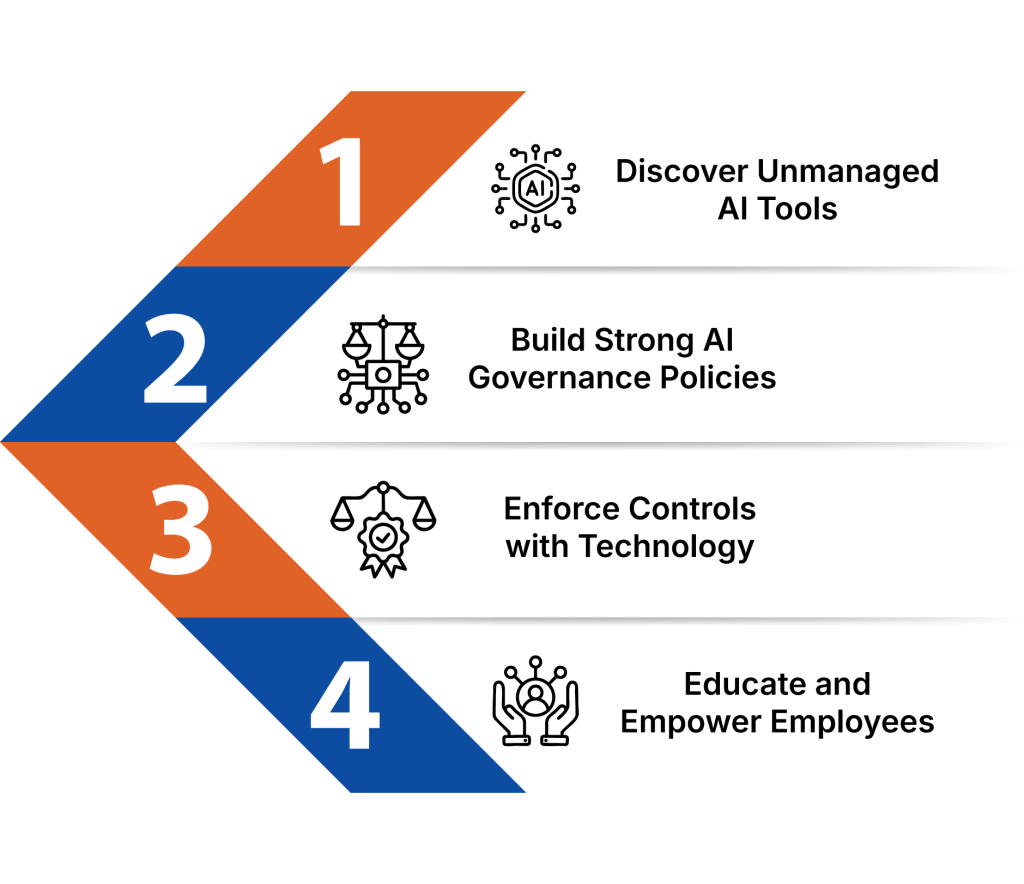
Step 1: Discover Unmanaged AI Tools
Visibility is the first step in managing unauthorized AI usage. Businesses must understand which AI tools are being used and how.
Common discovery methods include:
- Monitoring network traffic and application usage
- Using cloud access security tools
- Conducting employee surveys about AI usage
This helps identify shadow AI activity and assess potential risks.
Step 2: Build Strong AI Governance Policies
AI governance defines how AI should be used safely and responsibly. Policies should clearly explain:
- Which AI tools are approved
- What data can and cannot be shared
- How AI-generated outputs should be used
- Who is responsible for AI oversight
Policies must be simple and practical. Overly complex rules often lead to non-compliance. Strong AI governance reduces confusion and lowers shadow AI risks.
Step 3: Enforce Controls with Technology
Policies alone are not enough. Technical controls are required to enforce them.
Data Loss Prevention (DLP) tools play a key role in AI security. DLP can:
- Detect sensitive data shared with AI tools
- Block or warn users in real time
- Log AI-related data activity for audits
Access controls, secure gateways, and endpoint protection further support safe AI use without slowing down productivity.
Step 4: Educate and Empower Employees
Employees are a critical part of the solution. Regular training should cover:
- Shadow AI risks
- Data privacy in AI
- Safe use of approved AI tools
Explaining the reasons behind the rules encourages compliance. Open conversations about AI usage help build trust and reduce hidden behavior.
Benefits of Managing Shadow AI the Right Way
Utilizing artificial intelligence in an effective manner does not necessitate hindering creativity or the working pace of teams; rather, it allows for the proper and controlled integration of artificial intelligence into business operations. A properly designed AI governance process will help to achieve long-term value as well as security for companies.
Key benefits include:
- Stronger AI security
- Better protection of intellectual property
- Improved regulatory compliance
- Increased trust from customers and partners
Effective AI governance allows organizations to use AI with confidence.
Conclusion
Shadow AI is a hidden but serious business threat. Shadow AI risks include data breaches, IP leakage, compliance failures, and weakened AI security. While unmanaged AI tools may offer short-term convenience, they can cause long-term damage.
The solution is not to ban AI, but to manage it properly. Through discovery, clear AI governance, strong enforcement using DLP, and continuous user education, organizations can reduce risk while still gaining value from AI.
Acting early is the best way to protect your business and intellectual properties. Do not wait for a data breach or compliance failure. Start assessing your shadow AI exposure today. Build strong AI governance, secure your data, and educate your teams with expert guidance from ValueMentor. If you need help with how to control shadow AI in enterprises, managing unauthorized AI usage, or preventing IP loss through AI tools, ValueMentor can help you take the right steps-starting now.
FAQS
1. What problems does shadow AI create for IT and security teams?
Shadow AI creates blind spots. IT teams cannot secure or monitor AI tools they do not know exist, increasing overall security risk.
2. Why are employees using AI tools without permission?
Most employees use AI to save time, write faster, or solve problems quickly. The issue is not intent-it is the lack of awareness about AI security and data privacy risks.
3. How does shadow AI increase cyber risk?
Unmanaged AI tools may lack strong security, making them easier targets for attacks or misuse. They also expand the organization’s attack surface.
4. Can AI tools store or reuse business data?
Yes. Many AI platforms store user inputs or use them to improve their models. This is why sharing confidential data is risky.
5. What is the link between shadow AI and IP leakage?
When employees share code, designs, or strategies with AI tools, that information may leave the organization permanently, leading to IP leakage.
6. How can companies monitor AI usage without invading privacy?
Organizations can monitor tools and data flows instead of individuals. The focus should be on risk management, not employee surveillance.
7. What controls help manage unauthorized AI usage?
Key controls include AI usage policies, DLP solutions, access controls, secure gateways, and endpoint monitoring.
8. How often should AI governance policies be updated?
AI policies should be reviewed regularly, especially as new tools and regulations emerge. This keeps governance relevant and effective.
9. Does managing shadow AI slow down innovation?
No. When done right, managing shadow AI enables safe innovation by giving employees trusted tools and clear guidance.
10. Why should organizations act on shadow AI now?
AI adoption is growing rapidly. Acting early helps prevent data breaches, IP loss, and compliance failures before they happen.