The rise of e-commerce in the Middle East has put payment security at the core of all business strategies. With more people shopping online in the region, there is an increased risk of data breaches. For e-commerce businesses in the Middle East, it is not just nice to know PCI DSS e-commerce Middle East requirements; it is a necessity.
For e-commerce businesses in the MENA region, there is a complex array of laws, payment systems, and cross-border issues. This blog aims at explaining what PCI DSS compliance is all about in relation to e-commerce in the Middle East, the challenges that e-commerce businesses in the Middle East face.
What is PCI DSS and why does it matter?
The Payment Card Industry Data Security Standard is a known standard that helps keep credit card information safe. It is used by all businesses that take credit card payments whether they are small or big.
For companies, in the Middle East following the Payment Card Industry Data Security Standard is very important. This is because they need to meet the requirements of payment providers and also keep their customers safe. If they do not follow the Payment Card Industry Data Security Standard they could get fined, hurt their reputation and even lose the ability to take credit card payments.
Key PCI DSS requirements for E-commerce
It is based on 12 main requirements, which are further divided into six major objectives. The most significant PCI DSS requirements for e-commerce businesses include:
- Secure network infrastructure – Implementing firewalls and not using default system passwords.
- Data protection – Encrypting data in transit and rest.
- Access control – Restricting access to data based on business requirements.
- Monitoring and testing – Regularly monitoring and testing the network.
- Information security policy – Having an information security policy that is comprehensive and up to date.
Thus, the requirements are met to provide strong online payment security mena, which is significant in a region undergoing rapid digital transformation.
Unique payment trends in the Middle East
One of the defining characteristics of e-commerce in the Middle East is the diversity of payment methods. Unlike Western markets, where card payments dominate, MENA consumers use a mix of options:
- Cash on Delivery (COD): Still widely used in countries like Saudi Arabia and the UAE.
- Local payment gateways: Regional providers such as PayTabs, Telr, and HyperPay.
- Digital wallets: Apple Pay, STC Pay, and regional fintech solutions.
- Buy Now, Pay Later (BNPL): Services like Tabby and Tamara are gaining popularity.
Every payment system also brings with it unique compliance issues. For example, the use of third-party gateways helps to reduce PCI scope, but there are also risks involved in handling credit cards in-house. A business needs to align its online payment compliance strategies with the payment ecosystems.
Cross-Border challenges in the Middle East
Conducting business in different countries of the MENA region poses a number of complexities for PCI DSS compliance.
Some of the challenges are as follows:
1. Regulatory Variations
Different countries have their own data protection laws, such as the UAE’s Personal Data Protection Law and Saudi Arabia’s PDPL. Aligning these with PCI DSS requirements can be challenging.
2. Data Localization
Certain jurisdictions require that customer data be stored within national borders. This can impact how e-commerce businesses design their infrastructure and cloud strategies.
3. Multi-Currency Transactions
Handling multiple currencies increases the complexity of payment processing and fraud detection, requiring more robust security controls.
4. Third-Party Dependencies
Businesses often depend on international payment processors, logistics services, and SaaS solutions. Ensuring that all third-party dependencies comply with PCI DSS standards is an important part of compliance.
For businesses to effectively deal with these challenges, it is essential for them to implement pci dss for e-commerce in middle east in an effective manner.
Compliance strategies for E-Commerce businesses
Achieving and maintaining PCI DSS compliance doesn’t have to be overwhelming. Here are some practical strategies tailored for e-commerce businesses in the MENA region:
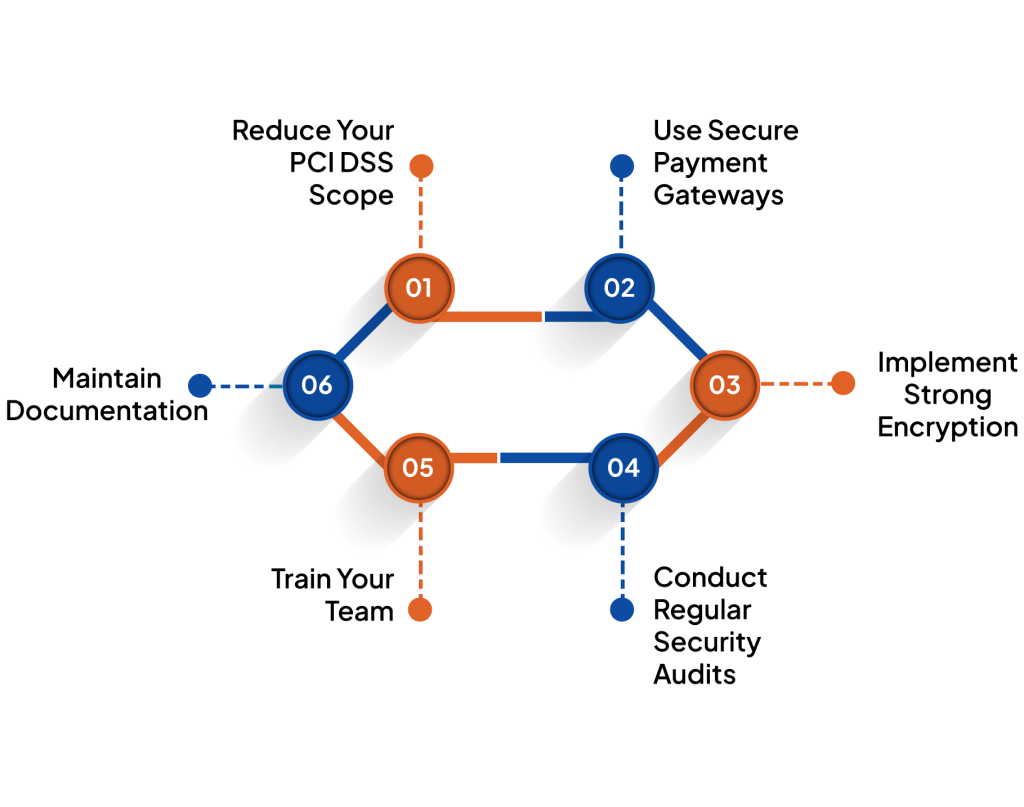
1. Reduce Your PCI DSS Scope
Consider outsourcing your payment processing services with PCI-DSS compliant third-party companies. This will definitely ease your compliance burden.
2. Use Secure Payment Gateways
Select regional or global payment gateways that have been PCI DSS compliant. This will ensure that your credit card data is being processed securely.
3. Implement Strong Encryption
Use SSL/TLS encryption on your website. Ensure that all your credit card data is being encrypted.
4. Conduct Regular Security Audits
Perform vulnerability scans and penetration testing to identify and fix potential weaknesses.
5. Train Your Team
Human errors are a major cause of data breaches. Regular training helps employees understand security best practices and compliance requirements.
6. Maintain Documentation
Keep detailed records of your security policies, procedures, and compliance activities. This is essential for audits and assessments.
These strategies not only support pci compliance mena but also enhance overall operational resilience.
The role of technology in compliance
Modern technologies can significantly simplify PCI DSS compliance for e-commerce businesses:
- Cloud platforms: Many cloud providers offer built-in security features and PCI-compliant environments.
- Tokenization: Replaces sensitive card data with unique tokens, reducing risk.
- AI-driven fraud detection: Helps identify suspicious transactions in real time.
- Automated compliance tools: Streamline reporting and monitoring processes.
Leveraging these tools can strengthen online payment security mena while improving customer experience.
Common mistakes to avoid
Even well-intentioned businesses can fall short of compliance. Some common pitfalls include:
- Storing card data unnecessarily
- Failing to update security patches
- Ignoring third-party risks
- Assuming compliance is a one-time effort
PCI DSS compliance is an ongoing process that requires continuous monitoring, regular assessment, and continuous improvement to maintain the effectiveness of security controls.
Final Thoughts
The Middle East in the context of online business is constantly evolving. There are huge opportunities for growth in this region. However, with the rise of digital business comes the need to protect the customer data and the payment systems. It is important to learn and implement PCI DSS for e-commerce in middle east for the growth and development of the business. By complying with the requirements of PCI DSS and addressing the issues in the payment systems in the region, the business can prosper.
Your customers trust you with their data-make sure you protect it right. With ValueMentor, achieving online payment security mena becomes simple and effective. Download our MENA e-commerce PCI compliance checklist or request a consultation today to strengthen your security framework.
FAQS
1. What is PCI DSS and why should e-commerce businesses care?
PCI DSS is a global security standard that protects cardholder data-essential for avoiding breaches and building customer trust.
2. Is PCI DSS mandatory for online stores in the Middle East?
Yes-if you accept card payments, compliance isn’t optional; it’s required by payment processors and banks.
3. How does pci compliance mena differ from other regions?
It combines global PCI standards with local data laws, payment preferences, and regional regulations.
4. Do I need PCI DSS if I use third-party payment gateways?
Yes-but your scope is reduced since the gateway handles sensitive card data.
5. What are the biggest risks of non-compliance?
Fines, data breaches, lost customer trust, and even losing the ability to process payments.
6. How can I improve online payment security mena for my store?
Use encryption, secure gateways, regular audits, and limit access to sensitive data.
7. Does Cash on Delivery (COD) require PCI DSS compliance?
Not directly-but if you also accept online card payments, PCI DSS still applies.
8. What role do local payment methods play in compliance?
They can reduce PCI scope but require careful integration to maintain secure data handling.
9. How often should I review my PCI DSS compliance?
At least annually, with continuous monitoring and updates throughout the year.
10. What’s the easiest way to achieve PCI DSS for e-commerce in middle east?
By partnering with PCI DSS providers and handling data in the least possible way.