The concept of cybersecurity has advanced much more than firewalls, anti-virus programs, and periodic compliance reviews. Cybersecurity for organizations today, takes place in a digital environment where cyber security threats like ransomware attacks, data breaches, compromise of the entire supply chain system of an organization and even insider attacks have become highly sophisticated and can cause huge financial losses. In past, businesses had taken the compliance route regarding cyber security. Being compliant and meeting all audits were the primary considerations. However, compliance is not enough anymore. An organization can never be immune to cyberattacks by being compliant with the standards and requirements.
Cyber resilience comes into play and it can be explained as an organization’s capability to prepare for, withstand, respond to, and adapt to a cyberattack without impacting their business processes. Resilient organizations are able to prepare for the attacks but not prevent them. The more an organization engages in digital transformation, the greater the need to develop resilience, not just comply. Otherwise, they may suffer serious consequences of attacks. This blog will define cyber resilience, explain why compliance does not provide complete protection against cyberattacks, and give tips on how to achieve greater resilience.
Why is compliance alone no longer enough?
GDPR, HIPAA, ISO 27001, PCI DSS, and NIST are some of the important security models that are very essential where the aspect of security requirements is concerned, as they provide basic levels of security for data and information systems. However, the primary concept behind such compliance models is that they only cover minimum security.
Hackers don’t care about whether you comply with security rules and regulations. They look for vulnerabilities and weak points in your defenses. You can pass an audit and still remain extremely vulnerable to attacks by hackers and cybercriminals.
There are several reasons why compliance alone falls short:
1. Threats Evolve Faster Than Regulations
The cyber threat landscape is constantly changing; regulation always comes later after the emergence of new kinds of attacks.
2. Compliance Encourages a Checklist Mentality
Organizations may think about compliance as a process done only once without making it an effective part of their cybersecurity policy, which might create an illusion of security and lead to distraction from actual danger preparation.
3. Human Error Remains a Major Risk
People, although their organization may have implemented compliance measures, may still put the company in danger by using weak passwords, clicking on phishing emails, and making unintentional mistakes leading to data breach/loss events
4. Modern Businesses Depend on Complex Digital Ecosystems
Cloud computing, work from home, third parties, and the extended value chain create a much larger attack surface that cannot be addressed through compliance alone.
The organization needs to go further and adopt a resilient approach to strengthen its security posture.
What Cyber Resilience Really Means?
Cyber resilience combines cybersecurity, business continuity, risk management, and operational resilience into a unified strategy. It focuses not only on preventing attacks but also on ensuring organizations can continue operating during and after an incident.
A cyber-resilient organization can:
- Identify and assess emerging threats
- Detect attacks quickly
- Respond effectively to incidents
- Minimize operational disruption
- Recover systems and data rapidly
- Learn from incidents and improve continuously
Cyber resilience recognizes an important reality: no organization is completely immune to cyberattacks. The true measure of security maturity lies in how effectively an organization responds and recovers.
Key Steps Organizations Must Take to Build Cyber Resilience
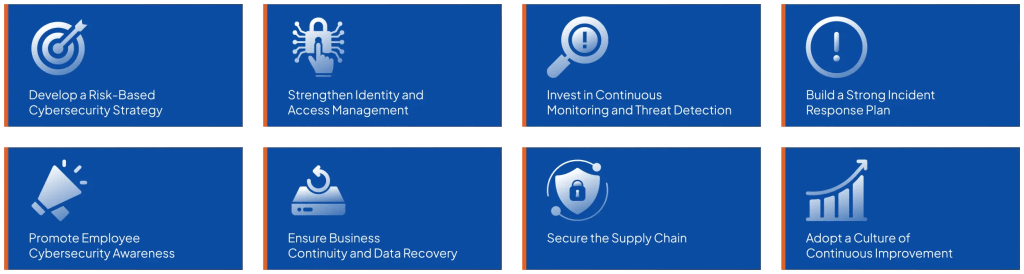
1. Develop a Risk-Based Cybersecurity Strategy
It is necessary for the organization to have a clear understanding of its risk environment first. It means that the organization should know which assets are vital for it and what potential risks it may face.
Using the risk-based approach makes it easier for the organization to allocate funds and control measures in order to minimize the effect of the most probable threats on the business.
Regular risk assessments should include:
- Critical infrastructure evaluation
- Third-party and supply chain risks
- Cloud security exposures
- Insider threats
- Regulatory obligations
- Emerging cyber threat intelligence
Cyber resilience starts with visibility and informed decision making.
2. Strengthen Identity and Access Management
The current security perimeter is identity. In light of remote work and cloud computing, companies can no longer solely rely on perimeter security measures. IAM principles should be adhered to without fail in order to ensure there are no unauthorized accesses.
Key measures include:
- Multi-factor authentication (MFA)
- Least privilege access controls
- Role-based access management
- Single sign-on (SSO)
- Privileged access monitoring
- Continuous identity verification
Zero Trust security models have become increasingly important because they assume no user or device should be trusted automatically, even inside the network.
3. Invest in Continuous Monitoring and Threat Detection
Real-time visibility is necessary for cyber resilience through observation of systems, networks, and users’ actions.
Tools used by security operation centers (SOC) team and endpoint detection and response (EDR), extended detection and response (XDR), and AI-based monitoring can be used by organizations to spot suspicious activities.
The following tools should be included in effective monitoring:
- Network traffic analysis
- Endpoint activity monitoring
- Log management
- Behavioral analytics
- Threat intelligence integration
- Automated alerting systems
Rapid detection significantly reduces the impact and cost of cyber incidents.
4. Build a Strong Incident Response Plan
Even the best defenses can fail. That is why organizations must prepare for cyber incidents before they happen.
An effective incident response plan outlines how teams will identify, contain, investigate, communicate, and recover from attacks or resolve the incidents. Without a clear plan, organizations often experience confusion, delays, and greater damage during crises.
A comprehensive response plan should define:
- Incident classification procedures
- Roles and responsibilities
- Communication protocols
- Escalation processes
- Legal and regulatory reporting requirements
- Recovery procedures
- Post-incident analysis
Continuous conduction of tabletop exercise and simulations enable team training, readiness and help to monitor the adequacy of the Incident Response Plan.
5. Promote Employee Cybersecurity Awareness
Employees are still among the most frequently used points of entry for hackers. This happens due to the fact that phishing e-mails, social engineering attacks, and credential stealing work well by exploiting human weaknesses rather than technology. A company must have a robust security culture for achieving cyber resilience.
The following topics should be covered in training programs:
- Phishing identification
- Password security
- Safe remote work practices
- Data handling procedures
- Social engineering awareness
- Incident reporting protocols
Security awareness training needs to happen all year round rather than just once a year. Constant testing and practice will go a long way in instilling best practices.
6. Ensure Business continuity and data Recovery
The possibility that something might go wrong cannot be ruled out regardless of any prevention. Business continuity planning enables the business operations to go on even when there is a cybersecurity attack.
Other methods for minimizing downtime and getting operational again, include:
- Regular data backups
- Offline and immutable backups
- Disaster recovery testing
- Redundant infrastructure
- Cloud recovery capabilities
- Recovery time objective (RTO) planning
The ability to recover quickly often determines whether an organization survives a major cyber event.
7. Secure the Supply Chain
Cybersecurity threats also come from third party vendors and suppliers. Any weakness in one vendor’s system can put multiple businesses at risk.
There have been several major cybersecurity attacks recently where hackers attacked vendors’ organization, in order to get into internal corporate networks.
Organizations should:
- Conduct vendor security assessments
- Include cybersecurity provisions in contracts
- Monitor third-party access
- Restrict unnecessary vendor privileges
- Continuously evaluate supply chain risks
Cyber resilience extends beyond internal systems to the entire business ecosystem.
8. Adopt a Culture of Continuous Improvement
Cyber resilience is not a one-time initiative. Threats, technologies, and business operations constantly evolve, requiring organizations to adapt continuously.
Organizations should regularly:
- Review security policies
- Update incident response plans
- Conduct penetration testing
- Perform vulnerability assessments
- Analyze lessons learned from incidents
- Track emerging threat trends
A resilient organization treats cybersecurity as an ongoing business-critical activity rather than a periodic compliance task.
Conclusion
There has been a transformation of the whole cyber security paradigm. In today’s cyber environment, simply following regulations is not sufficient to safeguard an organization against cyber-attacks that have become extremely advanced and devastating. Nevertheless, although compliance plays a significant role in helping organizations establish the basics of security frameworks, it is the cyber resilience that is required to continue further. Thanks to cyber resilience, organizations will be ready to deal with any attack that could happen, react effectively to any attacks, recover quickly from them, and sustain their business operations regardless of any disasters that happen
The era of cyber threats is here; they are not about “if” anymore but about “when.” Is your organization cyber resilient enough to deal with such modern cyber challenges? Our cybersecurity experts at ValueMentor can help you achieve this goal.
Start strengthening your cyber resilience strategy today by assessing your current security posture, enhancing your defenses, and preparing your teams to respond confidently to evolving threats. The organizations that invest in resilience now will be the ones best equipped to thrive in the future.
FAQs:
Cyber resilience is an organization’s ability to prevent, respond to, and recover from cyberattacks with minimal disruption.
2. Is compliance enough for cybersecurity?
No. Compliance sets minimum standards, but cyber resilience focuses on real-world threat preparedness and recovery.
3. Why is cyber resilience important today?
Modern cyber threats are faster, smarter, and more damaging, making resilience essential for business continuity.
4. How is cyber resilience different from cybersecurity?
Cybersecurity focuses on protection, while cyber resilience focuses on protection, response, recovery, and continuity.
5. What are the key pillars of cyber resilience?
Risk management, threat detection, incident response, employee awareness, and disaster recovery are the core pillars.
6. Can small businesses benefit from cyber resilience?
Absolutely. Small businesses frequently become cyberattack targets and need resilience strategies to reduce risks and downtime.
7. What role do employees play in cyber resilience?
Employees are the first line of defense and can help prevent phishing, social engineering, and human-error-based attacks, if trained properly
8. How often should organizations test incident response plans?
Organizations should test their plans regularly (at least once a year) through drills, simulations, and tabletop exercises.
9. What is the biggest cyber resilience challenge?
Keeping up with evolving cyber threats while managing complex digital environments is a major challenge.
10. How can organizations start building cyber resilience?
Start with risk assessments, stronger security controls, employee training, and a well-defined incident response plan.