India’s digital ecosystem is growing at a lightning pace. Businesses nowadays depend on cloud services, online apps, remote access, digital payments, customer portals, and connected tech just to get through the day. While this boost digitization and convenience, it also cranks up the risk of cyber attacks. In recent years, there’s been a huge spike in things like ransomware, data breaches, phishing, website hacks, insider threats, and cloud security problems for Indian companies.
These attacks aren’t just inconvenient, they lead to major financial losses, heaps of legal issues, and can really damage a firm’s image too. To beef up the nation’s cybersecurity and bump up incident response, CERT-In rolled out new directions and compliance needs. For today’s businesses, keeping up with these isn’t a choice anymore. Security’s vital for continuity, good governance, risk management, and earning customer trust. In this blog, we’ll break down those key CERT-In directions and what compliance entails, plus share some steps companies can follow to tighten their defenses and boost resilience.
Understanding the role of CERT-In in India’s Cybersecurity
CERT-In, also known as the Indian Computer Emergency Response Team, is the national cybersecurity incident response agency of India. It operates under the Ministry of Electronics and Information Technology (MeitY).
The organization is responsible for handling cybersecurity incidents, issuing advisories, sharing threat intelligence, coordinating response efforts, and helping organizations improve their cybersecurity posture.
CERT-In plays an important role in strengthening India’s overall cyber resilience by:
- Responding to cyber incidents
- Issuing cybersecurity alerts and advisories
- Coordinating with organizations during attacks
- Supporting digital forensic investigations
- Promoting cybersecurity awareness
- Encouraging stronger security practices
As cyber threats continue to evolve, the role of CERT-In has become increasingly important for both government and private organizations.
Why were these Cybersecurity directions introduced?
The increasing number of cyberattacks across the world has shown that many organizations are still not fully prepared to handle large-scale cybersecurity incidents.
In many cases, delayed incident reporting, poor monitoring, lack of logging, and weak response planning make investigations difficult and increase the overall impact of attacks.
The CERT-In directions were introduced to improve:
- Cyber incident visibility
- Threat intelligence collection
- Security monitoring capabilities
- Incident response readiness
- Digital forensic support
- Coordination during cyber incidents
The overall objective is to help organizations detect threats faster, respond more effectively, and improve cybersecurity maturity across industries.
Key Cybersecurity requirements businesses should be aware of
One of the most important requirements under the CERT-In directions is timely reporting of cybersecurity incidents.
If an organization experiences a major cyber incident, it must report the incident to CERT-In within the required timeframe. Quick reporting allows authorities to coordinate response efforts and reduce the spread or impact of attacks.
Incidents that may require reporting include:
- Data breaches
- Ransomware attacks
- Malware infections
- Website defacement
- Unauthorized system access
- DDoS attacks
- Intrusion attempts
- Network scanning activities
- Suspicious cyber activities
Many organizations often delay reporting because they are still investigating internally. However, delayed reporting can affect response coordination and increase operational risks.
Having a proper incident response process in place can help organizations meet reporting timelines more effectively.
Why Log Management and Monitoring matter?
Maintaining system logs is another important requirement.
Logs help organizations understand what happened during a cyber incident and are critical during investigations, threat analysis, and forensic reviews.
Organizations should securely maintain important ICT logs and monitoring records for the required retention period.
These logs may include:
- Firewall logs
- Authentication logs
- Server logs
- VPN logs
- Endpoint security logs
- Application logs
- Network device logs
Strong logging practices help organizations:
- Detect suspicious activities
- Investigate incidents faster
- Improve visibility across systems
- Support compliance requirements
- Perform forensic analysis
Today, centralized logging and SIEM implementation are becoming increasingly important for businesses handling critical systems and sensitive data.
1. Importance of Accurate System Time
Organizations are also expected to synchronize their systems with trusted Network Time Protocol (NTP) servers.
Accurate timestamps are extremely important during cybersecurity investigations because security teams often need to correlate events across multiple systems.
Incorrect time settings can create confusion during:
- Incident investigations
- Security monitoring
- Event correlation
- Digital forensic analysis
- Legal investigations
Even small time mismatches between systems can make it difficult to identify the actual sequence of events during a cyberattack.
2. Maintaining Customer and Operational Records
Certain organizations, including cloud service providers and virtual asset service providers, may need to maintain customer identification and operational records for a defined period.
The purpose of this requirement is to improve traceability during investigations and strengthen accountability.
As more businesses move toward cloud-based infrastructure and online services, maintaining proper records and visibility becomes increasingly important.
3. Building Stronger Security Monitoring and Response
CERT-In directions encourage organizations to improve their overall cybersecurity monitoring and response capabilities.
Traditional reactive security approaches are no longer sufficient against modern cyber threats. Businesses are now expected to adopt a proactive approach toward cybersecurity.
Organizations should focus on improving:
- Threat monitoring
- Vulnerability management
- Security visibility
- Incident response planning
- Detection capabilities
- Endpoint monitoring
- Cloud security monitoring
The ability to identify suspicious activities early can significantly reduce the impact of cyberattacks.
Why should businesses take CERT-In Compliance seriously?
Many organizations still treat cybersecurity as a purely technical issue handled only by IT teams. However, modern cyber incidents can directly affect business operations, customer trust, finances, and organizational reputation.
Ignoring cybersecurity risks may lead to:
- Operational disruption
- Financial losses
- Data exposure
- Regulatory scrutiny
- Reputation damage
- Customer trust issues
- Legal complications
For businesses that rely heavily on digital operations, even a short outage caused by a cyberattack can have a major impact.
CERT-In compliance should not be viewed only as a regulatory requirement. It should also be seen as an opportunity to strengthen cybersecurity practices and improve resilience.
Steps organizations can take to strengthen Cybersecurity
To get cybersecurity compliance, you need more than just security tools. It’s about having good preventive practices, constant watching, making staff aware, and being ready for incidents. This way, organizations can handle cyber risks better and boost their security.
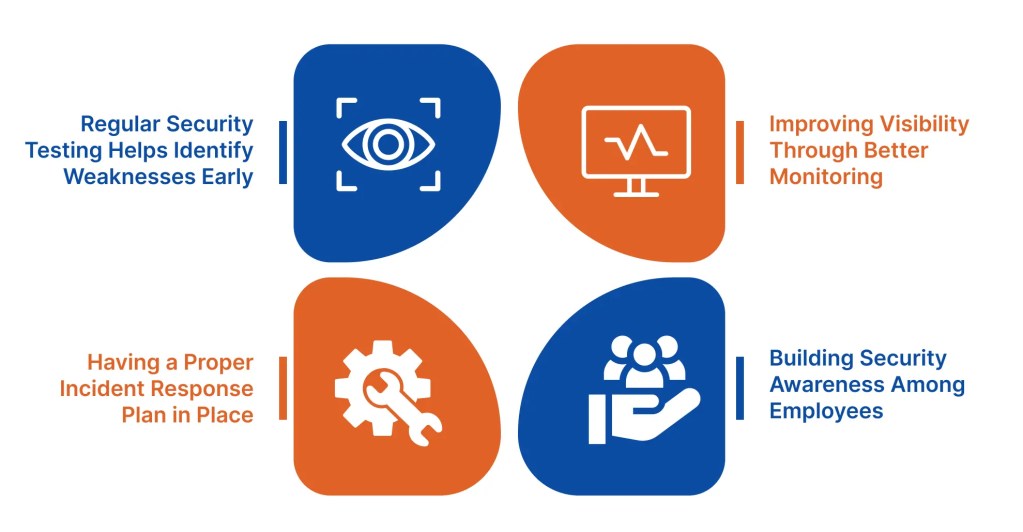
1. Regular Security Testing Helps Identify Weaknesses Early
Regular security testing helps organizations identify weaknesses before attackers can exploit them.
Organizations should perform:
- Vulnerability Assessments
- Penetration Testing (VAPT)
- Security Audits
- Cloud Security Assessments
- Configuration Reviews
- Network Security Assessments
Regular assessments improve visibility into security gaps and help organizations strengthen their defenses.
2. Improving Visibility Through Better Monitoring
Organizations should invest in better monitoring and visibility solutions.
This may include:
- Centralized logging
- SIEM implementation
- Security alerts
- Endpoint monitoring
- Threat detection systems
- Security dashboards
Strong monitoring capabilities help security teams respond faster and reduce incident impact.
3. Having a Proper Incident Response Plan in Place
Every organization should have a documented incident response plan.
A proper response plan helps businesses:
- Respond quickly during incidents
- Reduce downtime
- Minimize operational impact
- Preserve evidence
- Coordinate response activities
- Recover systems faster
Regular testing and simulation exercises can also improve incident response readiness.
4. Building Security Awareness Among Employees
Human error remains one of the biggest causes of cybersecurity incidents.
Employees should receive regular awareness training to help them identify:
- Phishing emails
- Fake login pages
- Suspicious links
- Social engineering attempts
- Unsafe online activities
Building a strong security culture across the organization is just as important as implementing security technologies.
Why is proactive cybersecurity becoming essential?
Cybersecurity threats continue to evolve rapidly. Attackers are constantly using new techniques to target organizations, steal sensitive information, disrupt operations, or demand ransom payments.
Because of this, businesses can no longer depend only on traditional security measures.
Organizations that invest in:
- Continuous monitoring
- Security governance
- Incident response readiness
- Security testing
- Threat intelligence
- Employee awareness
- Cloud security
will be in a much stronger position to handle modern cyber threats.
Cybersecurity is no longer only about protection. It is also about resilience, preparedness, and business continuity.
Closing Thoughts
CERT-In’s cybersecurity directions are a big deal for boosting India’s online safety scene. Instead of just seeing them as mandatory checkboxes, orgs should look at this as a chance to beef up their defenses and get more resilient. With ransomware, data breaches, and other threats ramping up, being proactive is key for any biz here. These cyber incidents can wreck ops, cost a lot of money, and tear apart client trust. By jumping in now, companies can spot weak spots, catch threats quicker, and handle future issues way better.
Contact our cybersecurity team at ValueMentor to strengthen your defenses and prepare for evolving compliance requirements.
FAQs:
Well, they aim to boost reporting of cyber incidents, amp up visibility on threats, and shore up India’s cybersecurity defenses overall.
Do CERT-In directions apply just to big companies?Why is timely cyber incident reporting important?
Nope. They hit smaller ops too—any org that runs digital systems, networks, or online services in India needs to follow these rules.
What happens if you don’t obey CERT-In requirements?
You face more cyber risks, investigation headaches, plus possible regulatory probes and ops breakdowns.
Why is timely cyber incident reporting important?
Early reporting enables faster response, better coordination with authorities, and helps limit the impact of cyberattacks.
How do security logs help with cyber investigations?
Logs track system actions, making it easier for teams to follow incident steps, spot attack routes, and gather useful forensic info.
What role does continuous monitoring play in cybersecurity?
It lets orgs catch odd behaviors on the fly and tackle threats to prevent bigger issues.
How can vulnerability assessments improve security?
They identify weaknesses in systems, applications, and networks, allowing organizations to remediate risks before attackers exploit them.
Why should businesses do regular cybersecurity training?
Cybersecurity training helps employees spot phishing scams and other trickery hackers use. It keeps everyone sharp against common dangers out there.
What must an incident response plan have?
A solid plan needs to lay out roles, talk paths, ways to contain issues, fix things, and know when to escalate problems.
How can firms stay tough against cyber attacks over time?
They need to blend being watchful, doing tests, keeping an eye on risks, educating staff, and getting ready for issues-all part of staying strong online.