With advancements in cyber attacks and changes in regulations becoming increasingly complex, it is crucial for organizations to prove their dedication to protecting data through effective information security and risk management practices. HITRUST certification is one of the most recognized benchmarks today used by organizations such as hospitals, technology companies, banks, and others that store important information. Nonetheless, numerous businesses face difficulty in deciding on the appropriate level for HITRUST assessment to be carried out. There are three main types of HITRUST assessment that a business may choose from depending on its unique circumstances; these are e1, i1, and r2.
When comparing HITRUST e1 vs i1 vs r2, understanding the differences between these assessment levels can help businesses choose the certification that best aligns with their security requirements and compliance goals. In this guide, we’ll break down each assessment level and help you determine which one aligns with your business goals.
Understanding the HITRUST Assurance Program
The HITRUST Assurance program offers organizations a framework for evaluating their cybersecurity controls. Instead of offering a generic process, which will not meet all the organizations’ needs, the HITRUST program has several tiers, depending on the type of risk the organization faces.
These include the following three levels:
Each assessment differs in scope, complexity, and assurance level, allowing organizations to choose the certification that best matches their security posture and stakeholder expectations.
What is HITRUST e1?
HITRUST e1 (Essentials, 1-Year) assessment is the basic level certification intended for organizations that have low risk exposure and simple environment.
In essence, this assessment is all about assessing basic practices of cybersecurity along with some of the key controls required. It is recommended for new companies, small health care vendors, business associates, and those at an early stage of becoming compliant.
Key Features of HITRUST e1
- Covers approximately 44 foundational security controls.
- Focuses on essential cybersecurity hygiene.
- Lower cost and faster implementation compared to other HITRUST assessments.
- Certification validity of one year.
- Ideal for organizations with limited regulatory obligations.
Best Fit For
- Startups and small businesses (<50 employees)
- Organizations needing basic security validation
- Small healthcare and SaaS providers
- Companies with limited sensitive data
- Businesses with low compliance requirements
The e1 assessment provides a practical starting point for organizations looking to demonstrate a commitment to cybersecurity without the extensive requirements of more advanced certifications.
What is HITRUST i1?
The HITRUST i1 (Implemented, 1-Year) Assessment is created for organizations that require higher cybersecurity assurance by assessing their implemented security controls. Differing from the e1 assessment that verifies only the foundations of controls, the i1 assessment assesses how effective and implemented those security controls have become. It takes into account cybersecurity risks and possible attack vectors.
Key Features of HITRUST i1
- Evaluates approximately 182 security controls.
- Focuses on demonstrated implementation rather than risk tailoring.
- Provides higher assurance than e1.
- Certification remains valid for one year.
- Emphasizes operational cybersecurity resilience.
Best Fit For
- Mid-sized healthcare organizations
- SaaS providers serving regulated industries
- Organizations with increasing customer security requirements
- Companies preparing for a future r2 assessment
Most organizations opt to go with the i1 assessment due to the balance it strikes between offering significant assurance and being simpler compared to the r2 assessment.
What is HITRUST r2?
The HITRUST r2 (Risk Based, 2-Year) Assessment is the most sophisticated assessment under the HITRUST certification, serving as the gold standard for security assurance. For organizations asking, “Which HITRUST certification is right for my organization?”, r2 is often the preferred choice when handling highly sensitive data, operating in heavily regulated environments, or requiring the highest level of security assurance.
The r2 assessment is tailored depending on the organizational risk, regulations, system complexity, and sensitivity of information processed or stored.
Key Features of HITRUST r2
- Risk-based and tailored assessment approach.
- Evaluates hundreds of controls depending on organizational scope.
- Includes maturity scoring across multiple domains.
- Certification valid for two years with an interim assessment.
- Recognized by healthcare organizations, regulators, and enterprise customers.
Best Fit For
- Large healthcare organizations
- Cloud service providers
- Organizations handling significant volumes of sensitive data
- Enterprises with stringent third-party risk requirements
- Companies seeking the highest level of security assurance
Due to the fact that it is more elaborate and customized, r2 requires more preparation, resources, and investment, but it also provides the highest degree of trust and compliance assurance.
HITRUST e1 vs i1 vs r2: Key Differences
While all three HITRUST certifications help organizations demonstrate their commitment to cybersecurity and compliance, each assessment offers a different level of assurance, scope, and complexity. This HITRUST certification comparison highlights the difference between HITRUST e1, i1, and r2, helping organizations determine which certification level best aligns with their security requirements, compliance obligations, and business objectives.
| Feature | HITRUST e1 | HITRUST i1 | HITRUST r2 |
|---|---|---|---|
| Assessment Type | Essentials Assessment | Implemented Controls Assessment | Risk-Based Assessment |
| Primary Purpose | Validate foundational cybersecurity practices | Demonstrate implemented security controls | Provide comprehensive, risk-based security assurance |
| Number of Controls | Approximately 44 controls | Approximately 182 controls | Varies based on organizational risk profile and scope |
| Risk Tailoring | No | No | Yes |
| Assessment Complexity | Low | Moderate | High |
| Level of Assurance | Basic | Moderate | Highest |
| Maturity Scoring | No | Limited | Yes, across multiple control domains |
| Certification Validity | 1 Year | 1 Year | 2 Years (with interim assessment) |
| Typical Organization Size | Startups and small businesses (<50 employees) | Growing and mid-sized organizations | Large enterprises and highly regulated organizations |
| Implementation Effort | Low | Moderate | High |
| Preparation Time | 4–8 weeks | 2–4 months | 4–6+ months |
| Internal Resource Commitment | Limited involvement from security and IT teams | Cross-functional involvement required | Significant involvement across security, compliance, IT, and leadership teams |
| Documentation Requirements | Basic policies and evidence | Moderate documentation and control evidence | Extensive documentation, testing, and risk analysis |
| Relative Cost | Low | Medium | High |
How to choose the right HITRUST Certification?
As part of this HITRUST assessment selection guide, it’s important to understand that selecting the right HITRUST assessment depends on several factors:
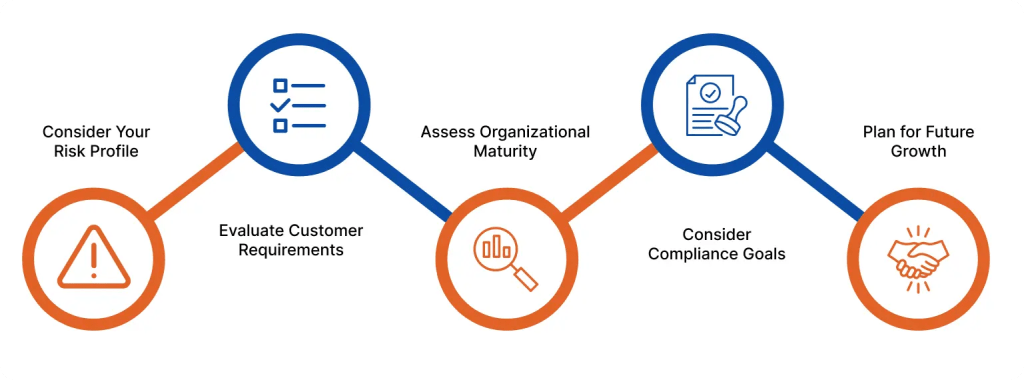
Consider Your Risk Profile
Organizations with limited exposure to sensitive data may find e1 sufficient. Businesses handling protected health information (PHI), financial data, or critical systems often require i1 or r2.
Evaluate Customer Requirements
Many enterprise customers and healthcare organizations increasingly request stronger assurance levels. If customers specifically require HITRUST certification, understanding their expectations can help determine the appropriate assessment level. A HITRUST certification costcomparison can also be valuable, as e1, i1, and r2 differ significantly in terms of implementation effort, assessment scope, and overall investment.
Assess Organizational Maturity
Organizations early in their cybersecurity journey may benefit from starting with e1 before progressing to i1 or r2. More mature organizations with established security programs can often pursue i1 or r2 directly.
Consider Compliance Goals
If your organization must demonstrate alignment with multiple regulatory frameworks and industry standards, the r2 assessment typically provides the most comprehensive compliance coverage.
Plan for Future Growth
Organizations expecting rapid growth or expansion into regulated markets should consider selecting a certification path that supports future security and compliance requirements.
Conclusion
Selection between e1, i1, and r2 of HITRUST assessment will depend on your organization’s level of risk exposure, compliance obligations, customer requirements, and level of cybersecurity. Although e1 is a good choice for a low-cost way into security validation, i1 assures higher level of security through implemented controls, while r2 provides high-level risk-based certification under HITRUST framework. By being properly cautious about the requirements of your company and what it needs to do, you should be able to find the appropriate assessment level for yourself that satisfies your security needs without spending too much money. Proper assessment level choice would lead to increased customer confidence and growth.
Choice of HITRUST certification levels will affect your overall compliance strategy, customer confidence, and security position. Whether you’re evaluating e1, i1, or r2 certification, ValueMentor can help you identify the most suitable path, prepare for assessment requirements, and streamline your certification journey. Contact our HITRUST experts today to discuss your compliance goals and get started with confidence.
FAQs
e1 covers foundational controls, i1 validates implemented controls, and r2 provides comprehensive risk-based assurance.
2. Which HITRUST certification should I choose?
Choose e1 for basic needs, i1 for stronger security validation, and r2 for advanced compliance and assurance requirements.
3. Is HITRUST e1 enough?
Yes, for startups and low-risk organizations with limited compliance requirements.
4. Who needs HITRUST r2?
Large enterprises, healthcare organizations, and businesses handling highly sensitive data typically require r2.
5. How much does HITRUST certification cost?
Costs vary by assessment type, with e1 being the least expensive and r2 requiring the highest investment.
6. How long does HITRUST certification take?
e1 typically takes weeks, i1 takes a few months, and r2 can take several months to complete.
7. Can an organization move from e1 to i1 to r2?
Yes, many organizations follow a phased approach as their security and compliance needs evolve.
8. Is HITRUST limited to healthcare providers?
No, other industries who deal with sensitive data may also utilize HITRUST certification.
9. Could HITRUST certification enable business growth?
Yes, an organization can acquire more customers using their HITRUST certification.
10. What considerations must be made when choosing between e1, i1, and r2?
Several aspects to consider include company size, level of risk, customer needs, and cybersecurity.