A PCI SAQ (Self-Assessment Questionnaires) is a tool specifically designed for businesses to check their compliance with the Payment Card Industry Data Security Standards (PCI DSS compliance). The right choice is made by determining how the business handles cardholder data by answering questions regarding the payment processes. This process involves various steps, such as analyzing the data environment of the cardholder, finding a suitable SAQ type for your environment, and consulting with the acquirer. Let’s explore the key aspects of choosing the right PCI SAQ type.
What Is a PCI SAQ?
It is a self-assessment questionnaire primarily used by merchants and service providers to evaluate and report their compliance with the Payment Card Industry Data Security Standard (PCI DSS). This process involves answering a series of questions related to the organization so that self-assessment can be done for the security posture and ensure that the necessary measures for the security of cardholder data are available. For every specific scenario and environment, different versions of SAQs are available, and they are designed for how each business handles credit card information. There are multiple types of SAQs, such as A, B, C, D, A-EP. They are particularly tailored for all kinds of scopes and different types of methods of handling card data. This is essential to ensure that the assessment is proportionate and relevant.
Why Businesses Need PCI SAQs?
Businesses need to ensure that they comply with the Payment Card Industry Data Security Standard (PCI DSS), which provides them protection against various threats to customer payment information. In this process, PCI SAQs play a crucial role by providing valuable insights to evaluate the business security measures, vulnerability detection, and ensure compliance with required data protection standards. Completion of the SAQ helps businesses to avoid any potential fines and hefty penalties for non-compliance. This also helps to reduce any potential data breach while ensuring customer trust. In short, the PCI SAQ is a crucial tool for maintaining and enhancing data security for businesses handling cardholder data. This process helps secure both business interests and customer trust.
Overview and Detailed Breakdown of PCI SAQ Types
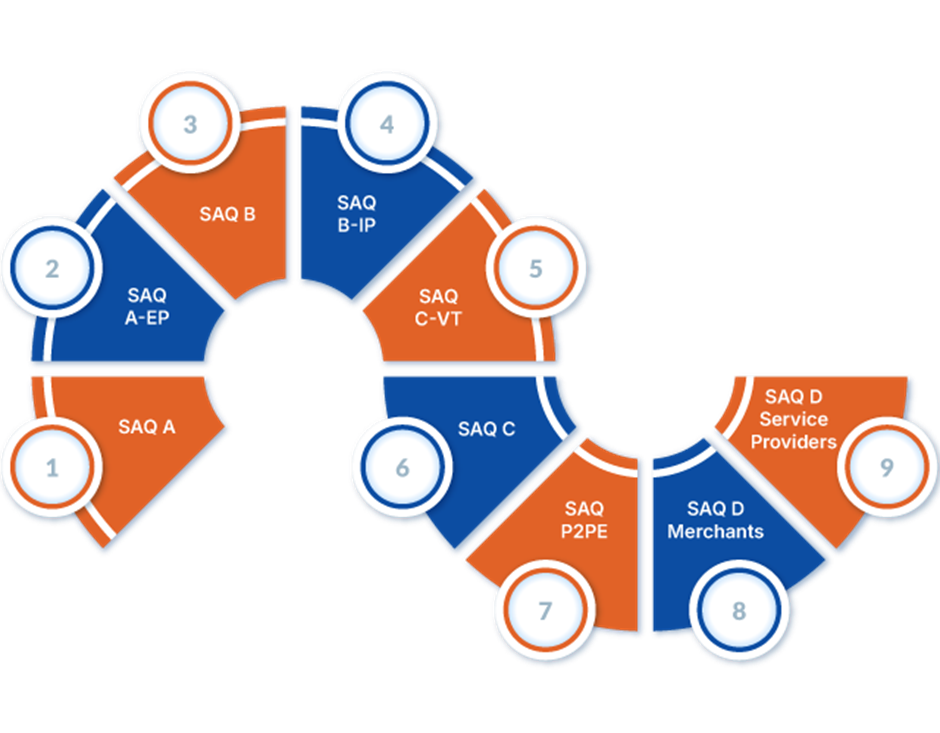
The PCI SAQ types are determined by how organizations handle the data and what kind of processes are followed during the data transmission. For every different scenario, there is a specific type that includes SAQ A, SAQ A-EP, SAQ B, SAQ B-IP, SAQ C-VT, SAQ C, SAQ P2PE, SAQ D Merchants, and SAQ D Service Providers. Let’s have a detailed overview of the PCI SAQ types.
SAQ A
This is suitable for e-commerce or mail/telephone order merchants who are utilizing the outsourcing services for all the payment processing from PCI DSS-validated third parties. They don’t have any in-house facility to store, process, or transmit cardholder data. This makes the PCI DSS validation requirements minimal for them, and it mostly focuses on ensuring that the third-party providers are compliant.
SAQ A-EP
In this type, the e-commerce merchants are included, who do not handle cardholder data directly but have a role to play in the security of payment transactions. This makes it essential for the merchant to implement the standard security controls to ensure the website security and components impacting the payment process integrity.
SAQ B
SAQ B is specifically built for those who have only deployed imprint machines or stand-alone dial-out payment terminals to process card transactions. They don’t have any electronic cardholder data stored, and instead of using the internet for connectivity, they use a dial-up line to maintain communication. This system significantly reduces the required complexity of security maintenance, which mostly includes protecting the physical devices and ensuring that the card data is not exposed digitally.
SAQ B-IP
Merchants who have stand-alone, IP-connected payment terminals deployed that are PTS-approved with direct connectivity over the internet with the payment processors. With the deployment of isolated terminals from other networks, they do not store the cardholders’ data electronically. The SAQ ensures their network segmentation standards and helps prevent unauthorized access.
SAQ C-VT
This is mostly applicable to merchants who manually enter cardholder data into a web-based virtual terminal enabled by a service provider with valid PCI-DSS compliance. The computer system used by the merchant must not store any cardholder data, and it must be dedicated only to payment processing. This is essential as per the compliance requirements. The isolation of these systems from any other network or systems is paramount for staying safe from malware or unauthorized access.
SAQ C
Highly applicable for merchants using the payment application systems via the internet for card transaction processing. These systems only transmit the cardholder data and do not store it. All the merchants using the SAQ C have to ensure that their networks and systems are properly segmented, securely configured, and protected from external threats during the cardholder’s data transmission.
SAQ P2PE
Dedicated former chants using PCI-validated point-to-point Encryption (P2PE) solutions. In this environment, card data is encrypted immediately when captured by the payment terminal and remains encrypted until it reaches the payment processor. Because the merchant’s systems never have access to unencrypted cardholder data, compliance requirements are reduced to ensuring the proper implementation and maintenance of the validated P2PE solution.
SAQ D Merchants
SAQ D for Merchants is the most comprehensive of all SAQ types. It applies to merchants that store, process, or transmit cardholder data on their systems, or whose business activities do not fit the criteria for other SAQ types. These organizations must comply with all PCI DSS requirements and perform an extensive self-assessment covering every security control specified in the standard.
SAQ D Service Providers
SAQ D for Service Providers applies to third-party companies that handle, process, or store cardholder data on behalf of other organizations. These providers must demonstrate full compliance with all PCI DSS requirements since they directly affect the security of payment data for multiple clients. This SAQ ensures that service providers maintain robust, end-to-end data protection throughout their systems.
How to Choose the Right SAQ Type
Choosing the right SAQ type is the outcome of a proper understanding of the business payment processes and channels requirements.
This process includes the crucial 7 steps, which are:
1. Identify Payment Acceptance Methods Document all channels where you accept card payments: In-person terminals, e-commerce websites, mobile apps, phone orders, or mail orders. Each channel affects your compliance requirements.
2. Determine Cardholder Data Handling Map the complete data flow: Where card numbers, expiration dates, and security codes enter your systems, how they’re transmitted, whether they’re stored, and where they exit. Understanding this flow is critical for compliance.
3. Review Technology Setup Inventory all systems involved in payment processing: Point-of-sale terminals, payment gateways, servers, databases, networks, firewalls, and security software. Include both physical and cloud infrastructure.
4. Assess Outsourced Payment Services: Identify third-party providers handling payment functions (payment processors, hosting providers, gateway services). Verify their PCI compliance status and understand which responsibilities they assume versus what remains yours.
5. Match Environment to SAQ Type Based on steps 1-4: Select the appropriate SAQ version (A through D, or P2PE). Each type addresses specific merchant environments with different security requirements and question sets.
6. Confirm with Acquirer/Payment Brand: Validate your SAQ selection with your merchant bank or card network to ensure correct compliance pathway.
7. Maintain Documentation: Keep records of all assessments, remediation efforts, and compliance evidence for annual validation and potential audits.
All these steps are critically designed for the precise assessment as per the compliance requirements, helping in the evaluation process.
Real-Life Scenarios: Matching SAQ Types to Business Models
Real-life businesses vary in how they handle cardholder data, making the correct SAQ type crucial for PCI compliance. Small e-commerce sites that outsource payment entirely may complete SAQ A, while brick-and-mortar stores using standalone terminals fit SAQ B.
Organizations with payment applications connected to the internet often require SAQ C, and those with complex, fully integrated payment systems typically use SAQ D. Matching SAQ types to business models ensures compliance scope is accurate, reduces audit burden, and strengthens data security. Proper selection aligns technical controls with operational practices, minimizing risk and regulatory exposure.
Common Mistakes When Choosing an SAQ
-
- Selecting an SAQ type without fully assessing how cardholder data is handled.
-
- Assuming all merchants fit a single SAQ type regardless of business model.
-
- Ignoring outsourced payment processes that could simplify compliance.
-
- Confusing SAQ requirements with general IT security controls.
-
- Failing to update SAQ selection after business or system changes.
-
- Underestimating scope, leading to incomplete or inaccurate responses.
-
- Overcomplicating by choosing a more stringent SAQ than necessary.
-
- Neglecting documentation and evidence collection for audit purposes.
-
- Relying solely on vendor advice without internal verification.
Final Thoughts
A PCI SAQ (Self-Assessment Questionnaire) is crucial for evaluating PCI DSS compliance by assessing cardholder data handling. The right SAQ depends on payment channels, data storage, and processing methods. SAQ types (A, A-EP, B, B-IP, C-VT, C, P2PE, D Merchant, and D Service Provider) serve specific business models from e-commerce to fully integrated systems. Accurate selection ensures precise compliance scope, reduces audit burden, and strengthens security. Avoiding mistakes like misidentifying SAQ type, ignoring system changes, and insufficient documentation is essential. Annual assessments aligned with payment processes safeguard cardholder data. ValueMentor is a proven partner in selecting the right SAQ for your business requirements.
FAQs
Q1. Which factors are important when determining SAQ forms?
The key factors include business type, payment processing methods, and whether cardholder data is stored, processed, or transmitted electronically.
Q2. What are the three types of SAQ questions?
The three types are closed-ended, open-ended, and scenario-based questions that assess compliance understanding and practical application.
Q3. What happens if I fail my PCI SAQ assessment? If you fail your PCI SAQ
you must address the identified compliance gaps by implementing required security controls and remediating vulnerabilities. You’ll need to complete corrective actions, resubmit your SAQ, and may face increased transaction fees or restrictions until compliance is achieved.
Q4. What are the six Ps of security?
The six Ps are Policy, Procedure, People, Products, Physical security, and Planning, forming a comprehensive security management framework.
Q5. Do I need to be PCI compliant if I only process a few transactions per month?
Yes, PCI compliance is required for any business that accepts credit card payments, regardless of transaction volume. All merchants must comply with PCI DSS standards and complete the appropriate SAQ to protect cardholder data.
Q6. Can I switch from one SAQ type to another during the year?
Yes, you should switch SAQ types if your payment processing methods or technology infrastructure change. Always notify your acquiring bank and complete a new SAQ assessment to ensure continued compliance with the correct requirements.
Q7. What is a level 4 merchant?
A level 4 merchant is a small business processing fewer than 20,000 e-commerce transactions or up to 1 million total transactions annually.
Q8. How to identify suppliers in procurement?
Suppliers can be identified through market research, supplier databases, trade directories, and recommendations from industry networks.
Q9. How often should a PCI SAQ be completed?
The PCI SAQ should be completed annually, or whenever significant changes occur in payment systems or business operations.
Q10. What is third-party merchant processing?
Third-party merchant processing uses an external provider to handle card transactions instead of in-house processing. Merchants remain responsible for secure integration and compliance with PCI requirements.