For SaaS providers and technology-driven businesses, SOC 2 compliance is now a standard requirement for building trust with enterprise clients. Surveys indicate that most Fortune 500 companies request a SOC 2 report before granting vendor access to their systems. The cost of achieving this attestation report, however, varies widely. A Type 1 audit, which reviews security controls at a single point in time, is typically less resource intensive. In contrast, a Type 2 audit extends over several months, adding expenses for continuous monitoring, evidence collection and auditor review. Understanding these differences early is critical for organizations to set accurate budgets and avoid unexpected financial strain during the compliance journey.
Why Understanding SOC 2 Costs Matters
SOC 2 compliance is often viewed as a security checkbox, but in practice it is a significant financial and operational commitment. Knowing the costs upfront helps organizations plan their budgets, avoid unexpected expenses and choose the right path to attestation.
The cost of SOC 2 varies depending on audit type, company size and the level of preparation. A clear understanding of these factors allows businesses to balance compliance needs with available resources. It also prevents overspending on tools or consultants that may not align with actual requirements. For growing companies, accurate cost planning ensures smoother compliance assessment and reporting without disrupting daily operations. For larger enterprises, it helps in scaling compliance efforts across multiple systems and teams. In both cases, visibility into costs strengthens decision-making and improves return on investment from the compliance process.
Key Factors That Influence SOC 2 Compliance Cost
The cost of SOC 2 attestation is shaped by several business and technical variables. Each of these plays a direct role in determining the time, effort and budget required to complete the audit.
1. Audit type and duration
Type 1 audits evaluate control design at a single point in time, while Type 2 audits test operating effectiveness over 3 to 12 months. Type 2 requires ongoing evidence collection and extended auditor engagement, which increases overall cost.
2. Scope of Trust Services Criteria (TSC)
Organizations may select Security alone to audit or extend this with other criteria like Availability, Processing Integrity, Confidentiality and Privacy. The wider the scope, the greater the range of systems, processes and items of evidence, directly contributing to the cost of audits.
3. Readiness and remediation needs
Companies that lack security policies, access controls or proper logging face extra costs to close these gaps before an audit. Conversely, businesses with mature security practices and well-documented processes spend less on pre-audit remediation.
4. Size and complexity of the organization
The number of employees, applications and third-party integrations have a direct effect on cost. Larger or multi-region entities require more sampling, walkthroughs and control mapping, making audits longer and more expensive.
5. Technology stack and architecture
Cloud-native businesses with Infrastructure as Code (IaC) may have frequent deployments that increase the volume of evidence, while hybrid or on-premises setups add layers of complexity for auditors. Each additional environment increases the effort required.
6. Data sensitivity and classification
Handling financial data, health records or personally identifiable information (PII) increases the depth of audit testing. Encryption, key management and retention controls are reviewed more closely, raising overall compliance costs.
7. Third-party and subservice organizations
Vendor dependencies also influence expenses. If subservice providers are included (“carve-in”), auditors perform additional testing. If excluded (“carve-out”), the company must manage bridge letters and vendor monitoring, which still adds effort.
8. Operational maturity in Security Operations
Organizations with structured processes for monitoring and handling security events spend less time and money during audits. Weak or ad-hoc practices often lead to additional remediation work and higher compliance costs.
9. Evidence collection and tooling
Automated compliance platforms streamline evidence collection and minimize auditor follow-ups. In contrast, organizations that rely on spreadsheets or static screenshots often spend significantly more time and resources compiling and re-submitting documentation.
10. Privacy requirements
If the Privacy TSC is selected, organizations must demonstrate controls around data subject rights, consent management and cross-border processing. This adds extra procedures and review effort.
11. Region and auditor market rates
Pricing varies depending on geography and the type of audit firm engaged. Large audit firms charge premium rates compared to boutique firms and regional differences in labor costs can influence final pricing.
12. Timeline and contractual obligations
Tight audit deadlines often increase fees, as firms charge more for accelerated reviews. In addition, bridge letters covering gaps between audit periods add to ongoing costs.
13. Use of inherited controls
Leveraging existing SOC reports from cloud providers can reduce the scope of testing. Weak shared responsibility mapping, however, results in duplicated controls and additional auditor work.
14. Ongoing compliance maintenance
Maintaining SOC 2 readiness requires recurring activities such as periodic access reviews, continuous monitoring and annual attestation updates. These measures ensure consistent control effectiveness, strengthen client confidence, and help prevent costly gaps or surprises during future audits.
15. Evidence sampling size
The size of user populations, change tickets and incidents directly impacts how many samples auditor’s review. Larger populations increase testing time and cost.
SOC 2 Compliance Costs
SOC 2 compliance involves multiple cost components that organizations must consider achieving and maintain attestation report. Below is a detailed breakdown of the key cost areas involved in SOC 2 compliance.
1. Attestation Report Cost Breakdown
SOC 2 attestation is not issued by a central authority but verified by an independent CPA firm after a third-party audit. The bulk of compliance expenses come from preparation, readiness assessments, audit fees and reporting. Costs for small startups average $10,000–$20,000, while larger or complex organizations may spend $50,000–$150,000 or more. These amounts include audits, tool subscriptions and time invested by internal teams.
2. SOC 2 Audit Costs
Audit fees are driven by the auditor’s reputation, trust service criteria evaluated and your organization’s size. Type I audits average $5,000–$10,000, while Type II audits range from $20,000–$50,000 for most companies. Large enterprises can pay over $100,000 for broad, multi-site audits.
3. SOC 2 Type I vs. Type II Costs
Type I is faster and less expensive, providing a point-in-time controls review. Type II evaluates control effectiveness over several months, requiring more resources and incurring higher costs. For most organizations, Type II is between 30–100% more expensive than Type I.
4. Tools and Technology Costs
Compliance automation platforms help streamline evidence collection, monitoring and reporting. Subscriptions cost $5,000–$30,000 per year, depending on features and scale. Tools reduce preparation time and internal workload, often helping to minimize consulting needs.
5. Consultants and Advisory Services
Consultants assist with readiness, gap assessments and remediation. Advisory fees typically range from $10,000–$50,000, depending on involvement and project complexity. Companies without existing security frameworks may require more consulting to prepare for their first audit.
6. Hidden and Ongoing Costs
- Internal team time (100–200 hours, often uncalculated in external budgets).
- Annual security training ($5,000–$15,000).
- Continuous monitoring solutions ($3,000–$10,000/year).
- Recurring audits are required every 12–24 months, renewing most major expenses.
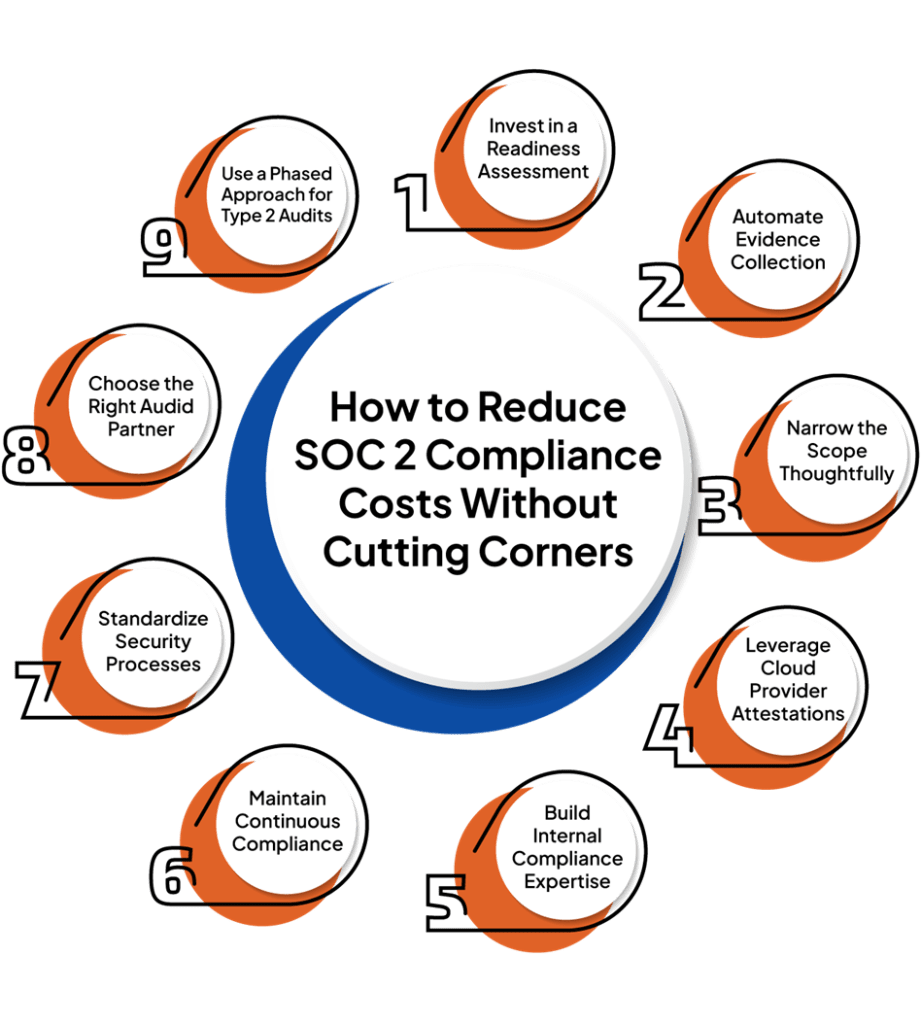
How to Reduce SOC 2 Compliance Costs Without Cutting Corners
Achieving SOC 2 compliance can be expensive, but organizations can control costs by using efficient processes and smart resource allocation instead of reducing audit quality. Below are practical strategies that help reduce expenses while maintaining compliance integrity.
1. Invest in a Readiness Assessment
A readiness review before the formal audit highlights gaps in controls, policies and documentation. Addressing these early reduces rework, last-minute fixes and auditor back-and-forth, which often drives up costs.
2. Narrow the Scope Thoughtfully
Limiting the audit to systems and processes that directly handle customer data lowers testing volume and documentation needs. A focused scope also decreases sampling size and auditor review time.
3. Leverage Cloud Provider Attestations
Major cloud platforms such as AWS, Azure and Google Cloud provide SOC reports that cover infrastructure-level controls. Inheriting these controls avoids duplicate testing and narrows the company’s responsibility, saving time and auditor effort.
4. Build Compliance Expertise
Building strong compliance knowledge whether through in-house teams or trusted external advisors-helps streamline SOC 2 efforts. Clear ownership and dedicated compliance champions can reduce inefficiencies and lower overall advisory and audit costs.
5. Automate Evidence Collection
Using compliance automation platforms simplifies control monitoring and evidence gathering. Automated log collection, access reviews and change-tracking minimize manual work and reduce the number of audit hours billed.
6. Maintain Continuous Compliance
Keeping policies, access reviews and logging practices updated throughout the year prevent costly remediation right before the audit. A steady compliance posture lowers the chance of findings that trigger retesting.
7. Standardize Security Processes
Consistent access management, documented change controls and clear incident response procedures reduce sampling complexity. Auditors spend fewer hours validating standardized practices, which lowers billable costs.
8. Choose the Right Audit Partner
Audit fees can vary significantly depending on scope and service approach. Partnering with an auditor experienced in your industry and business size ensures you receive the right expertise and support without adding unnecessary costs or complexity.
9. Use a Phased Approach for Type 2 Audits
Starting with SOC 2 Type 1 before moving to Type 2 spreads costs over time. The Type 1 audit builds a compliance baseline, which helps shorten the duration and reduce consulting hours for the Type 2 engagement.
Long-Term Cost of Maintaining SOC 2 Compliance
Maintaining SOC 2 compliance incurs continuous costs beyond the initial assessment and reporting. Organizations must invest in ongoing monitoring of controls to detect and address security gaps promptly. This includes subscription fees for automated compliance and security tools, which typically range from $3,000 to $10,000 annually depending on features and scale.
Annual or biannual re-assessments and audits are required to validate that controls remain effective and aligned with SOC 2 standards. These recurring audits resemble initial audit costs but may be lower if controls are well maintained; however, audit fees can still range from $20,000 to $70,000 depending on organization size and scope.
Internal resource allocation is an important consideration. Staff involvement in evidence collection, policy updates, training, and remediation typically requires dedicated hours. Many organizations allocate between $5,000 and $15,000 annually for security training and policy management to maintain compliance awareness across teams.
Lastly, evolving regulatory requirements and business changes may necessitate control updates or new implementations, adding to compliance maintenance costs. Proactive risk management and automation can reduce these expenses by streamlining updates and minimizing manual effort.
Conclusion
SOC 2 compliance is a recurring financial and operational commitment, shaped by factors such as audit type, scope, industry requirements and long-term maintenance. While the initial attestation is significant, the ongoing costs of monitoring, documentation, vendor oversight and annual audits often define the true investment. Organizations that adopt automation, maintain strong internal processes and engage the right advisory support can control expenses while ensuring their security posture remains audit ready.
To achieve compliance efficiently and avoid unnecessary cost overruns, partner with a trusted SOC 2 compliance expert. ValueMentor’s SOC 2 Compliance Services provide tailored guidance, audit readiness support and long-term cost optimization strategies to help your business meet SOC 2 requirements and maintain a sustainable compliance program.
FAQs
1. What is the typical cost range for a SOC 2 Type 1 audit?
Small to mid-sized companies usually pay between $5,000 and $20,000 for a Type 1 audit, depending on scope and auditor selection.
2. How much does a SOC 2 Type 2 audit typically cost?
Costs range from $20,000 to $50,000 for mid-sized organizations, with large enterprises sometimes spending $100,000 or more.
3. How much does a readiness assessment cost?
Organizations should budget $3,000 to $10,000 for a pre-audit readiness or gap assessment.
4. How costly are compliance automation tools?
Compliance platforms typically run $5,000 to $30,000 per year, depending on features and organization size.
5. What is the price range for a penetration test as part of SOC 2?
Penetration test engagements generally cost $4,000 to $20,000, depending on scope and complexity.
6. Which factors drive SOC 2 cost variation most?
Cost varies based on audit type (Type 1 vs. Type 2), number of Trust Services Criteria, company size, controls maturity and auditor selection.
7. Does location affect audit cost?
Yes. Audit costs are generally higher in the U.S. due to demand and firm rates. Costs vary elsewhere based on local auditor availability and market conditions.
8. What hidden costs should I account for?
Include internal staff time, training, remediation, tool subscriptions, legal reviews and lost productivity. These often drive up the total cost significantly.
9. Is automation cost-saving compared to manual compliance?
Yes. Automated platforms reduce internal labor, cut audit prep time and typically lower overall compliance costs compared to manual methods.