No, a legitimate SOC 2 Type II audit cannot be completed in two weeks, and any vendor claiming otherwise is either misrepresenting what they are delivering or conflating readiness tooling with an actual audit opinion. This distinction matters enormously, because the commercial value of SOC 2 certification rests entirely on the credibility of the process behind it.
The market for SOC 2 compliance services has expanded considerably in recent years, driven by enterprise procurement teams routinely requiring it as a condition of doing business with SaaS vendors and cloud service providers. That commercial pressure has created a fertile environment for vendors offering accelerated pathways, automated platforms, and compressed timelines. For time-pressed founders and compliance managers, the proposition is appealing. The risk, however, is that shortcuts taken at the audit stage can undermine the very trust the report is meant to establish.
AICPA, the professional body that governs SOC 2 standards, has signalled increasing attention to audit quality and auditor independence heading into 2026. For CISOs and compliance officers navigating this landscape, understanding what a legitimate SOC 2 audit actually requires in terms of timeline, evidence, and auditor conduct is no longer optional. It is paramount to making sound decisions about which partners to engage and which promises to question.
What Is the Realistic SOC 2 Audit Timeline?
Understanding the SOC 2 audit timeline requires separating two distinct phases: readiness and audit. The readiness phase is where an organisation identifies gaps in its current control environment, remediates those gaps, documents its policies and procedures, and positions itself to withstand independent scrutiny. This phase alone can take several months, depending on the maturity of existing security practices. Organisations that have never gone through a formal audit tend to underestimate how much foundational work this requires.
The audit phase itself then depends on which report type is being pursued. For a Type I, the auditor evaluates controls as they exist at a single point in time. There is no observation window, which is why Type I can be completed more quickly once readiness work is done. For a Type II audit, the auditor must observe controls operating over a defined period — typically six to twelve months — before rendering an opinion. That window cannot be artificially shortened without violating the standards that give the report its credibility.
Why “Fast SOC 2” Claims Warrant Scrutiny?
When a vendor advertises a SOC 2 audit completed in two weeks, one of several things is likely occurring. They may be offering a readiness assessment, not an audit. They may be delivering a Type I report and marketing it in terms that imply the rigour of a Type II. Or they may be operating with an auditor whose independence or methodology would not withstand close examination. In each case, the organisation receiving the report may believe it holds credible third-party assurance when, in practice, it holds something of substantially lesser value. When a provider advertises “SOC 2 in two weeks,” ask what the timeline includes, which report type is delivered, what period is covered, and which independent CPA firm issues the report. A short delivery promise is a reason to ask questions
The consequences of this misunderstanding surface most acutely during enterprise procurement reviews. Sophisticated buyers particularly those with their own compliance obligations under frameworks such as PCI DSS or ISO 27001 will scrutinise the period covered by a SOC 2 report, the identity and credentials of the auditing firm, and the scope of Trust Services Criteria included. A report that does not hold up to that scrutiny can stall or terminate a sales process that the SOC 2 was intended to accelerate.
How Fast SOC 2 Audit Promises Are Reshaping the Market?
The competitive dynamics of the SOC 2 market have shifted significantly. The entry of compliance automation platforms and tech-enabled audit firms has reduced the cost and friction associated with SOC 2 preparation, which is a genuinely positive development for smaller organisations. However, the same competitive pressure has encouraged some providers to blur the line between readiness tooling and audit assurance, and between Type I and Type II reports, in ways that mislead buyers.
From a market integrity standpoint, this matters because SOC 2 functions as a trust signal. Enterprise buyers rely on it to make procurement decisions that carry real risk implications for their own customers and stakeholders. When the signal becomes noisy — when it is unclear whether a given SOC 2 report reflects six months of rigorous control observation or a two-week automated scan — the entire framework loses credibility as a tool for distinguishing well-managed organisations from poorly managed ones.
AICPA has historically relied on professional standards and peer review processes to maintain audit quality. Heading into 2026, there are clear indications that the body is paying closer attention to how CPA firms are conducting SOC 2 engagements in the current automated environment, particularly with respect to the sufficiency of evidence gathered and the independence of auditors from the compliance platforms they endorse or partner with.
SOC 2 Compliance Automation: What It Can and Cannot Do
The value proposition of compliance automation in the SOC 2 context is real and should not be dismissed. Platforms that continuously monitor cloud infrastructure, automatically collect audit evidence, and map controls to Trust Services Criteria reduce the manual burden on internal teams dramatically. For organisations with lean security functions, this kind of tooling can be the difference between a manageable audit process and an overwhelming one.
Where Automation Adds Genuine Value
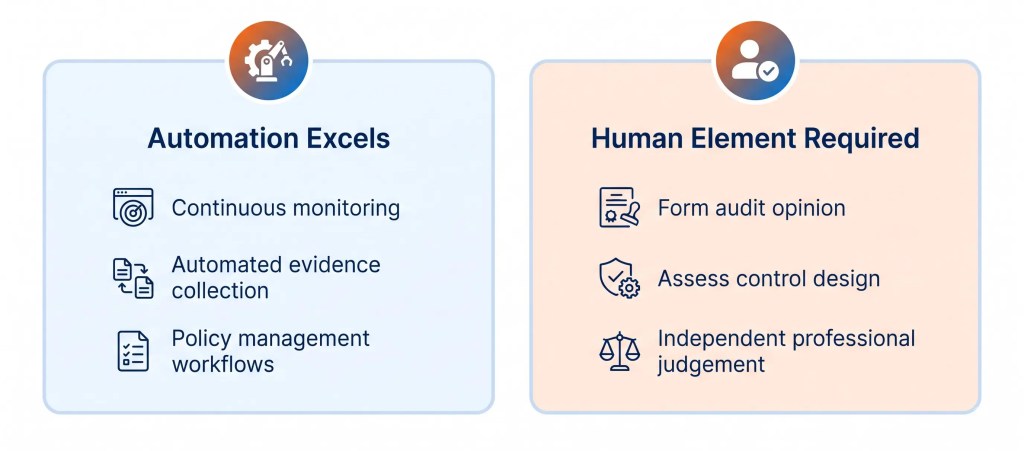
Automation excels at several specific tasks within the SOC 2 process. Continuous control monitoring ensures that deviations are caught in real time rather than discovered during the audit window. Automated evidence collection — pulling logs, access reviews, and configuration records directly from integrated systems — reduces the time internal teams spend preparing for auditor requests. Policy management workflows help ensure that documentation remains current and version-controlled. These are meaningful efficiency gains that translate directly to reduced preparation time and lower internal resource costs.
Where the Human Element Remains Non-Negotiable
However, the audit opinion itself — the formal, signed conclusion that controls are suitably designed and operating effectively requires professional judgement that no software can replicate or replace. An auditor must assess not just whether a control produced a log entry, but whether the control is appropriately designed for the risk it addresses, whether exceptions were investigated and resolved appropriately, and whether the overall control environment reflects a genuine culture of security. That qualitative assessment is inseparable from auditor independence and professional accountability.
Organisations should approach automation vendors who imply that their platform alone produces a SOC 2 report with caution. Automation can support readiness and evidence collection, but the SOC 2 opinion must come from an independent CPA practitioner whose objectivity and independence are not impaired.
Understanding SOC 2 Audit Evidence Requirements
The concept of audit evidence is central to understanding why SOC 2 audits take as long as they do. Evidence in this context is not simply a collection of documents; it is the body of information an auditor uses to form a professional opinion about whether controls are operating as described. For that opinion to carry weight, the evidence must meet specific quality thresholds that professional auditing standards have defined over decades.
What Constitutes Sufficient Evidence
Sufficiency relates to the quantity of evidence — specifically, whether enough instances of a control have been tested over the observation period to support a conclusion about its consistent operation. For a control that runs monthly, six months of evidence means six instances. For a daily control, the sample may be larger. Auditors use professional judgement to determine appropriate sample sizes, and that judgement is one of the areas AICPA is scrutinising more carefully as automated tools make it easier to produce large volumes of evidence that may not actually demonstrate control effectiveness.
Appropriateness relates to the quality and relevance of the evidence. A screenshot showing that a firewall rule exists is not the same as evidence that the rule was reviewed and approved by an authorised individual during the observation period. An access log showing that a user account was active does not, by itself, demonstrate that access was provisioned through an approved workflow. Auditors must evaluate whether evidence is genuinely probative of the control’s operation, not merely consistent with it.
SOC 2 Auditor Independence: Why It Is Non-Negotiable in 2026
Independence is not a bureaucratic formality. It is the mechanism that makes an auditor’s opinion meaningful. An auditor who has a financial relationship with the platform being used to generate evidence, or who derives revenue from consulting on the controls they subsequently audit, cannot provide objective assurance regardless of how competent or well-intentioned they may be. The AICPA Code of Professional Conduct defines these impairments in detail, and SOC 2 users should be aware that not every firm marketing SOC 2 services meets the independence requirements these standards impose.
The Compliance Platform Partnership Problem
A specific independence concern that has emerged in the current market involves CPA firms that maintain referral or revenue-sharing arrangements with compliance automation vendors. If a firm recommends a particular platform to clients, assists with its implementation, and then audits the evidence that platform produces, there is a structural tension with independence requirements that professional standards bodies are taking seriously. Organisations engaging a SOC 2 auditor should ask directly whether the firm has any financial relationship with the compliance tooling being used in the engagement and review the resulting disclosures carefully.
The integrity of the SOC 2 ecosystem depends on auditors who operate at arm’s length from the organisations and tools they evaluate. As AICPA tightens its oversight posture in 2026, organisations that engaged auditors with compromised independence face the real possibility that their existing reports will be called into question by sophisticated buyers — undermining the commercial investment that the audit was intended to protect.
SOC 2 Type II Audit: The Standard That Enterprise Buyers Actually Expect
The distinction between Type I and Type II is frequently obscured in vendor marketing, and the confusion is not always innocent. A Type I report confirms that controls are suitably designed at a point in time. It is a useful milestone, particularly for early-stage organisations working toward their first formal attestation, but it does not demonstrate that controls actually worked over time. Enterprise buyers understand this distinction, and procurement questionnaires in regulated sectors will often specify Type II explicitly.
The Observation Period and Why It Cannot Be Compressed
The observation period the window during which an auditor evaluates whether controls operated effectively is the defining feature of a Type II report. Professional standards require a minimum of six months, and many organisations opt for a twelve-month period to maximise the commercial credibility of the report. During this window, the organisation must not only maintain its controls but maintain them consistently enough to withstand sampling by an independent auditor. Any vendor claiming to deliver a Type II report in weeks is either misrepresenting the observation period covered or misrepresenting the nature of the report itself.
For CISOs and compliance managers advising leadership on SOC 2 strategy, the practical guidance is straightforward: build your programme timeline around a Type II target from the outset, even if a Type I is the first deliverable. Design controls that are sustainable and consistently operated, not controls that are activated in the weeks before an auditor arrives. The observation period will reveal the difference, and sophisticated auditors — the kind whose opinion carries genuine market weight — are specifically looking for evidence of consistent operation rather than episodic compliance.
Conclusion
The appeal of a two-week SOC 2 audit is understandable compliance timelines carry real commercial costs, and the pressure to demonstrate security posture quickly is genuine. But the value of a SOC 2 report is inseparable from the rigour of the process that produced it. As AICPA intensifies its oversight of audit quality and auditor independence in 2026, organisations that invested in shortcut solutions face the prospect of holding credentials that sophisticated buyers will not accept and in some cases, credentials that may not withstand professional scrutiny at all.
A legitimate SOC 2 Type II audit cannot be completed in two weeks. AICPA standards require a minimum six-month observation period, and the full timeline from readiness preparation to report issuance typically spans nine to eighteen months. AICPA’s heightened 2026 scrutiny targets auditor independence violations and insufficient evidence practices increasingly associated with “fast SOC 2” vendors. Compliance automation accelerates readiness but does not replace the independent professional judgement required for a valid audit opinion. Organisations should evaluate SOC 2 partners against independence standards, evidence sufficiency requirements, and the specific report type being delivered before committing to an engagement. Navigating SOC 2 requirements is complex and the cost of getting it wrong extends well beyond a failed audit. If your organisation is evaluating a SOC 2 programme or questioning the credibility of your current compliance pathway, ValueMentor’s team of compliance experts can help you build a defensible, timeline-appropriate approach from the ground up. Visit our website to explore how we partner with organisations to achieve SOC 2 certification that holds up where it matters most.
FAQs
A SOC 2 audit is an independent assessment performed by a licensed CPA firm that evaluates whether a service organisation’s controls adequately protect customer data. The audit is structured around the AICPA’s Trust Services Criteria and results in a formal opinion on control design and, for Type II, operational effectiveness over time.
How long does a SOC 2 audit take?
A SOC 2 Type I audit typically takes three to six months from the start of readiness work to report issuance. A Type II audit requires a minimum six-month observation period, making the total timeline from preparation to final report nine to eighteen months for most organisations, depending on their starting control maturity.
What is the difference between SOC 2 Type I and Type II?
A SOC 2 Type I report evaluates whether controls are suitably designed at a single point in time. A Type II report assesses whether those controls operated effectively across a defined observation period, typically six to twelve months. Enterprise buyers routinely require Type II, as it provides evidence of sustained control performance rather than a point-in-time snapshot.
How much does a SOC 2 audit cost?
SOC 2 audit costs depend on organisational complexity, scope of Trust Services Criteria, and the auditing firm’s market positioning. Most organisations should expect to invest between $20,000 and $100,000 or more for a credible Type II engagement, excluding internal preparation effort and any compliance automation tooling deployed to support readiness.