If your organization relies on SOC 2 reports to provide assurance on your security & operational controls then you will want to pay attention. SOC 2 has evolved significantly over the years to provide assurance and build trust between service organization and customers. However, with businesses now moving towards using cloud platforms, software, automation and an array of inter-connected technology providers, the job of SOC 2 is getting harder.
The AICPA have issued a draft proposal to update the SOC 2 Trust Services Criteria to ensure they remain clear and relevant to today’s technology landscape (AI, Risk Management, Vendor Relationships, System Operations, Resilience etc). We’ll discuss below what to expect from the proposed changes and how you can prepare.
| Summary |
|
Understanding the Proposed SOC 2 Update
In short, SOC 2 is an audit performed by an independent licensed CPA looking at your controls against one or more of the Trust Services Criteria (security, availability, processing integrity, confidentiality and privacy). This gives your customers assurance on how well your service organisation is managing any risks associated with the systems and services you provide.
As announced in October 2026 by the AICPA, this draft is currently open for public comment. This may mean that the content and requirements of this proposal may change. Below outlines what has been proposed:
| Milestone | Date |
|---|---|
| AICPA announces proposed update | October 2026 |
| Public comment period closes (proposed) | January 15, 2027 |
| Proposed effective date (new SOC 2 engagements) | On or after December 31, 2027 |
Until the updated criteria are finalised, apply the current criteria to your SOC 2 engagements. This draft should be used as a guide to get you thinking.
Key Changes to the Proposed SOC 2
There are quite a few changes to the framework. Some criteria have been consolidated, moved or clarified. The aim is to make the framework easier to understand.
Fewer Criteria
The number of criteria within the Trust Services Criteria has been reduced from 61 to 50. The Common Criteria (security of SOC 2) has also been simplified from 33 criteria across 9 series (CC1-CC9) to 20 criteria across 8 series (CC1-CC8).
Whilst the 5 Trust Services Criteria remain unchanged, the number of criteria within each has been reduced:
| Trust Services Category | Current Criteria | Proposed Criteria |
|---|---|---|
| Common Criteria (Security) | 33 | 20 |
| Availability | 3 | 4 |
| Confidentiality | 2 | 3 |
| Processing Integrity | 5 | 5 |
| Privacy | 18 | 18 |
| Total | 61 | 50 |
The Common Criteria have also been grouped into 8 series. Control Environment, Information and Communication, Risk Assessment, Monitoring Activities, Logical & Physical Asset Protection, System Operations, System Development & Change Management and Vendor Management.
Here’s how the old CC1–CC9 series map onto the new CC1–CC8 structure:
| Old Series | Old Name | New Series | What Happens |
|---|---|---|---|
| CC1 | Control Environment | CC1 | Carries over, with fewer, more condensed criteria. |
| CC2 | Communication and Information | CC2 | Becomes “Information and Communication”; internal/external communication combined. |
| CC3 | Risk Assessment | CC3 | Restructured around the risk lifecycle: establish, carry out, monitor/improve. |
| CC4 | Monitoring Activities | CC4 | Carries over, consolidated into fewer criteria. |
| CC5 | Control Activities | — (eliminated) | Removed as a standalone series; content folded into CC2 and other series. |
| CC6 | Logical and Physical Access Controls | CC5 | Becomes “Logical and Physical Asset Protection”; content largely unchanged. |
| CC7 | System Operations | CC5 / CC6 | Vulnerability and configuration monitoring moves to CC5; the rest becomes the new CC6 “System Operations.” |
| CC8 | Change Management | CC7 | Becomes “System Development and Change Management,” split into infrastructure, acquired software, and internal software. |
| CC9 | Risk Mitigation | CC8 | Vendor/business-partner risk becomes the new CC8 “Vendor Management”; business-disruption content moves mainly into Availability. |
Although there are fewer criteria, it has not been made easier to meet. Most of the criteria have been moved or consolidated. You will need to ensure your controls map to the new criteria.
Focus on Artificial Intelligence
The biggest change in this draft is the focus on Artificial Intelligence. Organisations are using AI in almost every aspect of their business (customer support, software development, data analysis, fraud detection, automation, decision making etc) and this means you need to think about the risks associated with confidentiality, data integrity, access, reliability and accountability.
Interestingly there is no specific category or criteria for AI. Instead there are 17 Points of Focus across the 50 criteria. This is guidance and not legal requirements. It is to give management and auditors some guidance on how the criteria may apply. Depending on your systems, services and risk, some may be relevant.
AI Governance & Risk Assessment
You will need to consider how you have identified, assessed, allocated and monitored any risks associated with AI. This could include risks around model drift, bias, poor data validation, data poisoning, adversarial inputs, poor explainability and misuse.
If your company are using an AI enabled customer support tool then you will need to know what data can be accessed, how data is processed, what checks are in place and what happens if the model goes wrong and produces incorrect/misleading outputs. This usually involves documenting all your use cases, who owns them, have they been approved and are there processes in place to review any major changes.
Unauthorised AI Tools
AI risk isn’t only for organisations who develop AI products. Employees may be using public AI tools to summarise documents, analyse information and develop code. Without appropriate controls, confidential/personal data could be shared externally.
The draft states you should limit the use of unauthorised AI platforms and highlight any unauthorised software/models. Usually this involves reviewing your acceptable use policy, approved software list, DLP controls, endpoint protection and employee awareness.
AI Agents
AI agents, robotic process automation and other automated services may have access to applications, databases, and business processes. These automated identities can pose similar risks to employee accounts, especially if they have been granted extensive/privileged access.
You may want to ensure your automated identities are controlled, approved, restricted, regularly reviewed and turned off when they are no longer needed. Any privileged access granted to AI agents should be treated the same as other privileged accounts.
Monitoring AI Components & Model Changes
AI enabled systems behave differently to traditional applications. This draft helps you consider how you will protect against prompt injection, attempting to manipulate model outputs, data poisoning, unusual outputs, model drift and bias. This has been covered by considering system monitoring, vulnerability management and change management.
Depending on your system and how you are using it you may need to monitor models, identify any suspicious inputs, validate any significant model/data changes, investigate unusual outputs and document remediation. The correct controls should be put in place depending on the risk and impact of this particular use case.
Third Party AI Services & Technology
Most organisations will be using third party AI models, APIs, plugins and software. As you have little control over how they have been developed this draft focuses more on vendor management and third party technology.
You may want to consider what security and availability assurances the provider offers, how they handle data, how they update, any subservices they rely on and what assurances they can provide. Your contract and due diligence should consider the risks involved with this service.
Better Risk Management Approach
Within the Risk Assessment series there is a better structure to ensure you have a risk management programme in place. This shows that you should be continuously managing risk.
You should be able to demonstrate how you identify, assess, allocate, manage and communicate risk. Risk assessments should also consider any significant changes to your organisation, technology, suppliers, processes and threat environment.
Some of the areas you may want to consider are:
- Defined risk assessment approach and clear governance.
- Appropriate risk appetite/tolerance for your services and business.
- Risk register with owners, risk rating, risk treatment decisions and target dates.
- Technology, people, operations, third parties and relevant emerging technologies considered.
- Demonstration of continuous monitoring, reassessments and management reporting.
- Ensure actions that have passed their due dates are followed up and residual risk has been approved by the appropriate people.
If you have a risk register without owners, risk treatment decisions and evidence of continuous monitoring then you are only telling half the story.
Focus on Vendor Management
Vendor Management has become its own series (CC8). This shows how important third party providers are to running a modern service. Most organisations will be using cloud infrastructure, SaaS platforms, data processing, payment providers, API vendors and AI model providers.
Whilst it is important to understand the details of their SOC 2 report, you will also need to know what was covered, what Trust Services Criteria were included, if there were any exceptions and what complementary user entity controls/subservices are applicable to you.
Your vendor management programme may also need to consider how you assess your vendors before onboarding, how significant vendors are categorised, how your contract considers security and privacy requirements and how changes to the vendor’s services are monitored.
Updates to Logical Access, Asset Protection & Security Operations
Several technical areas have been grouped together under Logical and Physical Asset Protection (CC5). This includes logical access, physical protection, IT hardware/software, network integrity, encryption and vulnerability management. This makes it easier to see what is happening in these key areas.
You may want to consider how you manage access. Are employee, privileged, service and automated identities being properly approved and regularly reviewed? Asset registers should identify what relevant hardware/software/systems you have. Network controls should consider segmentation, boundary protection and monitoring.
Encryption has its own criteria. You should consider how sensitive data is protected in transit and at rest. Are your cryptographic keys properly restricted, maintained and rotated? Vulnerability management has also been clarified so you should ensure you have evidence of scanning, assessment, remediation and follow up.
Clearer Change Management
The draft has separated change management into 3 areas. This is a big change from the current criteria which only has one criteria.
The areas are designed to cover different technology changes:
- Infrastructure – cloud, servers, network, platform.
- Purchased Software – updates/upgrades/patches/configuration changes from the vendor.
- Internal Software – application code, releases/testing/deployments.
You may want to consider if changes are being requested, assessed, authorised, tested, approved and documented. If you are using AI enabled systems then you may also need to consider any significant changes to models, data sets or fine tuning inputs.
Availability, Continuity & Resilience
Availability has increased from 3 to 4 criteria. This shows how important service resilience has become with organisations using cloud infrastructure, external technology providers and interlinked services. This criteria also considers how well you can maintain or recover your service.
You may want to consider:
- Capacity/resource management.
- Backup protection and system/data recovery.
- Business continuity/disaster recovery.
- Ransomware/resilience.
- Critical thirdparty service providers.
- Testing of recovery and evidence of achieving your recovery objectives.
If your service organisation are using cloud infrastructure you should consider what you would do if a critical service or external provider became unavailable. Whilst having a documented recovery plan is important, having evidence of testing will show you can recover.
Confidentiality, Processing Integrity & Privacy
The other Trust Services Criteria have also been updated. Confidentiality has increased from 2 to 3 criteria. This has been clarified to ensure you have appropriate information classification, protection and disposal. You may want to consider how you identify, restrict, store and securely dispose of confidential information.
Processing Integrity remains at 5 criteria. However there are Points of Focus for AI and Machine Learning considerations. This includes input data quality and origin, model validation, output monitoring and re-assessment after significant changes. This may be relevant if you are using AI to process information.
Privacy remains at 18 criteria. There is also a consideration for AI and how personal data is handled in AI systems. If you are using AI to process personal information then you may want to consider if your current privacy practices consider how personal data is used, stored and protected.
What this may mean for Customers
If you are requesting and reviewing SOC 2 reports as part of your vendor assurance/procurement process then this will affect you. During the transition period you may receive reports based on different versions of the Trust Services Criteria.
When reviewing a provider’s SOC 2 report you should continue to ask the same questions. What period was the report for? What systems were covered? What Trust Services Criteria were included? What was the auditor’s opinion? Were there any exceptions? What subservices are included? If they are using AI then ask how they are managing these risks.
Questions to ask your service providers:
- What version of Trust Services Criteria was used and what period was the report for?
- Does the system description indicate any significant use of AI, automation and external technology providers?
- How are relevant AI tools, models, agents and third party components being assessed and monitored?
- Are there any exceptions, subservices or complementary user entity controls that will affect how we use the service?
- What is their plan for assessing the final criteria and implementing where applicable?
Whilst a SOC 2 report is a good source of assurance, it shouldn’t replace your own vendor risk assessment. Weigh it up against how you are using the service, what is stated in your contract and your risk tolerance.
How you can Prepare?
As this is still in draft format you don’t need to completely redo your SOC 2 programmes. However it is useful to understand what is being proposed so you can identify any areas that may need attention.
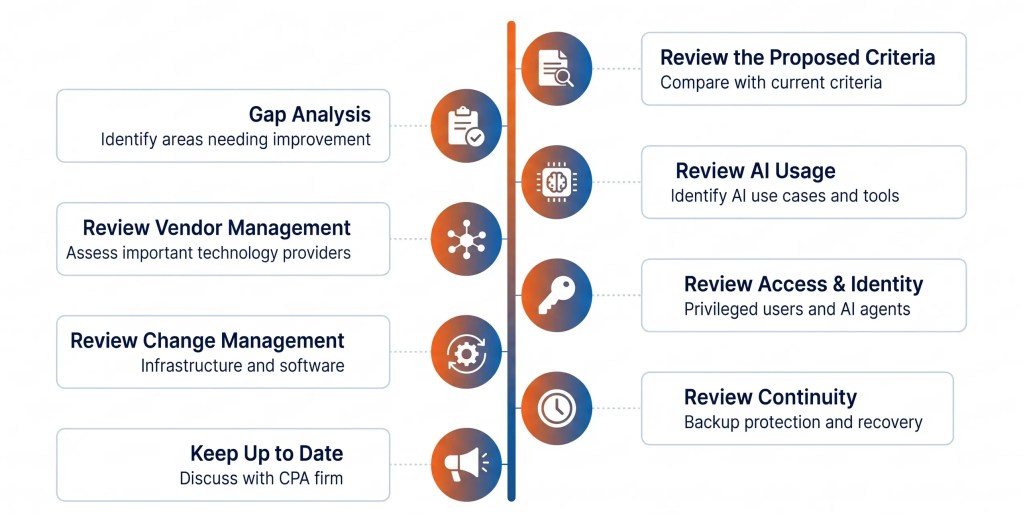
1. Review the Proposed Criteria
Understand how the criteria are being proposed. Compare with the current criteria you are using. Focus on the intent of the controls.
2. Gap Analysis
Identify any areas within your policies, processes or controls that may need clarification or improvements. Note down any potential gaps and assign someone to review when the final criteria are available.
3. Review AI Usage
Identify any AI use cases, external models, APIs, agents and public AI tools being used by employees. Consider if you have appropriate approval, data protection, access, monitoring and risk assessment in place.
4. Review Vendor Management
Review your vendor list. Are important technology providers, AI services and subservices being properly assessed? Are there any assurances available and are they covered within your contract?
5. Review Access & Identity Management
Consider if privileged users, service accounts, automated identities and AI agents are being reviewed. Are they being approved, restricted to business need and regularly reviewed?
6. Review Change Management & Monitoring
Review your change management for infrastructure, purchased and internal software. Have you got appropriate documentation for vulnerability management, incident monitoring and remediation?
7. Review Continuity
Review your backup protection, recovery, third party dependencies and testing. Ensure your recovery plans are still applicable to your services and systems.
8. Keep Up to Date & Discuss with CPA Firm
Keep up to date with the AICPA’s consultation and final publications. Discuss the proposed changes and transition with your independent CPA firm.
Conclusion
Overall this draft is to ensure the framework keeps up to date with the changes in technology. With AI, automation, cloud services and a range of third party providers organisations are changing how they develop, deliver and secure their offerings. The exposure draft has grouped the criteria and provided more light on the risks.
The best thing you can do as a service organisation is understand what direction this is going in, review your controls and identify any potential gaps. If you are a customer then this is a reminder to understand your SOC 2 reports in context and understand how your providers are managing the technology, security and third party risks.
Remember this may still change and the Points of Focus aren’t mandatory. Wait until the AICPA finalises everything.
At ValueMentor we help organisations through transitions like this. We can help you understand what the SOC 2 requirements are, identify where your controls are, identify any compliance gaps and prepare for the audit. If you would like a second pair of eyes on your current practices or help planning for the future then we can help.
FAQs
The AICPA have issued an exposure draft proposing changes to the SOC 2 Trust Services Criteria. The aim is to simplify the framework and make it relevant to current technology, risk management, AI and third party services.
2. Is the new SOC 2 framework finalised?
No. It is still in draft form and may change. Until the revised criteria are finalised continue to use the criteria applicable to your current SOC 2 engagements.
3. When will the proposed SOC 2 update come into effect?
The proposed effective date is for engagements starting on or after 31 December 2027. This is subject to final approval from the AICPA.
4. How many criteria are there in total?
Reduced from 61 to 50 criteria, with the Common Criteria reduced from 33 to 20.
5. Is there an AI category in the update?
There is no change to the 5 Trust Services categories. AI considerations have been incorporated into the 17 points of focus within the 50 proposed criteria.
6. Will there be less controls to implement?
Not necessarily. Some criteria have been combined, but focus has simply been redirected. Ensure that you are still aligning your controls to the new criteria.
7. What should we think about in relation to AI?
Consider how your organisation would approve, evaluate, access, oversee and make changes to your AI tool/models/datasets/APIs/automated agents. Ensure the right controls are implemented based on how you use AI and any risks associated.
8. How might this impact vendor management?
Vendor Management will be specifically mentioned in the Common Criteria. Greater focus will be placed on third party technology components. Consider if you need to update your vendor register, risk assessments, assurance reports, contracts and ongoing oversight.
9. What should we look out for in the SOC 2 report?
Consider the time frame, description of systems, Trust Service categories selected, opinion given, exceptions, subservice organisations and complementary user entity controls. Consider if any material AI or third party dependencies are relevant to your usage of the service.
10. What should we do now?
Look at the exposure draft, perform a high level gap analysis and identify any relevant AI or third parties. Review existing controls. Talk to your independent CPA firm about the transition plan. Don’t make any major changes until the final criteria and engagement guidance has been published.