Organizations aiming for compliance will benefit greatly from being familiar with the SOC 2 Type 2 timeline, which will help them understand the realistic time frame and plan for the necessary efforts. As opposed to a point-in-time evaluation, SOC 2 Type 2 is a review of how effective the controls are throughout an observed period, making the process much more involved than expected by most companies.
The duration of the process varies, depending on different elements such as readiness, control maturity, documentation, and preparedness for an audit. This blog will discuss what makes up the SOC 2 Type 2 process, potential challenges in terms of delays, and how to speed up the process.
Breaking down the SOC 2 Type 2 process
The SOC 2 Type 2 engagement involves analyzing whether the controls within the business not only exist but have been effectively running throughout a certain period. Even though each business will adopt its own steps, the process may involve readiness analysis, control adoption, data gathering, monitoring, and the audit itself.
In comparison to Type 1 testing, where controls are analyzed at one point in time, in Type 2 testing, controls need to have consistently performed during several months. This aspect plays a critical role when it comes to the entire timeline.
Typical SOC 2 implementation timeline
A standard SOC 2 implementation timeline generally ranges between 6 and 12 months, depending on the organization’s existing security posture.
A typical timeline may look like this:
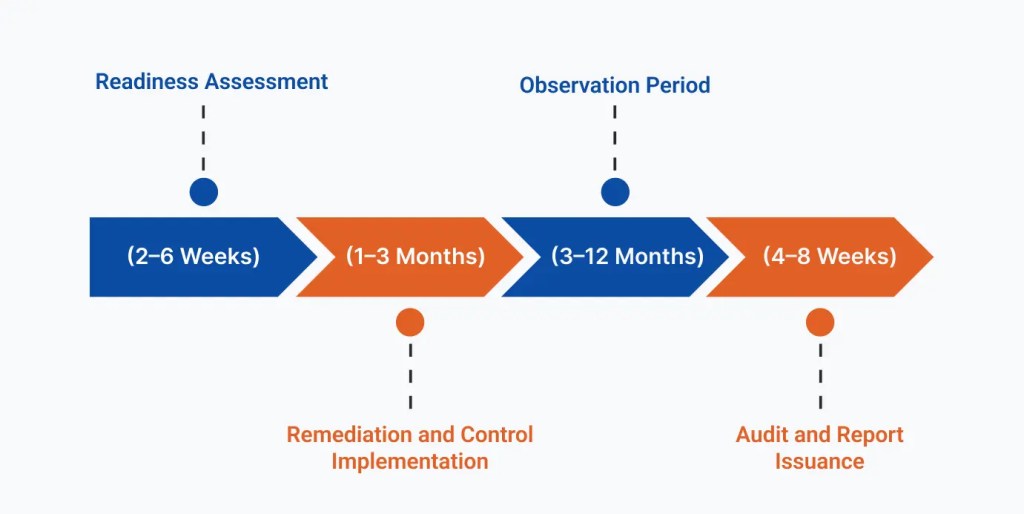
1. Readiness Assessment (2–6 Weeks)
Organizations begin by evaluating current security practices against SOC 2 requirements. During this stage, gaps are identified, priorities are established, and a compliance roadmap is created.
2. Remediation and Control Implementation (1–3 Months)
After identifying gaps, organizations implement or improve security controls, policies, procedures, and monitoring systems. The duration depends on the complexity of the required changes.
3. Observation Period (3–12 Months)
The observation period is often the longest phase. Auditors review evidence demonstrating that controls have been operating effectively over time.
4. Audit and Report Issuance (4–8 Weeks)
The auditor evaluates collected evidence, conducts interviews, performs testing, and prepares the final report.
Why does the SOC 2 Audit timeline take So long?
Many organizations underestimate the effort required to complete the SOC 2 audit timeline. Several factors contribute to the duration.
Evidence Collection Requires Consistency
SOC 2 auditors require proof that controls function consistently throughout the review period. Evidence such as access reviews, security monitoring logs, incident response activities, and employee training records must be collected and maintained regularly. Organizations that begin gathering evidence late often experience delays.
Policy and Documentation Gaps
Many companies have informal security practices but lack documented policies and procedures. Developing, reviewing, and approving documentation can take significant time, especially across multiple departments.
Cross-Functional Involvement
SOC 2 compliance is not purely an IT task. Various departments including human resources, legal, operations, executive, and security often provide documentation that aids in compliance efforts. Coordination of all the various parties involved can cause delays to projects.
Technical Remediation Efforts
Fixing any deficiencies observed in regards to security may involve the use of additional technology, configuration of tools to monitor processes, access controls, and vendor management.
The role of the SOC 2 readiness timeline
SOC 2 readiness timeline directly affects the total project length. Companies that already have an advanced security program will be able to move into the audit phase immediately, whereas those companies that have just started will need several months of preparation.
Some of the critical elements that affect the level of readiness are:
- Existing security controls
- Documented policies and procedures
- Risk management processes
- Employee security awareness programs
- Vendor management controls
- Continuous monitoring capabilities
Organizations that invest in readiness early typically experience smoother audits and fewer remediation cycles.
Common bottlenecks in the SOC 2 compliance journey
Every SOC 2 compliance journey presents unique challenges, but several issues frequently cause delays.
Lack of Executive Alignment
Without leadership support, compliance initiatives often compete with other business priorities. This can slow decision-making and resource allocation.
Manual Compliance Processes
Organizations relying on spreadsheets and manual evidence collection frequently struggle to maintain consistency and efficiency throughout the audit period.
Incomplete Asset Inventory
An inaccurate inventory of systems, applications, vendors, and data flows can create gaps that auditors identify later in the process.
Delayed Remediation Activities
Postponing security improvements can push critical milestones further into the future, extending the overall timeline.
How long does SOC 2 take for different organizations?
A common question is: how long does SOC 2 take?
The answer varies depending on company size and maturity.
Startups
Security-focused startups may complete preparation and auditing within six months if controls are already in place.
Growing SaaS Companies
Mid-stage companies often require six to nine months due to expanding infrastructure and operational complexity.
Large Enterprises
Organizations that have multiple facilities, business units, or a complex environment could take anywhere from nine to twelve months or even more in completing the entire process.
Strategies to accelerate your SOC 2 Certification timeline
Even though there are things that cannot be sped up in the process, organizations still have options that could save time.
Conduct a gap assessment Early
Identifying compliance gaps before engaging auditors helps prevent surprises and provides time for remediation.
Automate Evidence Collection
Compliance automation platforms can continuously collect logs, screenshots, access reviews, and monitoring records. This reduces administrative effort and improves audit readiness.
Assign Clear Ownership
Define responsibilities for each control and compliance task. Clear accountability helps maintain momentum throughout the project.
Standardize Documentation
Creating standardized policies, procedures, and evidence repositories simplifies review and minimizes confusion.
Monitor Controls Continuously
Rather than waiting until the audit begins, continuously monitor controls and collect evidence throughout the year.
Engage Experienced Advisors
Compliance specialists can help organizations avoid common mistakes, streamline implementation, and maintain realistic project expectations.
Building an effective SOC 2 project plan
A well-structured SOC 2 project plan can significantly improve efficiency and reduce delays.
An effective project plan should include:
- Defined compliance objectives
- Scope determination
- Control implementation milestones
- Evidence collection schedules
- Internal review checkpoints
- Auditor coordination activities
- Risk management procedures
Regular progress reviews ensure that potential issues are identified and addressed before they affect the overall timeline.
Conclusion
The SOC 2 Type 2 review process is so detailed – it analyzes the operational effectiveness of implemented security controls during a long period of time. Although the process takes time, its primary goal is to prove consistency, keep proper documentation, gather evidence, and validate effectiveness. Those who prepare for a readiness assessment, automate compliance procedures, define responsibilities and implement continuous monitoring will save much time. Knowing the factors that affect the process duration and eliminating the sources of potential delays is a key to getting ready to compliance quicker and easier.
SOC 2 Type 2 compliance need not be a headache. Regardless of whether you are a newcomer to the process or need to accelerate it, At ValueMentor, we will provide you with a professional consulting and assist with everything needed to become compliant quickly. Let us help you to get compliant and be competitive in the market.
FAQs:
Most organizations complete the SOC 2 Type 2 process within 6–12 months, depending on their readiness and security maturity.
2. How long does the SOC 2 observation period last?
The observation period typically ranges from 3 to 12 months, during which controls are tested for operational effectiveness.
3. What affects the SOC 2 implementation timeline?
Factors include existing security controls, documentation quality, remediation needs, and organizational complexity.
4. Can a startup achieve SOC 2 Type 2 quickly?
Yes. Startups with mature security practices and strong documentation may complete the process in as little as 6 months.
5. How does SOC 2 Type 1 differ from Type 2?
Type 1 audit assesses the design and implementation of controls at a specific point in time, whereas a Type 2 audit evaluates both the design and the operating effectiveness of those controls over a defined observation period.
6. Why does the SOC 2 auditing process take such a long time?
Several months are needed for collecting evidence, control monitoring, documentation review, and testing.
7. In what ways can businesses make SOC 2 compliance faster?
Gap assessment early on, automation, designated ownership, and constant monitoring could be useful in this case.
8. Is there any need for performing a readiness assessment before a SOC 2 audit?
Even though it is optional, doing so helps identify potential gaps and avoids audit delays.
9. What is included in a SOC 2 project plan?
A project plan typically covers scope, controls, milestones, evidence collection, remediation tasks, and audit preparation.
10. Does SOC 2 Type 2 require continuous compliance?
Yes. Organizations must maintain and monitor controls consistently throughout the reporting period and beyond.