


A SOC 2 report does not expire on a fixed statutory date, but in practice, most enterprise customers and procurement teams treat a report as current only when its coverage period ended within the last twelve months. If your report is older than that, it will raise questions and in competitive sales cycles, those questions can delay procurement decisions or jeopardize deals.
For CISOs, compliance officers, and founders navigating vendor security reviews, understanding the mechanics of SOC 2 report validity is not merely a compliance technicality; it is a business-critical operational concern. Enterprise procurement teams now routinely request SOC 2 reports as a baseline condition of doing business, and the age of that report matters as much as its contents. A report that accurately reflects yesterday’s controls environment is worth considerably more than one that describes how your organisation operated two years ago.
This blog walks through how long a SOC 2 report is considered valid, what happens when it lapses, how the renewal cycle works, and where a SOC 2 bridge letter fits into that picture. Whether you are managing your first audit or refining an established annual compliance programme, the goal here is to give you a clear, practical framework for keeping your assurance posture continuous and credible.
How Long Is a SOC 2 Report Valid?
This is a distinction worth internalising. The report itself does not self-destruct after a year. The AICPA does not impose a mandatory retirement date. What does change is the practical weight the report carries in vendor due diligence processes. A SOC 2 Type 2 report with a coverage period that ended eighteen months ago is not technically invalid but it will almost certainly prompt follow-up questions, requests for compensating documentation, or outright rejection from a procurement team assessing whether your current control environment meets their standards.
The reason for this twelve-month convention is straightforward: control environments change. Personnel turns over, technology stacks evolve, new third-party integrations are introduced, and threat landscapes shift. A report that accurately reflected your security posture a year or more ago may not reflect where your organisation stands today. Enterprise customers understand this, and their security or procurement teams are trained to look at the period-end date not the issuance date when evaluating whether a submitted report is current enough to rely upon.
For practical planning purposes, compliance managers should treat twelve months from the period-end date as a planning benchmark only, and confirm each customer’s report-freshness requirements. Any report approaching or exceeding that threshold should trigger a renewal planning process, not a reactive scramble once a customer flags the gap.
SOC 2 Report Expiration: What Actually Happens When a Report Lapses
In practical terms, a lapsed report creates friction at the worst possible moments. Sales cycles slow when procurement teams request updated assurance documentation that does not yet exist. Contract renewals with enterprise customers can stall. Prospective clients with mature vendor risk management programmes may deprioritise or disqualify a vendor whose most recent SOC 2 report is more than a year old.
The Distinction Between Issuance Date and Period-End Date
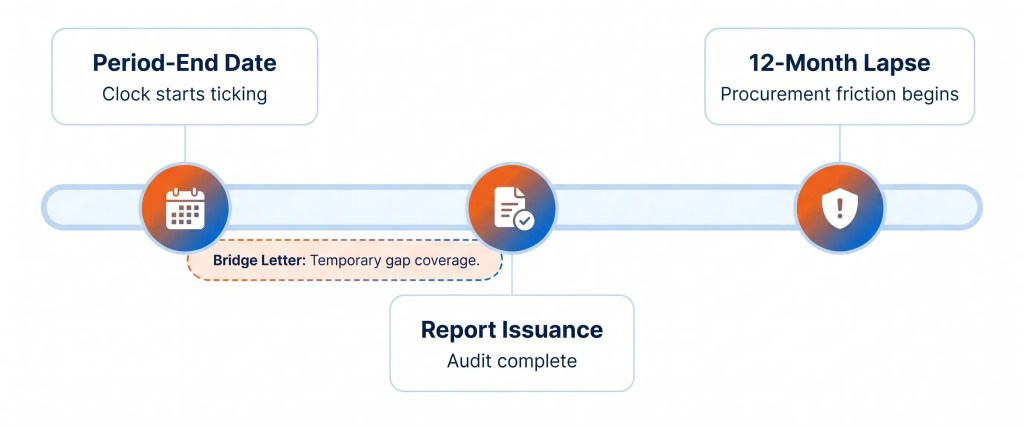
One of the most common sources of confusion among compliance teams is conflating the report issuance date with the coverage period end date. A SOC 2 Type 2 report issued in March may cover a period that ended in December of the prior year. The report is three months old by issuance date, but its coverage period ended four or more months earlier. Customers often focus on the coverage-period end date, not just the report issue date; check the customer’s stated policy.
This means organisations that delay report finalisation and issuance are inadvertently shortening their effective validity window. A report that took three months from period-end to issuance is already a quarter of the way through its practical shelf life before it reaches the customer’s desk. Efficient audit management working with an auditor who can move through fieldwork and report drafting at pace — is therefore not just an operational convenience; it directly extends the usable life of each annual report.
SOC 2 Report Validity and the Annual Renewal Cycle
The annual renewal model is now the de facto standard for service organisations serving enterprise customers. Rather than treating each audit as a discrete event, mature compliance programmes treat the SOC 2 reporting period as a rolling, continuous cycle. The observation window for the next report ideally begins on the day after the prior observation window closes, creating an unbroken chain of audited coverage that procurement teams can follow without gaps.
Planning Your SOC 2 Reporting Period
Selecting the right reporting period is a consequential decision that compliance managers sometimes underestimate. The most common approaches are calendar-year periods (January through December) and fiscal-year-aligned periods. Each has trade-offs. Calendar-year periods align naturally with customer renewal cycles and annual vendor reviews, making report timing predictable for both parties. Fiscal-year periods may align better with internal planning rhythms but can create misalignment with customers whose own vendor review cadences follow the calendar year.
Regardless of the period selected, the critical discipline is initiating renewal planning at least three to four months before the current period ends. Audit fieldwork, evidence collection, auditor scheduling, and report drafting all require lead time. Compliance teams that treat the period-end date as the trigger to begin thinking about renewal will consistently find themselves in a gap a window during which no current report exists and no bridge letter fully substitutes for one.
SOC 2 Bridge Letter: Purpose, Format, and Limitations
Bridge letters are a legitimate and widely accepted tool in the SOC 2 ecosystem. They are most commonly used when an organisation’s new audit is underway but not yet complete, and a customer or prospect requires current assurance documentation to proceed with a contract or renewal. Rather than leaving a documentation vacuum, the bridge letter provides the customer with a qualified statement from the auditor that the controls described in the prior report remain substantially in place.
What a Bridge Letter Can and Cannot Do?
It is important to be clear-eyed about the limitations of a bridge letter. It is not a substitute for a full SOC 2 report, and increasingly sophisticated procurement teams know this. A bridge letter does not include the same level of testing, evidence review, or auditor opinion that a Type 2 report provides. It is, by its nature, a statement of absence an attestation that nothing material has changed rather than a positive affirmation that controls are operating effectively.
Most enterprise customers will accept a bridge letter as a short-term continuity measure, typically covering a gap of three to six months. Bridge letters covering longer gaps, or organisations that rely on them repeatedly without producing updated reports, will encounter pushback. Some customers’ security teams explicitly prohibit accepting bridge letters in lieu of current reports as a matter of vendor risk policy. Knowing your customers’ specific requirements before a gap emerges is a fundamental part of proactive compliance management.
Bridge letters must be requested from and issued by the same independent CPA firm that conducted the prior audit. They are not documents an organisation can self-produce. The auditor’s signature and independence are central to their credibility, and any attempt to produce an internally authored continuity letter will be viewed with justifiable scepticism by a diligent procurement team.
SOC 2 Report Renewal: Building a Sustainable Compliance Programme
The organisations that handle SOC 2 renewal most effectively are those that have embedded compliance readiness into their day-to-day operations. Evidence collection is ongoing rather than a last-minute scramble before audit fieldwork begins. Control owners understand their responsibilities year-round. The compliance function maintains an audit-ready posture continuously, which means that when the annual observation window opens, the organisation is already prepared rather than spending the first several weeks building the foundation.
Partnering with the Right Auditor
The choice of audit partner has a meaningful impact on renewal efficiency. An auditor who understands your industry, your control environment, and your customer base can conduct fieldwork more efficiently and produce a higher-quality report in less elapsed time. This directly translates to a shorter gap between coverage period end and report issuance preserving more of the twelve-month validity window for active commercial use. ValueMentor works as a partner to organisations navigating exactly this challenge, helping compliance teams build audit-ready programmes that reduce friction at every stage of the renewal cycle.
A sustainable renewal programme also involves periodic scope reviews. As organisations grow, add new products, expand into new geographies, or acquire new infrastructure, the scope of the SOC 2 audit should evolve accordingly. Failing to update scope means the report may not cover controls that customers reasonably expect to see evaluated — which can create its own credibility gap even when the report is technically current.
Conclusion
SOC 2 report validity is one of those compliance mechanics that looks straightforward on the surface and then reveals meaningful complexity the moment it intersects with live customer requirements, sales timelines, or contract renewals. The practical twelve-month validity window, the nuances of period-end versus issuance dates, and the appropriate but limited role of bridge letters are all areas where organisations benefit from clarity well before a gap emerges. Treating the SOC 2 renewal cycle as a continuous programme discipline rather than an annual event is what separates organisations that maintain audit-ready postures from those that find themselves explaining stale documentation to a sceptical procurement team. Looking ahead, enterprise expectations around SOC 2 currency are only becoming more rigorous. Vendor risk management functions are maturing across industries, and the tolerance for documentation gaps or bridge-letter workarounds is narrowing. Organisations that invest now in building sustainable, continuously audit-ready compliance programmes with clear ownership, well-scoped observation periods, and efficient auditor relationships are the ones best positioned for high-performance outcomes as these expectations continue to rise. Navigating SOC 2 validity, renewal timing, and bridge letter requirements is far more manageable with a knowledgeable partner in your corner. Visit ValueMentor to explore how our compliance specialists work alongside your team to keep your SOC 2 programme current, credible, and aligned with your customers’ expectations so your assurance posture is never the reason a deal stalls.
FAQs
A SOC 2 Type 1 report assesses whether controls are suitably designed at a single point in time. A SOC 2 Type 2 report evaluates both the design and the operating effectiveness of those controls over a defined observation period, typically six to twelve months. Type 2 is the standard most enterprise customers require for ongoing vendor qualification.
Who needs a SOC 2 report?
Service organisations that store, process, or transmit customer data typically need a SOC 2 report. This includes SaaS companies, cloud infrastructure providers, managed service providers, and data centres. Enterprise customers, particularly in regulated industries such as financial services and healthcare, routinely require SOC 2 reports as a condition of vendor approval and contract execution.
What is a SOC 2 report?
A SOC 2 report is a formal audit report produced by an independent, licensed CPA firm that evaluates whether a service organisation’s controls meet the AICPA Trust Services Criteria. It covers one or more of five categories — security, availability, processing integrity, confidentiality, and privacy and is widely required by enterprise customers as evidence of a credible security posture.
How long does it take to get a SOC 2 report?
A SOC 2 Type 1 report generally takes two to four months from readiness assessment through issuance. A SOC 2 Type 2 report requires an additional observation window of six to twelve months, meaning the full process from initial readiness work to a completed Type 2 report can span eight to sixteen months depending on organisational preparedness and auditor efficiency.


