In today’s world, the usage of Artificial Intelligence (AI) has transitioned from being merely a technological resource, to becoming an integral part of the corporate strategies of all organisations. At this same time, organisations have also recognised how powerful these new capabilities become when used within the proper guidelines established by the boards of directors. In recognizing this power of AI and its value to corporations, the corporate executives and board members should be vigilant regarding the AI risks that occur for their organisations and be aware of operational and finances associated with AI, but also ethical and regulatory AI risk management. However, the board will have to bridge the gap between technical risk that AI poses and how that might affect the decision – making of board members.
In this context, effective board reporting of AI practices is essential to ensure that technical risks are translated into clear, strategic insights. In this blog, we will discuss how companies may effectively communicate AI risk to the board, provide a simple AI risk reporting form and provide some education tips for the directors regarding their duty to govern AI as a corporation.
Overview of AI Risk for Board Decision-Making
Before creating an outline for a board of directors regarding artificial intelligence (AI) liability concerns, executives need an overview of the various types of AI risk. Three broad categories exist:
- Operational Risk: Examples of operational risk include failure of the system due to defects, errors, or human error in interpreting results, as well as inaccurate predictions made by AI models. For example, a predictive inventory planning tool may not be able to predict every possible disruption (e.g., weather) that could cause problems within the supply chain.
- Ethical & Compliance Risk: Examples of ethical/compliance risk are discrimination resulting from bias in AI systems and/or regulation regarding discrimination from AI systems. As AI is becoming more widely used in hiring, lending, and health care, regulators will continue to focus on potential unethical or unlawful behavior resulting from AI-driven decision-making.
- Strategic & Reputational Risk: An example of strategic/reputational risk could be an AI-based marketing campaign that misrepresents the value proposition for a product, thereby harming the company’s brand and reputation. An AI program designed to generate customer referrals could also result in decreased customer satisfaction/loyalty. Therefore, the first step in establishing sound AI governance policies at the board level is to identify the potential business impacts of the various categories of AI risk, and to communicate the technical AI-related challenges in a manner that demonstrates to the board their potential impacts on their company.
How to Explain AI Risk to the Board?
Clarity, context, and accountability are the basis for an effective boardroom. When communicating AI risk to the board, the focus should be on three factors:
1) Impact
When estimating how much money may be lost from an AI-risk incident, quantify it with dramatic examples (i.e. “If this AI model fails to provide an accurate number during peak season, $X million revenue loss”). Directors understand how serious these potential risks could be.
2) Likelihood
Estimate the chance of this event happening with vague terminology, instead of with a technical figure (like a p-value). Use simple terms like “low,” “medium,” and “high” to rate risk. A visual matrix for assessing levels of risk will help direct board members to understand quickly and easily.
3) Business Scenario
To increase your chance of gaining board support, the presentation of risk should occur in the context of a specific business function. For example, if an AI tool is biased in regard to recruiting candidates, that might negatively impact the quality and quantity of hires as well as their ability to meet diversity and inclusion targets and maintain compliance with the law.
By discussing Impact, Likelihood, and Business Scenario together, executive leadership can communicate risks to the board in a succinctly organized and understandable manner.
AI Risk Reporting Template for Boards
A standardized reporting template ensures consistency and clarity. Below is a simple example tailored for board presentations:
| Risk Name | Description | Business Impact | Likelihood | Mitigation Strategy | Owner | Status |
|---|---|---|---|---|---|---|
| AI Model Bias | Risk of biased hiring outcomes due to flawed AI training data | Medium impact: regulatory scrutiny, reputational harm | Medium | Audit training data, implement fairness checks | AI Lead | Ongoing |
| Predictive Model Failure | Inaccurate demand forecasting | High impact: revenue loss up to $2M | Low | Model validation, scenario testing | Data Science Head | Planned |
| Regulatory Non-Compliance | AI solution not meeting emerging legal requirements | High impact: fines, legal action | Medium | Regular compliance review, external audit | Compliance Officer | Active |
Tips for using this template effectively:
- Keep descriptions concise and non-technical. Avoid algorithmic details unless requested.
- Focus on risk implications for business outcomes.
- Include mitigation strategies and status updates to show proactive management.
- Assign clear ownership to ensure accountability.
This approach aligns with AI governance for boards by ensuring directors see the full picture without being overwhelmed by technicalities.
Board-Level AI Governance Practices
To effectively oversee A.I., boards must put in place regulations that strike a balance between encouraging creativity and keeping an eye on the processes surrounding the use of A.I. The following are strategies that would help with this goal:
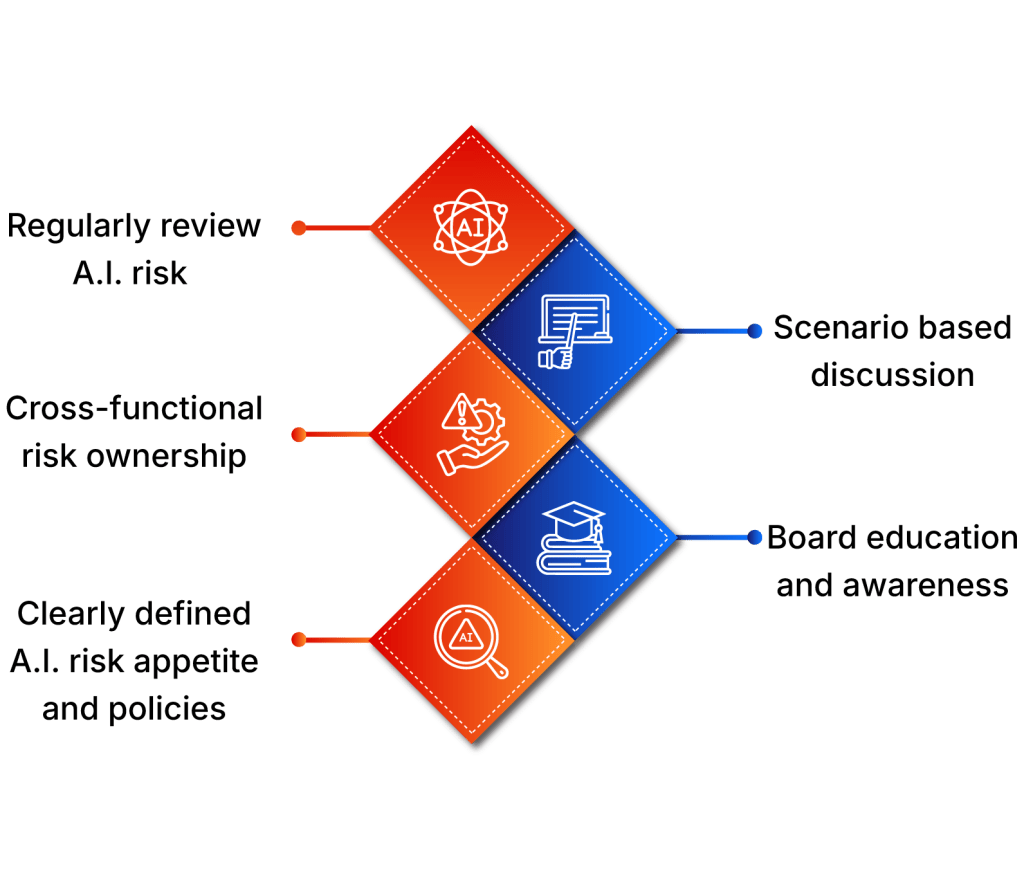
- Regularly review A.I. risk – By holding quarterly meetings where all A.I. risks are reviewed, boards keep A.I. information top of mind for their members, allowing for timely decisions on any needed intervention.
- Scenario based discussion – When discussing any A.I. risk, use a specific example to demonstrate the potential negative impact should the risk materialise. Scenario planning is essential for all boards to encourage forward thinking and require the development of plans for mitigating A.I. risks.
- Cross-functional risk ownership – Although the primary responsibility for managing and minimising A.I. risks reside with the A.I. teams themselves, all team members involved (e.g., risk management, compliance, business areas) should work together to evaluate A.I. risks from multiple disciplines.
- Board education and awareness – A good board will hold training or workshops for directors on A.I. education. Some possible topics of concern include A.I. ethics, regulatory trends and emerging threat areas.
- Clearly defined A.I. risk appetite and policies – A.I. initiatives should each be clearly defined, including the acceptable level of risk. Failure to do so hampers the board’s ability to consistently make decisions regarding the allocation of resources.
By implementing these practices, companies can improve their organisational resilience and align their A.I. initiatives with their corporate strategies.
Practical Tips for Educating Directors
It is equally crucial to prepare a company’s board about the threats posed by Artificial Intelligence (AI). To accomplish this, an executive may utilize some of the tools outlined below:
- Present Data Visually – Risk heat maps, dashboards, and charts are methods by which complex sets of information become more comprehensible.
- Use Peer Benchmarking – Comparing the way other firms (such as competitors) handle their AI risks provides relative comparisons.
- Identify Developing Regulatory Trends – Identifying new legal requirements will assist in forming AI-related strategic initiatives.
- Eliminate Technical AI Terminology – Reduce usage of technical, AI-related terminology; emphasis should be placed on business implications and avenues for action.
- Conduct Interactive Workshops – Interactive workshops containing case studies and role-playing exercises provide board members with firsthand experience of real-world AI risk circumstances.
Promoting an educational orientation toward boards will enable them to make informed strategic decisions even without the benefit of knowledge regarding all the underlying technical complexities.
Conclusion
Both for compliance and as a tool to help boards of directors with their AI risk, communicating AI risk to the boards is also a strategic imperative. Executive management can enable boards of directors to make informed decisions that strike a balance between innovation and responsibility by converting technical risks to actionable insights that are understandable for the business. By implementing structured approaches-e.g., impact/likelihood/scenarios reporting structure, implementation of AI risk reporting templates with defined standards across the organization, and conducting ongoing board education on AI technologies-organizations can set up a structure within their organization that supports strong governance for their boards with respect to AI risks and helps organizations raise AI risk to the same level as other risks.
Good AI risk management is not simply “avoiding” AI breakdown but enabling boards of directors to responsibly use AI to develop successful strategies that utilise AI safely, confidently and ethically. Organisations that wish to strengthen their AI governance and risk management processes at the board level can benefit from the best practices and advice delivered by ValueMentor. Find out how to convert AI risk into actionable insights for your board and create effective AI governance practices with ValueMentor to elevate AI risk management to the level of a board priority today.
FAQS
1. What is board reporting AI?
Board reporting AI refers to presenting AI risk and performance information to the board in a clear, concise, and actionable manner.
2. Why is AI risk management important for boards?
AI can significantly impact operations, compliance, and reputation. Boards must oversee AI risk to protect stakeholders and ensure strategic alignment.
3. How often should AI risks be reported to the board?
Quarterly reporting is recommended, with updates on significant changes or incidents as needed.
4. What makes AI risk different from other enterprise risks?
AI risk often involves technical complexity, unpredictability, and ethical considerations that may not appear in traditional risk frameworks.
5. Can AI risk be fully mitigated?
No. AI risk can be managed, monitored, and reduced, but complete elimination is rarely possible due to inherent uncertainties.
6. Who should own AI risk in the organization?
A cross-functional approach works best, with risk owners from AI teams, compliance, legal, and business units.
7. How do boards evaluate AI risk?
Boards evaluate AI risk based on impact, likelihood, and business context, rather than technical model details.
8. What is an AI risk reporting template?
A structured format for documenting AI risks, their impact, likelihood, mitigation strategies, ownership, and status, to communicate effectively with boards.
9. How can boards ensure AI projects align with strategy?
By incorporating AI risk reviews, setting clear risk appetite, and aligning initiatives with business objectives.
10. How can boards stay updated on AI governance trends?
Through industry reports, regulatory updates, AI risk workshops, and consulting with AI governance experts.