
The banking and finance sector remains a prime target for cybercriminals due to the immense value of financial data. In Q1 2025 alone, the financial services industry led all sectors with 193 reported data compromise incidents, accounting for nearly a quarter of all cases affecting over 91 million individuals. In this climate, data privacy in banking and finance isn’t just a regulatory requirement, it is essential for maintaining customer trust and operational continuity. Digital banking, AI-based fraud detection, fintech apps, and open banking APIs have made financial services faster and smarter but have also introduced new privacy risks. So, how can institutions balance innovation with protection? Let’s find out.
What is data privacy in banking and finance?
Data privacy in the financial industry refers to the responsible collection, processing, storage, and sharing of customers’ personal and financial information. This includes everything from bank account details and credit card numbers to income history, investment patterns, and biometric identifiers. Unlike general data protection, financial privacy is bound by both national regulations and industry-specific compliance frameworks. For example, financial institutions must comply with country-specific regulations enforced by authorities like the Saudi Arabia Monetary Authority (SAMA) in KSA and the Central Bank of Bahrain (CBB) in Bahrain.
Why is financial data privacy essential and where does it drive value in banking?
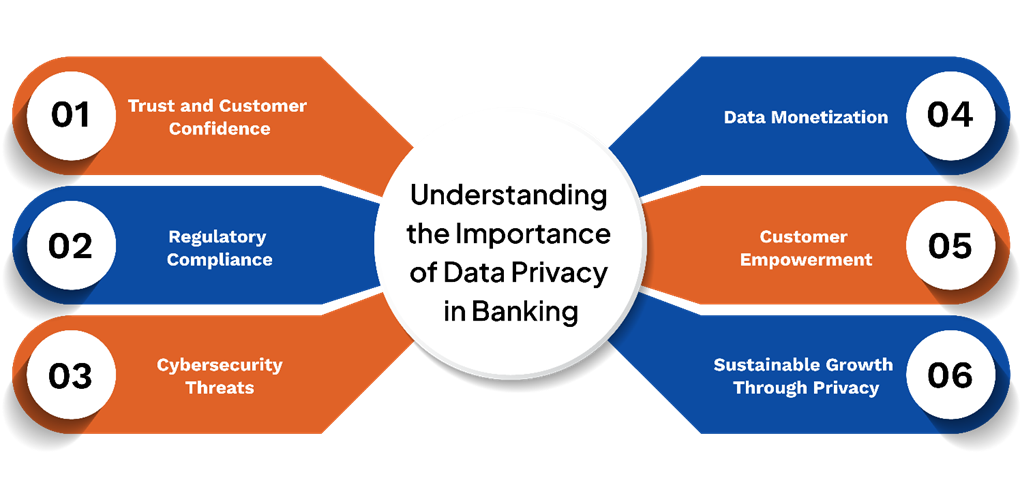
The stakes are higher in finance than most sectors. One data leak could expose thousands of customers to fraud, identity theft, or account takeovers. For businesses, it means loss of reputation, legal action, and customer churn. Trust, once broken, is rarely regained in this industry. The more empowered customers feel, the more likely they are to engage deeply and share data with confidence.
1. Trust and Customer Confidence
For banks and financial institutions, privacy starts with building trust. Clients want assurance that their sensitive financial information is secure. Trust is the foundation of long-term loyalty and once lost, it is difficult to regain.
2. Regulatory Compliance
Privacy compliance isn’t optional. Regulations such as GDPR, UAE PDPL, and India’s DPDP Act demand clear consent, data minimization, secure storage, and timely breach notifications. Financial regulators like the RBI, MAS, DFSA, and ECB are enforcing stricter standards to ensure accountability.
3. Cybersecurity Threats
As cyberattacks grow more sophisticated phishing, ransomware and third-party breaches protecting financial data becomes critical. These threats don’t just compromise systems they target customer trust and personal information.
4. Data Monetization
Banks increasingly rely on data analytics to personalize services and drive innovation. But without privacy safeguards, data monetization can pose significant risks. Transparent consent and governance are essential for responsible innovation.
5. Customer Empowerment
Modern privacy is about control. Giving individuals ownership over their data like what is collected, how it is used and who sees it builds transparency and deepens engagement.
6. Sustainable Growth Through Privacy
Empowered customers are more likely to trust and interact with digital banking services. Strong privacy practices not only protect data but also drive sustainable business growth and customer loyalty. In an industry where trust is currency, how financial institutions handle personal data directly impacts loyalty, reputation, and innovation. By investing in privacy, banks and fintech’s are not just minimizing risk they are unlocking strategic advantages that drive growth in a competitive market.
How is data privacy implemented in financial institutions?
In the finance sector, data privacy is both a compliance requirement and a trust-building strategy. Here is how banks and financial institutions implement it effectively:
1. Data Classification
Identifying and labelling sensitive data (like account details or KYC info) helps determine appropriate protections such as encryption, access control and retention rules.
2. Purpose Limitation & Privacy Notices
Data should only be collected for specific, legitimate reasons. Privacy notices must clearly explain why data is collected, how it’s used, and if it’s shared ensuring transparency and compliance.
3. Role-Based Access Control
Limiting access based on job roles reduces internal risks and ensures only authorized users handle sensitive financial data.
4. Encryption & Tokenization
Sensitive data is encrypted or tokenized to secure it during storage and transmission minimizing breach risks.
5. Data Subject Rights
Customers have legal rights to access, correct, or delete their data. Institutions must support these requests through clear processes.
6. Retention & Disposal Policies
Data should only be stored as long as necessary. Clear retention schedules and secure disposal reduce exposure and legal risk.
7. Privacy by Design
Privacy is built into digital banking products and processes from day one through data minimization, consent controls, and secure system architecture.
8. Audit Logs
Detailed access logs help monitor who accessed what and when critical for detecting misuse and supporting regulatory audits.
9. Privacy Risk Assessments
Regular assessments (like DPIAs) help uncover privacy gaps before launching new tools or workflows.
10. Third-Party Risk Management
Banks must ensure vendors and fintech partners follow the same privacy standards through contracts, audits, and monitoring.
Organizations like ValueMentor support banks and financial institutions in implementing end-to-end data privacy frameworks ensuring both compliance and resilience.
Best practices for financial data privacy
Financial institutions must move from reactive fixes to proactive, privacy-by-design strategies. Building a privacy-first culture not only safeguards sensitive data but also strengthens customer trust and operational integrity. Here are five essential practices that every forward-thinking bank or fintech should adopt:
1. Build privacy into the foundation, not the finish.
Treat privacy as a design principle not a compliance patch. Incorporate privacy requirements early in the system development lifecycle to ensure data protection is baked into every feature and workflow.
2. Train your people
Employees remain the weakest link in most data breaches. Regular privacy training, phishing simulations and role-specific security awareness programs can significantly reduce the risk of internal mishandling.
3. Map your data and keep it updated.
You can’t protect what you can’t see. Conduct routine data mapping exercises to understand where sensitive customer data is stored, how it flows across systems, and who has access. This clarity is critical for both compliance and breach response.
4. Adopt Zero Trust principles for access control.
With remote work and digital banking on the rise, trust boundaries have dissolved. Enforce strong authentication, role-based access, and least-privilege policies to limit exposure and contain potential threats.
5. Leverage automation for smarter privacy management.
Modern privacy tools can automate tasks like consent collection, breach detection, data minimization, and secure data disposal. These technologies not only improve efficiency but also ensure compliance with evolving global regulations.
The future of data privacy in banking
In a future shaped by AI-driven insights, open banking frameworks, and seamless cross-border transactions, the institutions that stand out will be those that embed privacy into every layer of their operations from app interfaces to back-end infrastructure. Customers increasingly expect personalization without intrusion. To meet this demand, financial institutions must master the art of privacy-preserving innovation delivering tailored services while safeguarding individual data rights. That balance will define digital trust in the years ahead.
On the regulatory front, the momentum toward data localization and stricter governance is accelerating. Countries across the Middle East, Asia, and Europe are enacting laws that demand localized processing and heightened accountability from those handling financial data. Frameworks like Sensitive Data Services Provider (SDSP) are setting new standards for who can manage and store critical financial information and under what conditions. As a result, cloud-native, compliance-ready, and privacy-centric architecture will no longer be optional it will be foundational. Banks that invest early in this transformation won’t just stay ahead of regulation they will build reputations as privacy leaders in a trust-fragile era.
Final thoughts
Financial services have entered an era where privacy equals performance. Customers don’t just want their money managed well they want their data treated with the same level of care. With the regulatory spotlight brighter than ever, building privacy-first systems is no longer optional it’s the foundation of trust in a digital-first financial world. Organizations that embed privacy into every touchpoint from mobile apps to internal workflows aren’t just staying compliant. They are sending a message: Your data is safe with us. And in finance, that is the most valuable currency of all.
FAQs
1. What’s the difference between data privacy and data security in banking?
Data security focuses on protecting data from unauthorized access or breaches, while data privacy ensures that customer data is collected, used, and shared in ways that respect individual rights and comply with regulations.
2. Which regulations apply to financial data privacy in the Middle East, US, and India?
In the Middle East, regulations like Personal Data Protection Law (UAE) and SAMA’s frameworks apply. The US has GLBA and state-specific laws like CCPA, while India enforces the Digital Personal Data Protection Act. Each region has strict rules around consent, storage, and cross-border data transfers.
3. How do fintech’s ensure data privacy when integrating with banks?
FinTech’s must comply with the bank’s data handling policies, follow third-party risk management protocols, use secure APIs, and must undergo audits to prove adherence to privacy and security requirements. They also implement additional privacy controls such as encryption, role-based access, data minimization, consent management, and data retention policies to safeguard customer information.
4. What are some real-world consequences of poor data privacy in finance?
Consequences include regulatory fines, legal actions, customer churn, reputational damage, and suspension of operations. Some banks have lost millions and suffered long-term trust erosion after breaches.
5. How often should financial institutions conduct privacy risk assessments?
Ideally, assessments like Data Protection Impact Assessment should be conducted annually or before launching new digital services, partnerships, or data-intensive initiatives to identify and mitigate privacy risks proactively. While not always mandated by law, DPIAs are a regulatory requirement under laws like the EU GDPR (Article 35) for high-risk data processing. In other regions, including the UAE and India, they are considered a best practice for proactive privacy risk management and compliance readiness.
6. Is customer consent enough to collect and use financial data?
No. While consent is essential, banks must also ensure purpose limitation, data minimization, transparency, and secure storage-all part of a broader compliance framework.
7. What is ‘Privacy by Design’ in banking applications?
It’s a practice where privacy features like encryption, data minimization, access control, and consent flows are integrated into apps and systems from the beginning rather than being added later.
8. Can banks use AI and analytics while still respecting data privacy?
Yes, if done ethically. Techniques like anonymization, differential privacy, and strict access controls allow banks to derive insights without compromising individual data rights.
9. How does Zero Trust architecture help protect financial data?
It ensures that access is granted only after strict verification, regardless of the user’s location. It limits access to sensitive financial systems and data based on clear need, reducing the risk of unauthorized exposure or misuse-even from within the organization.
10.What should customers do if they suspect a breach of their financial data privacy?
They should promptly report it to their bank’s data protection officer or support team, monitor account activity, and notify the relevant data protection authority ideally within 72 hours, as recommended under laws like the EU GDPR.