Card payments have become the backbone of modern businesses in Qatar, but with growing digital transactions comes a rising risk of data breaches and fraud. Customers now not only expect ease of doing business, but they also expect complete security while they share their payment information. That is where PCI DSS Certification in Qatar plays a vital role. With this, you can protect your customers’ sensitive information and operate your business with trust and security, adhering to universally accepted security standards. Whether you own a shop or run an online store, security is a key aspect to be considered.
In this blog we want to help the people in charge of computers the teams that make sure companies follow the rules and the owners of businesses, in Qatar that handle card payments. We will show them how to do things in a way that works for them. We will talk about what the rules are how to get certified. This guide will cover everything these people need to know to get certified and stay certified.
How do Card Payments work in Qatar?
The payment system of Qatar is one of the most developed systems in the region, especially because of the high degree of regulation and emphasis on digital transformation. The increased use of digital wallets, contactless cards, and electronic commerce has resulted in an increase in the number of transactions using cards many times over in the last few years. The Qatar Central Bank (QCB) is the main governing body, which oversees the activities of financial institutions so that a high degree of security is achieved in the system. Organizations have to adhere to both global requirements and local requirements while conducting business in the country. This necessitates a well-structured approach to data security.
Another factor that has contributed to the development of the payment system in Qatar is the collaboration between banks, financial technology organizations, and payment gateways. Even though this collaboration has increased the overall level of comfort for users, it has also increased the risk factor; therefore, PCI DSS compliance is a must in Qatar.
Who needs PCI DSS in Qatar?
One of the most important questions businesses ask is: Who needs PCI DSS in Qatar? The answer is simple—any organization that stores, processes, or transmits cardholder data must comply with PCI DSS requirements.
This includes a wide range of businesses such as:
- E-commerce platforms handling online transactions
- Retail stores using POS systems
- Banks and financial service providers
- Hotels, restaurants, and other hospitality businesses
- Payment processors and third-party service providers
Neither are small and medium-sized businesses immune. Although validation requirements may vary depending on volume, responsibility for securing card holder data is the same for all businesses. Knowing your level of compliance early on can actually simplify the process for you.
Step-by-Step process to get PCI DSS Certification in Qatar
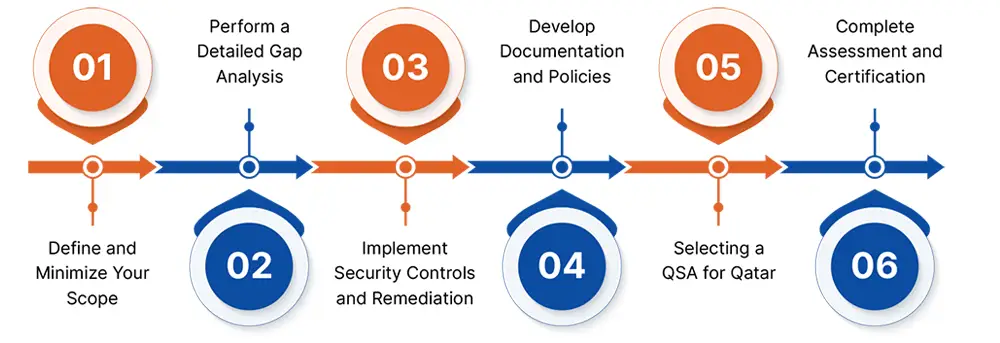
1. Define and Minimize Your Scope
The initial process in the Step-by-step process is the identification of the location of the cardholder data within your organization. This could include systems, applications, networks, and even integrations with third parties.
Reducing your scope for PCI can greatly help in lowering your costs and requirements. Most businesses in Qatar use a payment gateway for this purpose.
2. Perform a Detailed Gap Analysis
A gap analysis is a key process in identifying discrepancies between your current security posture and the PCI DSS requirements. This process entails a review of your infrastructure, policies, and procedures in order to identify vulnerabilities.
Common gaps include:
- Weak password policies
- Lack of encryption
- Insufficient monitoring systems
- Outdated software or hardware
Addressing these gaps early helps prevent delays during the formal assessment stage.
3. Implement Security Controls and Remediation
Once gaps are identified, the next step is implementing corrective measures. PCI DSS outlines 12 core requirements, covering areas such as network security, data protection, access control, and monitoring.
Key actions include:
- Installing and maintaining firewalls
- Encrypting cardholder data during transmission and storage
- Restricting access based on business need
- Regularly testing systems for vulnerabilities
This phase often requires collaboration between IT teams, cybersecurity experts, and senior management to ensure full alignment.
4. Develop Documentation and Policies
Documentation is a critical yet often underestimated aspect of PCI DSS compliance. Organizations must create clear policies related to:
- Data protection and privacy
- Incident response
- Risk management
- Employee training and awareness
Well-documented processes not only support compliance but also improve internal governance and accountability.
5. Selecting a QSA for Qatar
For many organizations, especially those with higher transaction volumes, working with a Qualified Security Assessor (QSA) is mandatory. Selecting a QSA for Qatar requires careful consideration of several factors.
Look for a QSA who:
- Has experience with Qatar’s regulatory framework
- Understands your industry-specific challenges
- Offers end-to-end support, including pre-assessment and remediation guidance
A knowledgeable QSA can help simplify complex requirements and ensure a smoother certification journey.
6. Complete Assessment and Certification
The final stage involves validating your compliance. Depending on your organization’s size and transaction volume, you may:
- Complete a Self-Assessment Questionnaire (SAQ), or
- Undergo a full audit conducted by a QSA
Successful validation results in an Attestation of Compliance (AOC) or Report on Compliance (ROC), confirming that your organization meets PCI DSS standards.
How much does PCI DSS certification cost in Qatar?
Understanding Costs and timelines is essential for effective planning. The total investment depends on several variables, including:
- Size and complexity of your IT environment
- Number of card transactions processed annually
- Existing security infrastructure
- Need for external consultants or QSA services
However, for smaller businesses, the cost may remain relatively low, especially if the businesses use third-party payment systems. In the case of larger businesses, the cost may be high as the businesses may need to upgrade their infrastructure, conduct audits, and use monitoring tools.
The timeline may take anywhere from 3-6 months for businesses that are well prepared to more than a year for businesses that need more work.
What are the ongoing PCI DSS requirements after certification?
Achieving compliance is only the beginning. With post-certification, organizations must continuously monitor and maintain their security posture to remain compliant.
Key activities include:
- Conducting regular vulnerability scans and penetration testing
- Updating systems and applying security patches
- Monitoring access logs and suspicious activities
- Providing ongoing employee training
Compliance is an ongoing process, not a one-time achievement. Businesses that treat it as part of their core operations are better positioned to handle evolving cybersecurity threats.
Common challenges and how to overcome them?
Many organizations in Qatar face challenges during their PCI DSS journey, including:
- Limited internal expertise
- Budget constraints
- Complexity of legacy systems
- Lack of awareness among different departments
In order to overcome these challenges:
- Invest in employee training and awareness
- Use automation tools for compliance
- Work with seasoned consultants and QSAs
- Divide the process into manageable phases
This will greatly reduce stress and increase the success rate.
Conclusion
As Qatar grows as a financial hub keeping payment information safe should be top priority for businesses. PCI DSS certification is an accepted security standard that helps businesses meet requirements and gain customer trust. The Qatar payment ecosystem, the importance of PCI DSS in Qatar and a step-by-step guide to getting certified can help businesses get on track. With a plan and the right tools, investing in PCI DSS certification makes sense for businesses. It helps businesses protect customer data and build trust. PCI DSS certification is an investment for businesses in Qatar.
Ready to achieve PCI DSS compliance in Qatar? Get in touch with ValueMentor to streamline your certification journey with expert guidance, proven methodologies, and end-to-end support tailored to your business needs.
FAQs
1. Is PCI DSS certification mandatory in Qatar?
Yes. If your business handles card payments, PCI DSS compliance is required to protect cardholder data and meet regulatory expectations.
2. Who exactly needs PCI DSS compliance in Qatar?
Any business that stores, processes, or transmits card data—including e-commerce sites, retailers, and service providers.
3. How long does PCI DSS certification take?
It can take anywhere from 3 months to over a year, depending on your current security setup and business complexity.
4. What is the first step to get PCI DSS certified?
Start with scoping your environment and identifying where cardholder data is stored, processed, or transmitted.
5. How much does PCI DSS certification cost in Qatar?
Costs vary widely—from a few thousand dollars for small businesses to significantly higher for large enterprises with complex systems.
6. Do small businesses in Qatar need PCI DSS compliance?
Absolutely. Even small businesses must comply if they accept card payments, though validation requirements may be simpler.
7. What is a QSA and do I need one?
A Qualified Security Assessor (QSA) is a certified auditor. Larger businesses typically need a QSA, while smaller ones may use a Self-Assessment Questionnaire.
8. Can I outsource PCI DSS compliance requirements?
You can outsource payment processing, but not responsibility. Your business is still accountable for compliance.
9. What happens if my business is not PCI DSS compliant?
Non-compliance can lead to penalties, data breaches, loss of customer trust, and even restrictions from payment providers.
10. Is PCI DSS certification a one-time process?
No—compliance is ongoing. You must continuously monitor, update, and maintain your security systems.