For many organizations, cybersecurity has traditionally been approached through the lens of compliance meeting regulatory requirements, passing audits, and maintaining certifications. These efforts provide discipline, structure, and accountability, and they remain essential. However, in today’s environment, cybersecurity can no longer succeed as a compliance‑led exercise. Threats evolve too quickly, business environments change too often, and the impact of cyber incidents has grown too severe.
The limitations of a compliance‑only approach
Compliance frameworks set valuable baselines. Yet when they become the main driver of cybersecurity decisions, organizations encounter structural limitations even when compliance is done well.
1. Compliance reflects a point in time
Most compliance assessments are periodic. They validate controls at a specific moment often once a year.
Cyber risk does not wait for audit cycles.
Between reviews, organizations adopt new technologies, migrate services to the cloud, integrate third parties, and change how employees work. At the same time, new vulnerabilities and attack techniques emerge continuously. An organization may remain compliant while its actual exposure increases unnoticed.
2. Threats evolve faster than regulations
Compliance requirements are designed to be stable and broadly applicable. Attackers are not bound by that pace.
Recent years have shown how quickly threat patterns evolve-AI‑driven phishing, identity‑based attacks, and supply‑chain compromises often gain traction long before regulations or standards adapt. Many major incidents exploit gaps that no compliance framework had yet anticipated.
Organizations that rely solely on compliance often find themselves responding to yesterday’s risks while today’s threats go unmanaged.
3. The “Checkbox Effect” creates false confidence
When success is measured primarily by audit outcomes, security efforts naturally drift toward minimum conformance rather than maximum resilience.
This mindset can result in:
- Controls optimized for documentation, not effectiveness
- Risks outside compliance scope being deprioritized
- Leadership assuming risk is under control because requirements are met
The danger is not lack of effort, but misplaced assurance.
4. Compliance does not fully reflect business reality
Cyber risk is always business‑specific. Digital dependency, data sensitivity, geographic reach, and third‑party reliance all shape an organization’s risk profile.
Generic compliance requirements cannot capture these nuances. When cybersecurity decisions are driven by standard checklists instead of business impact, critical exposures may remain under‑addressed.
5. The core issue
- Compliance optimizes for conformance.
- Cybersecurity must optimize for resilience.
This distinction explains why organizations can be fully compliant and still experience serious cyber incidents. Addressing this gap requires a fundamental shift in how cybersecurity is approached.
Cybersecurity is a strategy for managing risk
At its core, cybersecurity is about one fundamental question:
How does cyber risk affect our ability to operate, grow, and maintain trust?
When organizations start from this question, cybersecurity becomes a strategic capability rather than a technical function. Controls, policies, and technologies are chosen based on impact-not checklists.
In such a model:
- Cyber risk drives decisions
- Security capabilities align with business priorities
- Compliance emerges naturally as an outcome of disciplined execution
This distinction is subtle but critical. Compliance confirms alignment with external expectations; cybersecurity strategy determines whether the organization can withstand real‑world threats.
Why risk management must anchor cybersecurity strategy
Technology is evolving at an unprecedented pace-cloud adoption, AI, remote work, and deep digital supply chains are now default operating conditions. Threat actors evolve just as rapidly, often faster.
Consider a few realities many organizations face today:
- AI‑assisted phishing campaigns that are customized, context‑aware, and difficult even for trained employees to detect
- Supply‑chain compromises that exploit trusted vendors rather than internal weaknesses
- Identity‑based attacks that bypass traditional perimeter defenses entirely
- Vulnerabilities exploited within hours or days-long before advisory guidance or regulatory updates exist
Compliance frameworks were never designed to respond at this speed. They are necessarily deliberate and stable. Risk management fills that gap by continuously evaluating what matters most, what could realistically go wrong, and where effort delivers meaningful protection.
In this environment, risk management is no longer a supporting activity-it is the cornerstone of cybersecurity strategy.
From compliance thinking to capability thinking
A useful way to understand a risk‑driven cybersecurity strategy is to shift the conversation from requirements to capabilities.
The NIST model offers a practical lens for this-not as a checklist, but to frame what an organization must be able to do to manage cyber risk effectively.
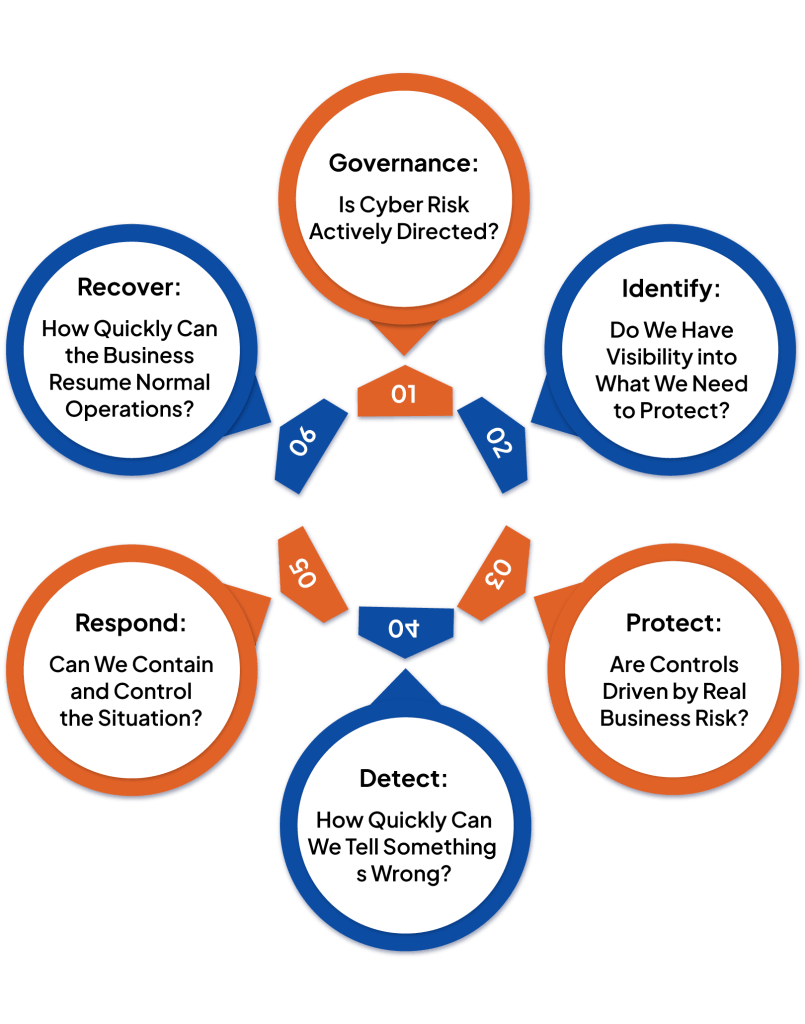
1. Governance: Is cyber risk actively directed?
Cybersecurity begins with governance. Without clear direction, accountability, and oversight, technical controls operate in isolation.
This is where adopting a structured cybersecurity management system-such as ISO 27001 adds real value. Not because it “achieves compliance,” but because it:
- Establishes ownership and accountability
- Integrates cybersecurity into enterprise risk management
- Enables consistent decision‑making and continual improvement
Strong governance turns cybersecurity from an operational concern into a leadership‑owned risk.
2. Identify: Do we have visibility into what we need to protect?
Risk cannot be managed without visibility.
Organizations must understand:
- What assets exist across on‑prem, cloud, and third‑party environments
- Which systems and data are critical to business operations
- Where dependencies and concentrations of risk sit
This capability depends on accurate inventories, asset discovery, and environmental visibility-not assumptions.
3. Protect: Are controls driven by real business risk?
Protection is where many organizations overspend and still underprotect.
A risk‑driven approach asks:
- Which risks pose material business impact?
- Which controls meaningfully reduce those risks?
- Where is “good enough” sufficient-and where it is not?
Risk assessments move protection from generic control deployment to focused, impact‑driven risk treatment.
4. Detect: How quickly can we tell something is wrong?
Modern cybersecurity assumes that defenses can be bypassed.
Detection capabilities such as threat intelligence, continuous monitoring, security operations, threat hunting, and testing determine how quickly an organization identifies an incident.
The difference between minor disruption and major crisis often comes down to time to detection.
5. Respond: Can we contain and control the situation?
Response is not just a technical exercise it is a business capability.
Effective incident response ensures:
- Clear decision authority during crises
- Coordinated technical and business actions
- Controlled communication and regulatory response
Without practiced response and crisis management, even small incidents can escalate into organizational disruption.
6. Recover: How quickly can the business resume normal operations?
Recovery determines resilience.
This includes:
- Backup and restoration capabilities
- Disaster recovery planning
- Lessons learned and improvements post‑incident
Recovery is not about returning to yesterday’s state it is about returning stronger and better informed.
Ultimately where compliance fits and where it should not lead
Compliance remains essential. It provides:
- Baseline expectations
- External assurance
- Industry consistency
But compliance is most effective when it supports a risk‑driven strategy, not when it defines one.
Organizations that lead with risk build security capabilities that are aligned with reality. Compliance then happens to become sustainable, evidence‑based, and far less reactive. Bridging the gap between regulatory requirements and real cyber risk requires both a strategic perspective and operational depth. ValueMentor Supports organizations in translating security frameworks into practical, risk‑driven programs-helping them strengthen resilience, maintain regulatory confidence, and stay ahead of evolving threats.
FAQS
1. If we are already compliant, what additional value does a risk‑based approach provide?
Compliance confirms that baseline requirements are met. A risk‑based approach goes further by continuously evaluating how cyber threats could impact your specific business operations, priorities, and dependencies. This helps organizations focus on effort and investment where real business impact exists-not just where controls are prescribed.
2. Does a risk‑driven cybersecurity approach replace compliance frameworks like ISO 27001 or PCI DSS?
No. Compliance frameworks remain important and highly relevant. A risk‑driven approach complements them by providing context and prioritization. When cybersecurity strategy is anchored in risk, compliance naturally follows as a structured and sustainable outcome.
3. Why do cyber threats evolve faster than regulations and standards?
Regulations are designed to be stable, broadly applicable, and carefully governed. Threat actors, on the other hand, adapt rapidly leveraging new technologies, exploiting trust relationships, and evolving tactics in real time. This gap makes continuous risk management essential.
4. How can non‑technical leaders meaningfully engage in cybersecurity risk decisions?
Leaders do not need deep technical knowledge. Effective engagement starts with understanding:
* Which business processes are critical
* What cyber incidents could disrupt them
* What level of risk the organization is willing to tolerate
Cybersecurity becomes a leadership concern when it is framed in business impact, not technical detail.
5. What capabilities matter most in a risk‑driven cybersecurity strategy?
Organizations should focus on building capabilities across governance, visibility, protection, detection, response, and recovery. These capabilities ensure cyber risk is not only prevented where possible, but also detected early, contained effectively, and recovered quickly.
6. Is it realistic for organizations to manage cyber risk continuously?
Yes-but not manually. Continuous risk management relies on a combination of governance, automation, monitoring, and skilled expertise. The goal is not perfection, but timely awareness and informed decision‑making as conditions change.
7. How should organizations measure success in cybersecurity beyond compliance?
Beyond audit results, meaningful indicators include:
* Reduced time to detect and respond to incidents
* Improved visibility into critical assets and risks
* Faster recovery from disruptions
* Clearer executive understanding of cyber risk exposure
These outcomes reflect resilience, not just compliance.
8. Where does an external cybersecurity partner add the most value?
An effective partner brings independent perspective, cross‑industry insight, and specialized capabilities-helping organizations translate frameworks and risk concepts into practical, operational outcomes aligned with business priorities.