Cybersecurity compliance across the GCC is becoming increasingly complex as governments introduce new regulations to protect digital ecosystems. Despite this, many organizations continue to repeat the same compliance mistakes, leaving themselves exposed to cyber threats and regulatory penalties. These errors happen because companies do not really understand what they must do to be compliant. They also struggle to put these rules into practice and manage them on an ongoing basis. In the GCC, protecting data and being safe from cyber threats is very important. So, companies need to do more than just follow the rules. Catching and correcting these mistakes early can meaningfully strengthen a company’s security posture in a region where regulatory scrutiny keeps growing.
In this blog we will look at the common cybersecurity compliance mistakes that companies make in the GCC. We will also talk about how companies can avoid making these mistakes. Cybersecurity compliance is a big deal, and companies need to take it seriously to avoid problems. Companies need to understand cybersecurity compliance and take steps to avoid Compliance Mistakes.
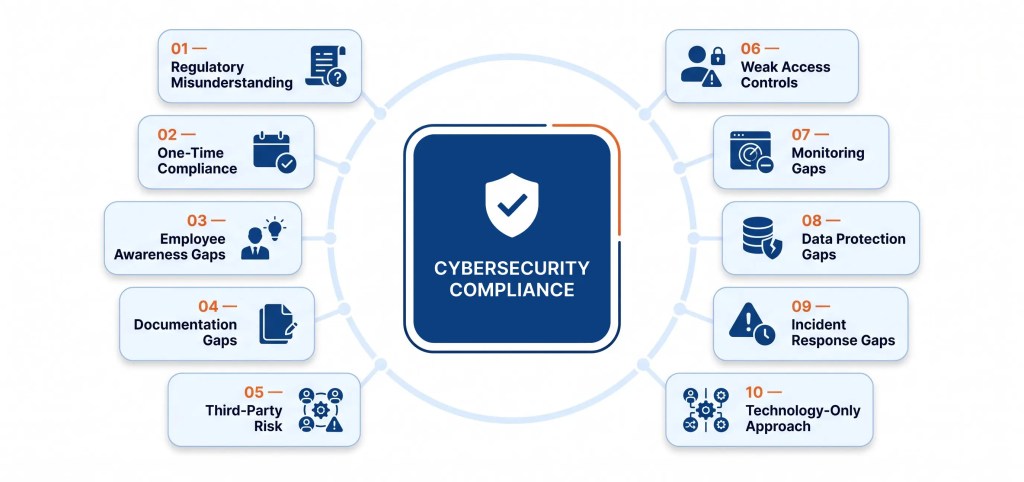
1. Misunderstanding Regulatory Requirements
Many organizations struggle to keep up with cybersecurity regulations in the GCC. Each country and often each industry has its own requirements, which makes a single, one-size-fits-all approach unreliable. Rather than tailoring their compliance program to each specific regulation, many companies apply a generic approach across the board, resulting in partial compliance: some requirements are met while others are missed or misunderstood entirely.
For example, companies often focus heavily on technical controls while overlooking the documentation and record-keeping needed to prove compliance. This gap tends to surface only during an audit, when it is far more costly to fix.
Solution:
Organizations should get people who really know the rules either by hiring them or by working with experts who have a lot of experience to make sure they understand and do everything that is required by the rules.
2. Treating Compliance as a One-Time Activity
People often think that following the rules is something you do once and you are done. A lot of companies check to see if they are doing things right, make some changes and then think they are all set forever. The truth is, following the rules is something you must keep doing all the time. The rules change and new problems come up. The way companies do things changes too. Something that is okay today might not be okay tomorrow.
Failing to maintain compliance can result in:
- Increased vulnerability to cyber threats
- Failed regulatory audits
- Unexpected penalties
Solution:
Adopt a continuous compliance model that includes regular audits, policy updates, and ongoing risk assessments.
3. Lack of Employee Awareness and Training
Technology alone cannot ensure compliance. Employees play a critical role in maintaining cybersecurity standards, yet many organizations underestimate the importance of training.
Uninformed employees may:
- Click on malicious links
- Share sensitive data unintentionally
- Use weak or repeated passwords
These actions can directly lead to compliance violations and security breaches.
Solution:
Implement continuous cybersecurity awareness programs. Regular training sessions, phishing simulations, and policy updates can significantly reduce human-related risks.
4. Inadequate Documentation and Reporting
Documentation is a cornerstone of compliance, yet it is often overlooked. Many organizations fail to maintain proper records of their security practices, policies, and incident responses.
Without proper documentation:
- Demonstrating compliance during audits becomes difficult
- Internal accountability is reduced
- Incident tracking and improvement become challenging
Regulators in the GCC expect clear, well-maintained records as proof of compliance.
Solution:
Use automated tools to maintain logs, generate reports, and ensure that all compliance-related activities are documented and easily accessible.
5. Ignoring Third-Party Risks
Most organizations today rely on third party vendors, cloud providers, and external partners to get work done. That reliance comes with real risk. If a vendor’s security is weak, it can become an entry point for attackers to steal data or trigger a compliance breach.
Despite this many companies fail to:
- Conduct proper vendor assessments
- Monitor third-party security practices
- Include compliance requirements in contracts
Solution:
Implement a robust third-party risk management program. Ensure that all vendors meet your organization’s compliance and security standards.
6. Weak Access Control Measures
Improper access control is a significant compliance risk. Many organizations grant excessive privileges or fail to monitor user access effectively.
This can lead to:
- Unauthorized access to sensitive information
- Insider threats
- Data leaks and compliance violations
Without strict access control policies, even a single compromised account can cause widespread damage.
Solution:
Adopt the principle of least privilege (PoLP), enforce multi-factor authentication (MFA), and conduct regular access reviews to ensure users only have necessary permissions.
7. Failure to Implement Continuous Monitoring
Many organizations do security checks from time to time instead of watching what is happening all the time with security monitoring. This way of doing things, where you wait for something to go wrong, means that you find out about security threats later than you should.
In a region with strict regulatory enforcement, delayed detection can turn a minor security issue into a full-blown compliance breach.
Organizations without continuous monitoring often:
- Detect threats too late
- Fail to respond effectively
- Struggle to meet reporting timelines
Solution:
Implement advanced monitoring solutions such as SIEM systems to enable real-time visibility and rapid incident response.
8. Overlooking Data Protection Requirements
Data protection is a key focus of GCC regulations, yet it is frequently mishandled. Organizations often lack proper data classification and protection strategies.
Common issues include:
- Storing sensitive data without encryption
- Poor data lifecycle management
- Lack of visibility into where data resides
These gaps increase the risk of data breaches and non-compliance.
Solution:
Develop strong data governance frameworks, classify data based on sensitivity, and implement encryption and retention policies.
9. Insufficient Incident Response Planning
An effective incident response plan is critical for minimizing damage and meeting compliance requirements. However, many organizations either lack a formal plan or fail to test it regularly.
Without preparation:
- Response times are delayed
- Confusion arises during incidents
- Regulatory reporting deadlines are missed
This not only increases damage but also leads to compliance failures.
Solution:
Create a detailed incident response plan and conduct regular drills to ensure readiness in real-world scenarios.
10. Relying Solely on Technology
Cybersecurity tools are important, but they are not enough, by themselves. Many organizations spend a lot of money on tools but forget about having good procedures and management.
To meet compliance requirements, you need to have an approach that includes:
- Clear policies and procedures
- Skilled personnel
- Strong governance frameworks
Over-reliance on tools without proper management leads to inefficiencies and compliance gaps.
Solution:
Adopt a holistic cybersecurity strategy that integrates technology with people and processes.
Conclusion
Cybersecurity compliance in the GCC isn’t just a regulatory obligation, it’s a business imperative. As cyber threats grow more sophisticated and regulations get stricter, companies need to move beyond simply following the rules and build a genuine security-first culture. The most common mistakes, from misunderstanding regulations and neglecting employee training to ignoring third-party risk and skipping continuous monitoring, can lead to serious financial and reputational damage. With the right strategy, tools, and mindset, these risks are manageable. Organizations that stay proactive about compliance will strengthen their defenses, protect their data, and build lasting trust with customers and stakeholders.
Avoid costly compliance mistakes and strengthen your cybersecurity posture with expert guidance. Partner with ValueMentor, a trusted cybersecurity and compliance expert, to assess your current compliance status, identify critical gaps, and implement tailored solutions aligned with GCC regulations. Take action today with us to protect your business, ensure compliance, and stay ahead of evolving cyber threats.
FAQs:
The biggest mistakes include poor understanding of regulations, weak access controls, lack of monitoring, and ignoring third-party risks.
2. Why is cybersecurity compliance important in GCC?
It helps businesses avoid legal penalties, protect sensitive data, and maintain trust in a highly regulated environment.
3. Is compliance a one-time process?
No, compliance is continuous and requires regular updates, monitoring, and audits.
4. How do employee actions impact compliance?
Human errors like weak passwords or phishing clicks can directly lead to compliance violations and breaches.
5. What role does documentation play in compliance?
Proper documentation proves compliance during audits and ensures accountability across the organization.
6. Are third-party vendors a compliance risk?
Yes, vendors can introduce vulnerabilities if their security standards don’t meet compliance requirements.
7. What is the biggest access control mistake?
Granting excessive permissions instead of following the principle of least privilege.
8. How does continuous monitoring help?
It detects threats in real time, enabling faster response and reducing compliance risks.
9. Why is data protection critical for compliance?
GCC regulations heavily focus on safeguarding sensitive and personal data from misuse or breaches.
10. How can businesses avoid compliance mistakes?
By adopting a proactive approach, investing in training, and partnering with experts like ValueMentor.