Modern mobile applications are far more complex than they were a few years ago. That complexity is exactly what attackers love. Today’s apps rely heavily on APIs, cloud integrations, third-party SDKs, biometric authentication, and real-time data processing. Insecure data storage, weak authentication, exposed API endpoints, misconfigured permissions – the attack surface keeps growing, and security teams are expected to catch everything without slowing down a single sprint.
This blog explores how AI is transforming mobile application security testing, covering smarter vulnerability detection, runtime behavioural analysis, penetration testing support, risk prioritization, and continuous testing across the development lifecycle. It also explains why these changes matter now and what security teams stand to gain by embracing AI-driven approaches.
Why is traditional mobile security testing struggling to keep up?
Let’s be honest: manual-only security testing was never built for the pace of modern mobile development.
Today’s security teams aren’t just reviewing code. They’re assessing runtime behaviour, API communication, authentication flows, supply chain risks, and platform-specific controls across both Android and iOS, across dozens of device types, on release cycles that don’t wait for anyone.
Throw in alert fatigue from fragmented tools, pressure from faster DevSecOps pipelines, and a growing list of risks from the OWASP Mobile Top 10 (think improper credential usage, insecure data storage, inadequate supply chain security), and you start to see why manual approaches are breaking under the strain.AI doesn’t replace security expertise. But it does give teams the leverage they desperately need.
How is AI reshaping mobile application security testing?
Finding vulnerabilities is not the hard part anymore finding the right ones, fast, is. AI brings precision to a process that has long been overwhelmed by volume, helping mobile security teams work smarter across every stage of testing.
1. Smarter Vulnerability Detection
AI-enhanced analysis can recognize patterns associated with insecure coding practices, exposed secrets, unsafe API usage, and weak authentication logic. Instead of simply flagging large volumes of raw findings, machine learning models can help distinguish likely exploitable issues from lower-value noise. This makes static and dynamic analysis more useful for mobile security teams that need to focus on the vulnerabilities most likely to matter.
2. Better Runtime and Behavioural Analysis
Many of the most dangerous mobile threats appear during execution rather than in source code alone. In earlier approaches, security analysts often had to spend significant time and effort deobfuscating code before they could understand application logic, investigate suspicious activity, and identify potential vulnerabilities. This slowed down security analysis and made it harder to detect issues quickly in complex mobile environments. AI helps reduce that effort by recognizing suspicious runtime behaviour such as unusual process activity, abnormal network requests, automation patterns, instrumentation attempts, signs of tampering, and RASP security checks that detect conditions like root or jailbreak status, debugger attachment, emulator use, hook frameworks, and other runtime integrity issues. This is especially valuable in mobile environments, where applications run on user-controlled devices and may be exposed to rooted devices, reverse engineering, or manipulated sessions.
3. Faster, More Scalable Penetration Testing Support
AI can support penetration testing by generating test cases, suggesting attack paths, and highlighting high-risk areas such as session management, token handling, local storage, and API interactions. While it does not replace skilled testers, it can reduce repetitive work and speed up the discovery of common weaknesses. This helps teams test more frequently and align security validation with DevSecOps pipelines.
4. Risk Prioritization and Reduced False Positives
One of the biggest challenges in application security testing is volume. AI helps by correlating findings across multiple scanners and signals, ranking vulnerabilities based on exploitability, context, and potential business impact. Instead of treating all findings equally, teams can focus on the issues that create the greatest real-world exposure. This improves response times and reduces time lost chasing low-priority alerts.
5. Continuous Security Testing Across the SDLC
AI makes it easier to shift security left and test continuously. Security checks can run earlier in development, during builds, before release, and after deployment. This is particularly important for mobile teams shipping frequent updates across Android and iOS while also managing dependencies, SDKs, and backend integrations. Continuous testing helps organizations detect regressions quickly and maintain stronger security over time.
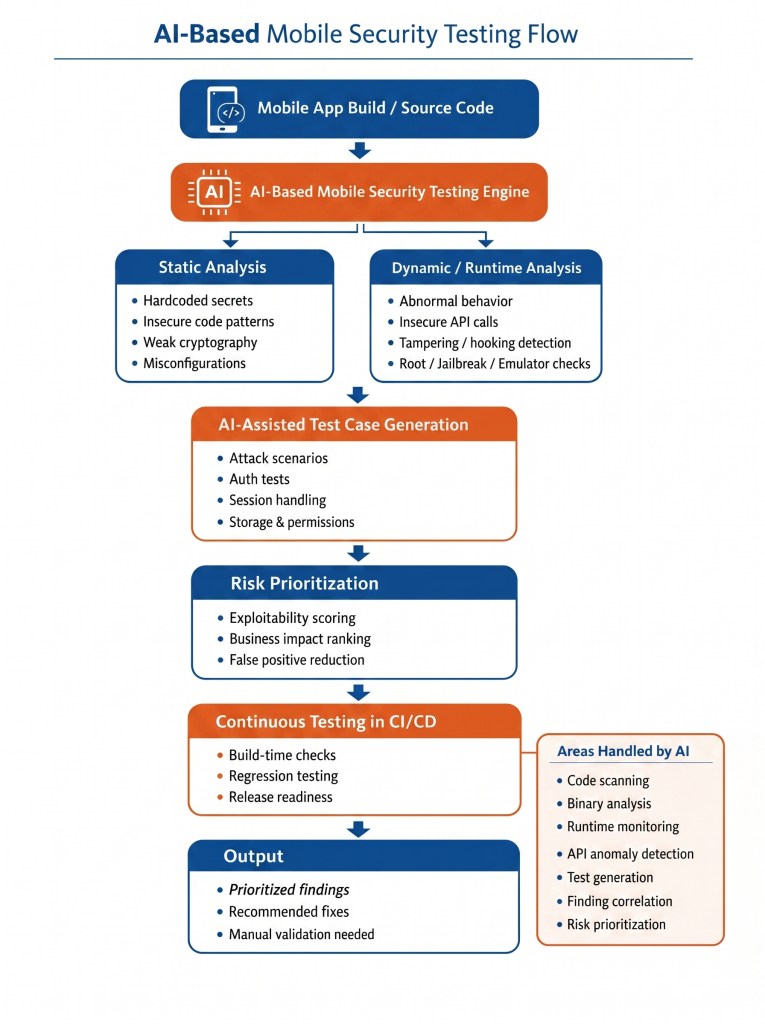
The flow highlights that AI is most effective in high-volume and pattern-driven activities such as code and binary scanning, runtime behaviour analysis, insecure API and communication detection, automated test case generation, finding correlation, and vulnerability prioritization. These capabilities help security teams identify issues faster and reduce repetitive effort; however, human validation remains essential for confirming exploitability, assessing business logic weaknesses, and making final risk decisions.
The Real-World Benefits AI Delivers for Security Teams and Developers
The value of AI in mobile security is not theoretical – it shows up in day-to-day workflows in ways that directly reduce risk, save time, and improve outcomes.
Here is what teams consistently gain when they integrate AI into their mobile security programs:
- Faster vulnerability identification across code, binaries, and runtime behaviour without manual layer-by-layer review
- Broader coverage across devices, operating systems, APIs, and release cycles that traditional testing struggles to match
- Reduced manual effort on repetitive testing tasks, freeing skilled testers for higher-value work
- Smarter prioritization of findings based on real exploitability and business impact – not just severity scores
- Earlier detection of security issues within DevSecOps workflows, reducing the cost and complexity of remediation
- Scalable testing capacity that grows with the application without requiring proportional increases in team size or budget
AI Has Real Limitations and Ignoring Them Is a Risk in Itself
AI is a powerful ally in mobile security testing, but it is not infallible. Understanding where it falls short is just as important as knowing what it can do.
Models are only as effective as the data, rules, and context they are built on. Poorly tuned systems can still produce false positives, miss business-logic flaws, or overstate confidence on incomplete results. Explainability is a genuine challenge when AI flags a risk, teams need to understand why, not simply trust the output. In regulated industries, privacy and model governance add further layers of complexity that cannot be ignored.
There is also a threat on the other side. Attackers are actively using AI to automate reconnaissance, improve evasion techniques, and probe defenses faster than ever. This makes thoughtful, well-governed use of AI in security testing not just a best practice but a competitive necessity.
How to build a Mobile Security Program that uses AI the right way?
Having access to AI-powered tools is only the starting point. Getting real value from them requires a deliberate approach that pairs automation with expertise, standards alignment, and continuous improvement.
- Augment, do not replace – use AI to support skilled mobile security testers, not substitute for their judgment on complex issues
- Align with recognized standards – map testing coverage to the OWASP Mobile Top 10 and OWASP MASTG to ensure no critical area is left untested
- Validate critical findings manually – AI-generated findings for high-severity issues should always be confirmed by a human before action is taken
- Integrate into CI/CD pipelines – build security checks directly into your development workflow so testing runs continuously, not just at release
- Monitor third-party dependencies – SDKs and open-source libraries are among the fastest-growing sources of mobile vulnerabilities and need ongoing review
- Layer your testing methods – combine code scanning, runtime analysis, API testing, and business-logic review for coverage that no single approach can provide alone
Conclusion
AI is reshaping mobile application security testing by making it more intelligent, proactive, and scalable. From smarter vulnerability detection and runtime monitoring to faster penetration testing support and better risk prioritization, AI helps teams secure modern mobile apps more effectively. The strongest approach is a balanced one: combine AI-driven automation with human expertise, secure development practices, and recognized mobile security standards to build resilient applications in a rapidly changing threat landscape.
That balance is exactly what ValueMentor delivers. Our mobile application security testing services combine AI-enhanced analysis with the hands-on expertise of seasoned security professionals helping organizations identify real risks, reduce noise, and maintain a strong security posture across every stage of the mobile development lifecycle. Get in touch with our team today to find out how we can help secure your mobile applications with confidence
FAQs
Traditional tools rely on fixed rules and flag anything that matches a predefined pattern. AI learns from context and recognizes emerging threat behaviours, which means it can identify risks that rule-based tools miss and reduce the false positives that slow security teams down.
2. Can AI detect vulnerabilities that static analysis tools miss?
Yes. Static analysis only examines code at rest. AI can monitor application behaviour during execution and flag vulnerabilities that only appear at runtime such as insecure API calls, abnormal data flows, and tampering attempts.
3. How does AI help security teams dealing with alert fatigue?
AI correlates findings across multiple scanners and ranks them by exploitability and business impact. This reduces the volume of alerts that require manual review and helps teams focus their time on the vulnerabilities most likely to cause real harm.
4. Is AI-powered mobile security testing suitable for both Android and iOS?
Yes. AI-enhanced testing covers both platforms and can be tuned to address platform-specific risks, including Android intent vulnerabilities, iOS keychain misuse, insecure local storage, and permission misconfigurations on either platform.
5. Can AI support security testing for mobile apps that use third-party SDKs?
Yes. AI can flag insecure SDK behaviour, detect suspicious third-party library activity, and surface supply chain risks introduced by dependencies – risks that are easy to overlook when teams focus only on their own code.
6. How does AI assist in testing mobile app authentication and session management?
AI can identify weak authentication logic, token handling flaws, and insecure session management patterns by analyzing how the app behaves during real authentication flows going beyond what signature-based scanners can detect.
7. Does AI-powered testing work within agile and DevSecOps workflows?
Yes. AI-driven security checks integrate directly into CI/CD pipelines and run automatically at each build or deployment, allowing security to keep pace with rapid release cycles without requiring manual intervention.
8. How does AI help with mobile API security testing?
AI analyzes API communication patterns, detects anomalies in request and response behaviour, and identifies exposed endpoints or insecure data transmission providing coverage that goes beyond what standard API scanning tools offer.
9. What role does AI play in identifying rooted or jailbroken device risks?
AI detects runtime signals associated with compromised devices, including hook framework activity, integrity check bypasses, and emulator indicators giving teams a clearer picture of how their app holds up in untrusted environments.
10. How does continuous AI-powered testing improve long-term mobile security posture?
Running security checks throughout the development lifecycle not just before release – means regressions are caught early and vulnerabilities do not accumulate between cycles, resulting in a stronger and more consistent security baseline over time.