Modern organizations today depend on APIs for their digital services, cloud apps, mobile platforms, AI, and automation. These APIs link up apps, cloud setups, users, and outside services in a communication network. With companies speeding up their digital makeovers, API networks are growing fast. Big firms might be running thousands of APIs in various settings on the cloud, in Kubernetes, for internal use, and in mobile and AI-driven systems without always knowing just how extensive their API use is. Though APIs enable better flexibility and quicker progress, they also pose major security issues in today’s tech world. Among the most dangerous and overlooked risks in this expanding ecosystem is the rise of Shadow APIs. Shadow APIs are undocumented, forgotten, deprecated, or unmanaged APIs operating outside formal visibility and security governance processes. These APIs often continue functioning silently inside production environments without proper monitoring, authentication enforcement, or security testing. Let us explore Shadow APIs, understand how these hidden APIs become a serious threat to organizations, and examine the best ways to identify, monitor, and secure these unmonitored attack surfaces.
What are Shadow APIs and why do they matter?
Shadow APIs are APIs that exist outside an organization’s official API inventory and governance process. These APIs may still process sensitive data and business operations, but security teams often have little or no visibility into their existence. Unlike officially managed APIs that undergo authentication enforcement, penetration testing, runtime monitoring, and vulnerability management, Shadow APIs frequently operate without proper oversight.
These APIs usually emerge naturally during software development and operational activities. Developers may create temporary APIs for testing purposes, older API versions may remain active after migrations, or internal APIs may accidentally become exposed to the internet through cloud or Kubernetes misconfigurations.
Over time, these APIs become forgotten while continuing to process requests inside production environments. This creates dangerous blind spots attackers can exploit easily.
Why are Shadow APIs growing rapidly?
The growth of Shadow APIs is closely connected to how modern applications are built today.
Traditional applications generally operated within centralized infrastructures where security teams could maintain visibility relatively easily. Modern software environments are very different. Organizations now rely heavily on microservices, Kubernetes clusters, cloud-native architectures, serverless platforms, mobile applications, AI integrations, and third-party SaaS services. These environments continuously generate APIs.
Development teams are under pressure to release features quickly. APIs are often deployed rapidly to support frontend applications, automation workflows, AI integrations, cloud scalability, and business requirements.
As a result, APIs are frequently created faster than security governance processes can track them. Multiple API security studies show that organizations usually underestimate the number of APIs within their systems. Many companies only find out about undocumented APIs during security checks. Plus, containers come and go, serverless functions create brief endpoints, and internal services can accidentally be exposed due to misconfigurations. Because of this, places build up lots of hidden APIs running around their infrastructure over time.
Why have Shadow APIs become a major security risk?
Shadow APIs are dangerous because they frequently bypass modern security protections completely. Officially managed APIs generally receive authentication enforcement, authorization validation, API gateway protections, vulnerability scanning, runtime monitoring, logging, penetration testing, and security patching. Shadow APIs often receive none of these protections. This makes them attractive entry points for attackers.
A Shadow API may expose customer records, administrative functionality, internal workflows, financial systems, cloud management functions, or AI orchestration capabilities without proper security controls. In many cases, developers assume internal APIs are trusted and therefore implement weaker authorization checks. If these APIs become externally accessible, attackers may gain direct access to highly sensitive business operations.
Another major issue involves outdated vulnerabilities. Because Shadow APIs often slip past formal patch management processes, they might keep running on outdated and vulnerable software long after official APIs have been updated. Hackers take advantage of problems like Broken Object Level Authorization and Insecure Direct Object References. They also go after excessive data exposure, weak JWT validation, and misuse of GraphQL introspection. Plus, security misconfigurations offer easy targets too.
The risks aren’t just technical; Shadow APIs can cause regulatory issues, financial troubles, damage reputations, and erode customer trust. What makes them really scary is that organizations usually don’t even know these APIs exist. As the saying goes, you can’t protect what you can’t see.
How do attackers discover Shadow APIs?
Attackers actively search for hidden APIs because they are often easier to exploit than heavily protected public interfaces.
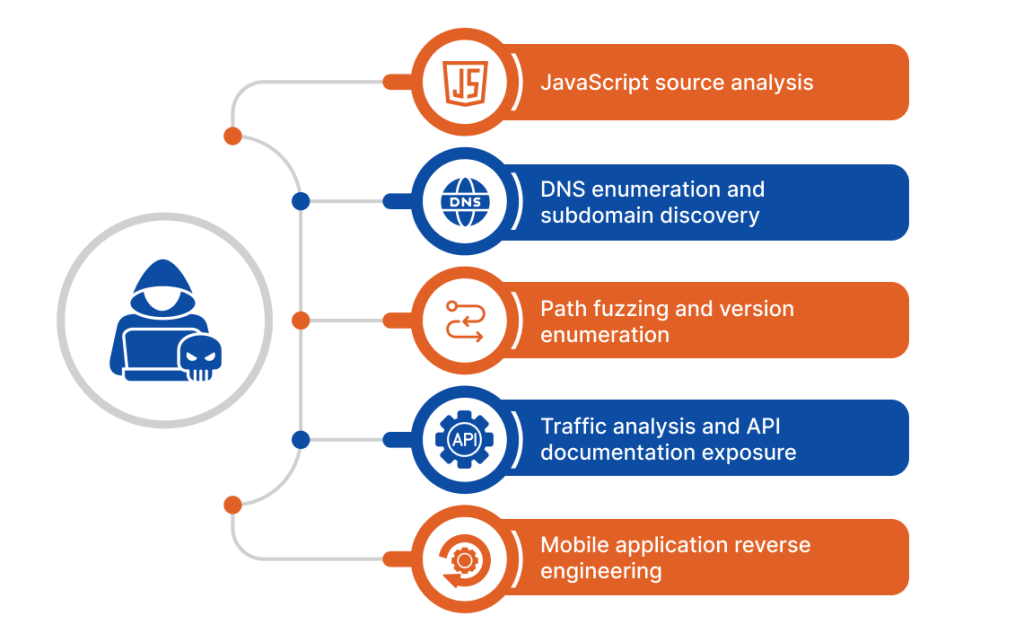
- JavaScript source analysis – Attackers analyze frontend JavaScript files and bundled source code to identify hidden API routes, internal endpoints, admin paths, debug APIs, and undocumented backend functionality referenced by the application.
- DNS enumeration and subdomain discovery – Attackers use DNS enumeration tools and certificate transparency logs to identify API-related subdomains such as legacy APIs, staging environments, internal APIs, and forgotten infrastructure hosting Shadow APIs.
- Path fuzzing and version enumeration – Once a base API path is identified, attackers systematically test different endpoint variations, API versions, internal routes, debug paths, and administrative patterns to discover undocumented APIs.
- Traffic analysis and API documentation exposure – Attackers intercept application traffic and search for publicly exposed Swagger files, OpenAPI schemas, Postman collections, and API documentation that may reveal hidden or internal endpoints.
- Mobile application reverse engineering – Attackers reverse-engineer Android and iOS applications to extract hardcoded API URLs, backend references, authentication tokens, and deprecated API versions still referenced by mobile applications. As API ecosystems continue expanding, Shadow API discovery is becoming increasingly automated.
Why Traditional Security Approaches Fall Short for Modern APIs?
Traditional perimeter-based security models are no longer sufficient for modern API ecosystems. Organizations historically relied heavily on firewalls, VPNs, network segmentation, and Web Application Firewalls. However, modern APIs now operate across multi-cloud environments, Kubernetes infrastructures, mobile applications, third-party integrations, distributed microservices, and AI systems.
Trust boundaries have become fragmented. Many Shadow APIs bypass centralized logging, runtime monitoring systems, API gateways, and access governance controls entirely.
Traditional asset management systems were not designed for highly dynamic cloud-native environments where APIs continuously appear and disappear. As a result, organizations frequently maintain incomplete visibility into their API ecosystem. This creates dangerous blind spots attackers can exploit easily.
Detecting and securing Shadow APIs
Since organizations cannot secure APIs they are unaware of, discovering Shadow APIs becomes the first and most critical step in reducing hidden attack surfaces and preventing potential security risks. Here are some effective ways to identify Shadow APIs:
- Enforce API governance through gateways and CI/CD – Ensure all APIs are registered through API gateways and automatically validated against the official inventory during deployments.
- Automated API discovery and validation – Continuously analyze runtime traffic, infrastructure, API gateways, cloud environments, and security assessment results to identify undocumented, hidden, deprecated, or unmanaged APIs.
- Implement proper API lifecycle management – Define decommission timelines and completely remove deprecated or unused APIs from production environments.
- Perform continuous attack surface monitoring – Monitor cloud environments, Kubernetes infrastructures, and external-facing services for newly exposed APIs.
- Apply consistent security controls across all APIs – Ensure active, legacy, and deprecated APIs enforce proper authentication, authorization, logging, and monitoring.
- Monitor for exposed API credentials – Continuously scan for leaked API keys and tokens and rotate compromised credentials immediately.
- Strengthen collaboration between teams – Maintain continuous coordination between development, DevOps, and security teams to ensure APIs remain properly documented and governed.
Final Thoughts
Shadow APIs are no longer a hidden technical issue limited to development environments. They’ve become a serious business and security risk, able to expose sensitive data, internal systems, customer info, and key ops without the organization even knowing. To handle this, companies need constant visibility into their API setups along with security checks to find those hidden pieces, like exposed services, outdated versions, and auth issues, before bad guys can. Those that focus on continuous API finding, real-time watching, strong API controls, and regular security tests will be way better ready to cut down hiding spots for attacks and boost their general cybersecurity stance.
Undocumented and unmanaged APIs can create significant security blind spots that attackers are quick to exploit. A comprehensive API security assessment can help uncover shadow APIs, identify authorization weaknesses, evaluate exposed endpoints, and strengthen API governance across your environment.
ValueMentor’s API security experts help organizations discover hidden APIs, assess security risks, and implement effective controls to reduce their attack surface. Contact our team today to improve API visibility and secure your expanding digital ecosystem.
FAQs:
Shadow APIs are hidden, undocumented, or forgotten APIs that exist outside an organization’s official security oversight.
2. Why do organizations struggle to identify Shadow APIs?
Rapid development, cloud adoption, and decentralized teams often create APIs faster than they can be tracked.
3. Can old API versions become Shadow APIs?
Yes, deprecated API versions that remain active after upgrades are a common source of Shadow APIs.
4. Which environments are most at risk from Shadow APIs?
Cloud platforms, Kubernetes clusters, microservices architectures, and serverless environments top the list.
5. How do these unseen APIs boost an organization’s risks?
By forming secret entry points that often skip necessary security checks.
6. So, are Shadow APIs a compliance worry?
Yes, they might trigger rule breaches since they could reveal sensitive info without adequate protection.
7. Can internal APIs become Shadow APIs?
Yes, internal APIs can become Shadow APIs when they are forgotten, undocumented, or unintentionally exposed externally.
8. What role does API discovery play in reducing Shadow API risks?
API discovery helps organizations maintain an accurate inventory of active APIs and identify unmanaged endpoints.
9. How does API governance help prevent Shadow APIs?
Strong governance ensures APIs are documented, reviewed, monitored, and properly retired when no longer needed.
10. What is the first step in securing Shadow APIs?
The first step is gaining complete visibility into your API ecosystem through continuous discovery and monitoring.