Selecting the right HITRUST consulting partner can be the decisive factor between achieving certification efficiently and encountering prolonged delays, escalating costs, and significant operational disruptions. HITRUST is no small undertaking it is a recognized gold standard that rolls HIPAA, NIST, ISO, GDPR and other requirements into one framework. For any organization, earning HITRUST certification sends a clear message: you value data security, and you are willing to meet the toughest compliance expectations. The challenge? The road to certification is anything but simple. You will be mapping scope, identifying gaps, fixing controls, and preparing for an in-depth audit all while keeping daily operations on track. That is why experienced HITRUST consultants can be game changers. The best ones don’t just guide you through the checklist; they work alongside your team, shaping the process so it fits your business and strengthens your overall security posture.
In this blog, we will look at how to evaluate potential partners, what to expect from top-tier HITRUST certification services and share a practical, CISO-friendly checklist to help you make the right call.
Why choosing the right HITRUST consulting partner is a critical CISO decision?
For a Chief Information Security Officer (CISO), pursuing HITRUST certification is more like a strategic, high-stakes initiative. Regulators, partners, and enterprise customers often regard HITRUST as the gold standard for data security and privacy. In industries like healthcare, insurance, fintech, SaaS, and even global BPO, earning this certification can directly drive business growth, help win competitive contracts, and strengthen stakeholder confidence. The challenge is that the certification process is anything but simple. It’s resource-heavy, requires meticulous planning, and leaves little room for error. Without the right HITRUST consulting partner, organizations risk costly delays that push certification back by months, budget overruns from inefficient remediation, and even audit failures caused by incomplete or poorly aligned control implementations.
A seasoned HITRUST consultant does far more than walk you through the framework. They act as a true partner translating HITRUST CSF requirements into clear, actionable steps for your team, anticipating auditor expectations to reduce last-minute surprises, and aligning the certification journey with other frameworks like SOC 2, ISO 27001, HIPAA, and PCI DSS so you get the most out of your compliance investments.
Key qualities to look for in a HITRUST consulting partner
HITRUST certification is a serious investment, so the partner you choose should meet high professional and technical standards. Here are the non-negotiable qualities every CISO should demand:
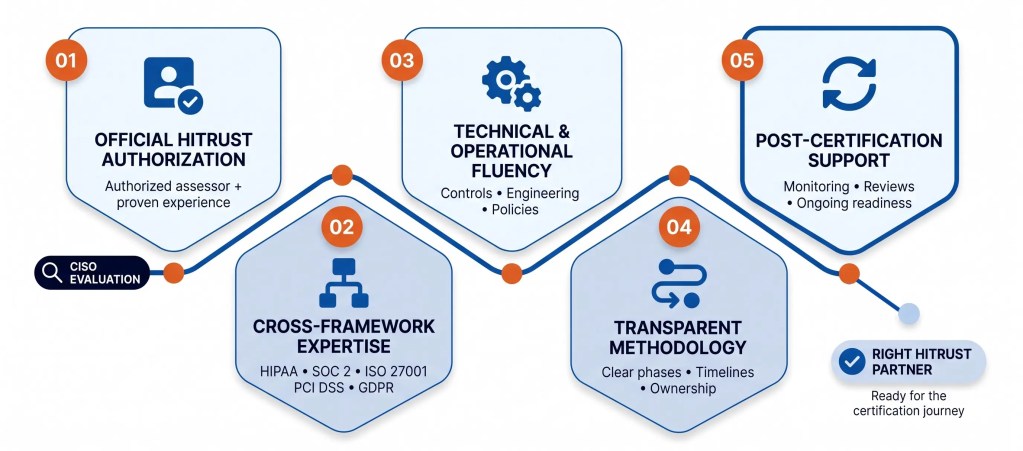
- Official HITRUST Authorization & Proven Experience
Only HITRUST Authorized External Assessors can perform validated assessments. Ask for proof of accreditation and a track record of at least 10+ successful certifications in your industry. - Cross-Industry & Regulatory Expertise
A top HITRUST consulting partner understands how HITRUST overlaps with HIPAA for healthcare, SOC 2 for SaaS, PCI DSS for payments and GDPR for EU data privacy. This ensures you are not duplicating effort across frameworks. - Technical and Operational Fluency
Some HITRUST consultants focus heavily on documentation but lack engineering insight. Your partner should be equally comfortable discussing control mapping and firewall configurations as they are talking about policy templates. - Transparent Methodology
They should present a clear, phased approach — Gap Assessment → Remediation Guidance → Readiness Review → Validated Assessment — with timelines, deliverables and ownership defined upfront. - Post-Certification Support
Not all HITRUST certifications follow the same timeline. The HITRUST r2 Certification is valid for two years, with an interim assessment required at the one-year mark. In contrast, HITRUST i1 and e1 Certifications are valid for one year only. Regardless of the certification type, maintaining compliance is an ongoing process. The best consultants provide continuous monitoring, interim review support and advisory services to ensure you stay compliant year-round.
Evaluating HITRUST consultants and questions every CISO should ask
When interviewing potential HITRUST certification services providers, your goal is to separate the genuinely capable from the “just say yes” crowd. Here is a CISO-level question set that digs deep:
- What is your HITRUST certification success rate, and can you back it with references?
A strong partner should have 90%+ first-time certification success and be willing to connect you with past clients. - How do you handle remediation planning?
Do they just identify gaps, or do they work alongside your teams to close them? - What’s your typical timeline for organizations of our size and complexity?
Look for realistic ranges (6-9 months for mid-size, 12-18 months for large enterprises). Beware of “too fast” promises. - Do you integrate HITRUST with other compliance programs?
This can save significant effort if you’re also maintaining SOC 2, ISO, or HIPAA. - What kind of post-certification support do you offer?
The right answer involves quarterly reviews, policy updates, and preparation for the next certification cycle. - How do you transfer knowledge to our internal team?
A good HITRUST consultant doesn’t keep you dependent – they build your in-house capability.
By asking these, you force vendors to prove they have done more than “read the CSF.”
Red flags that signal a risky HITRUST consulting engagement
Not every HITRUST consultant is the right fit and as a CISO, spotting the red flags early can save you a lot of time, money, and frustration. A major warning sign is the absence of HITRUST Assessor status. Without this accreditation, a consultant can only advise, not perform validated assessments, meaning you’ll have to hire another firm later often doubling your costs. Be cautious of anyone promising lightning-fast timelines, like taking a large, non-compliant organization from zero to certified in under 90 days. That simply skips over the reality of remediation and proper control implementation.
A one-size-fits-all approach is another risk if proposals feel generic and controls aren’t tailored to your environment, you’re more likely to fail the audit. Some consultants even disappear after the initial certification, leaving you without ongoing compliance support and vulnerable during interim reviews. And perhaps the most dangerous pitfall? Low technical competence. When compliance is treated as a paperwork exercise rather than a security priority, you end up with “paper compliance” everything looks fine on paper but fails in practice. The bottom line: protecting your budget, security posture, and reputation starts with avoiding these pitfalls and choosing a HITRUST partner who can truly deliver.
How top HITRUST certification services perform?
Industry benchmarks offer a valuable lens for evaluating whether a HITRUST consulting proposal is grounded in reality or inflated with overpromises. For certification timelines, small to mid-sized organizations (200–500 employees) typically take 6-9 months, while large enterprises with complex IT environments can expect 12-18 months. In terms of first-time certification pass rates, top-performing HITRUST consultants maintain an impressive 90-95%+ success rate – but only when clients commit to thorough readiness assessments and remediation steps.
The total cost of certification also varies significantly: smaller organizations usually invest $50K–$80K (covering consulting and remediation), whereas large enterprises often exceed $150K due to broader control scope and complexity. Another hallmark of best-in-class HITRUST certification services is strong integration capability – the ability to map up to 70% of HITRUST controls to other frameworks like SOC 2, ISO 27001, and PCI DSS, which streamlines multi-compliance efforts.
These figures should serve as a clear sanity check for CISOs: if a provider’s proposal falls dramatically outside these ranges, it’s a signal to dig deeper into their methodology, assumptions, and track record before moving forward.
Building a collaborative roadmap with your HITRUST partner
The most successful HITRUST projects aren’t just vendor transactions – they’re true partnerships built on shared accountability and trust.
Here’s what that looks like in practice:
- Kick-off & Alignment Workshop – Start with a collaborative session to set clear expectations, agree on milestones, and align your business priorities with compliance goals.
- RACI Matrix – Clearly define who’s doing what (Responsible, Accountable, Consulted, Informed) so there’s no confusion or dropped tasks.
- Regular Progress Reviews – Keep momentum with weekly or bi-weekly check-ins to catch roadblocks early and adjust as needed.
- Risk Register – Track control gaps, technical risks, and mitigation plan in one place so issues are visible and addressed proactively.
- Change Management Process – Document and approve any scope or control changes early to avoid last-minute audit surprises.
A great HITRUST consultant doesn’t just hand over a to-do list – they roll up their sleeves, work alongside your team, and make the certification process far smoother and more predictable.
The CISO’s HITRUST partner selection checklist
Before you sign on the dotted line, make sure your HITRUST consulting partner truly measures up. Look for these must-haves:
- Verified HITRUST Authorized External Assessor – Non-negotiable for credibility and quality.
- Proven Track Record – At least 10 successful certifications in your industry shows they understand your world.
- Clear, Realistic Project Plan – Timelines that are achievable, not just “sales promise”.
- Transparent, All-Inclusive Pricing – Including remediation work, so you don’t get hit with hidden costs later.
- Cross-Framework Expertise – Ability to align HITRUST with SOC 2, ISO 27001, PCI DSS, and HIPAA for efficiency.
- Post-Certification Support – Ongoing readiness reviews to keep you audit-ready year after year.
- Dedicated Engagement Manager – One accountable point of contact and a consistent delivery team from start to finish.
- Strong Client References – From organizations like yours, proving they can deliver in the real world.
This checklist isn’t just about ticking boxes – it’s about finding a partner who will stand with you, not just for the first HITRUST certificate, but as a trusted compliance ally for the long haul.
Final thoughts
Earning your HITRUST certification is more than a compliance milestone – it’s your way of showing customers, partners, and regulators that protecting their data is non-negotiable for you. Sure, the process can feel overwhelming at first, but with the right preparation and the right HITRUST consultant by your side, it becomes smoother, faster, and far less stressful. Think of it as an investment in trust, stronger security, and long-term business growth.
If you want a partner who has been there, done that and can make the journey easier for you, we are ready when you are. Reach out to our experts today.
FAQs
1. What is HITRUST certification?
HITRUST certification verifies that your organization meets the HITRUST CSF’s stringent data security and privacy requirements. It’s widely recognized across healthcare, finance, and other regulated industries.
2. How long does it take to get HITRUST certified?
Most organizations take 6-12 months, depending on size, complexity, and readiness.
3. Is HITRUST mandatory?
No. However, many partners, customers, and regulators expect it, especially in healthcare and fintech.
4. How much does HITRUST certification cost?
Costs vary based on scope, number of systems, and remediation needs. For mid-sized firms, it typically ranges from tens of thousands to over a hundred thousand USD.
5. What is the role of a HITRUST consultant?
They guide you through the process, map requirements to your environment, oversee remediation, and prepare you for a successful validated assessment.
6. Can HITRUST align with other compliance frameworks?
Yes. Many organizations integrate HITRUST with SOC 2, ISO 27001, HIPAA, and PCI DSS to save time and reduce duplicate work.
7. What happens if we fail the HITRUST audit?
You’ll receive a corrective action plan and have the opportunity to address gaps before re-submission.
8. How often do we need to renew HITRUST certification?
HITRUST certification is valid for two years, but an interim review is required at 12 months.
9. Who issues HITRUST certification?
Only HITRUST-authorized External Assessors can validate and submit your certification for approval.
10. Can small companies get HITRUST certified?
Yes. HITRUST offers scalable assessment levels, making it achievable for startups and small businesses.