The rapid growth and development of the UAE as a financial hub and a center for technology and innovation have made data protection a top priority for organizations in the region. With the rise of cyber attacks and regulatory requirements, organizations are expected to be proactive in information security. It is at this point that ISO 27001 certification comes into action. ISO 27001 is a standard developed by the International Organization for Standardization that offers a globally recognized standard for organizations to implement an Information Security Management System (ISMS). It helps organizations to identify risks and improve their information security posture. For organizations in the UAE, ISO 27001 is not just a compliance requirement; it is a matter of trust and a competitive advantage in a security-conscious environment. In this blog, we will be discussing how to achieve ISO 27001 certification in a step-by-step manner for organizations in the UAE.
Why ISO 27001 Certification is important in UAE?
The UAE is a highly volatile market when it comes to conducting business. Every organization is either conducting business across international boundaries or dealing with a huge volume of information. Be it banks, hospitals, or tech companies, every organization is under immense pressure to secure its information.
Key advantages include:
- Stronger protection of sensitive information
- Higher levels of trust from customers and stakeholders
- Higher possibilities of winning contracts and partnerships
In terms of the benefits of ISO 27001 certification to businesses, it is beneficial in the sense that it ensures compliance with various regulations, both globally and locally. It is also beneficial in the sense that it adds value, especially when working with global clients who value information security. It is also beneficial in the sense that it ensures compliance with various regulations and helps in reducing the risk of incurring huge costs in case of data breaches.
ISO 27001 supports organizations in aligning with UAE cybersecurity and data protection expectations, including sector-specific requirements in finance, healthcare, government, and critical infrastructure. Many UAE organizations pursue ISO 27001 to strengthen governance, support regulatory readiness, and meet contractual requirements from enterprise and international clients.
Step-by-Step ISO 27001 Certification process
1. Define the Scope of Your ISMS
The first and most critical stage in the entire process toward attaining the ISO 27001 certification is determining the scope of your Information Security Management System. This stage establishes the ground rules for all the stages to come, as it establishes the scope of your entire organization.
It is critical for any organization to evaluate its business processes and systems before determining the scope. An example of an organization in the UAE, in the fintech industry, might decide to only include its payment systems in the scope to make the process more manageable.
Key considerations include:
- Business units, departments, or locations to be included
- Types of data and systems involved
- Regulatory and contractual requirements
Having a defined scope can also assist in efficiently focusing the resources in the right direction to avoid any complexities. It also ensures that the auditors know exactly what they are dealing with. A poorly defined scope is one of the most common reasons for delays during certification audits.
2. Conduct a Comprehensive Risk Assessment
Risk assessment forms the basis of the ISO 27001 standard, and this step is all about organizations taking a thorough look at their information assets and potential risks. It is all about identifying what can go wrong, how likely it can happen, and how severe the impact can be.
The process is all about gathering all critical information assets like databases, software systems, employee information, customer information, and assessing all potential risks like a cyber attack or a system failure and vulnerabilities that currently exist.
Typical activities include:
- Identifying information assets
- Analyzing threats and vulnerabilities
- Assessing risk likelihood and impact
- Prioritizing high-risk areas
A well-executed risk assessment provides clarity on where the biggest risks lie and helps prioritize actions. It also forms the basis for selecting appropriate security controls in the next step. Organizations should establish a documented risk assessment methodology that defines risk criteria, likelihood, impact, risk owners, and treatment priorities.
3. Perform Risk Treatment and Implement Controls
After identifying risks, organizations need to determine how to mitigate them. This is done through a process called risk treatment, where an appropriate set of security measures is implemented to mitigate identified risks.
ISO 27001 has provided an extensive list of controls in Annex A, which include various information security issues such as access control, encryption, physical security, and incident response. However, it is not necessary for organizations to implement all these controls; only those which are necessary.
Common risk treatment options include:
- Mitigating risks through security controls
- Avoiding risks by changing processes
- Transferring risks (e.g., insurance or outsourcing)
- Accepting low-level risks when justified
This stage is critical because it transforms theoretical risk assessment into practical action. It ensures that the organization has real mechanisms in place to protect its data and systems.
4. Develop ISMS Policies and Documentation
Documentation is one of the essential requirements of ISO 27001. This is because documentation is used to prove that an organization has been able to institute uniform security practices. This is because it is difficult to prove this without documentation.
An organization is required to develop various policies and procedures that define how information security is handled. These documents serve as a guideline for both employees and auditors. Besides facilitating ISO 27001 certification, documentation is also beneficial to an organization.
Essential documents include:
- Information Security Policy
- Risk Assessment and Treatment Plan
- Statement of Applicability (SoA)
- Incident Response Plan
- Business Continuity Plan
5. Build a Security-Aware Culture Through Training
Technology alone cannot guarantee information security—employees play a crucial role in maintaining it. This is why ISO 27001 places strong emphasis on training and awareness.
Organizations must ensure that employees understand security policies, recognize potential threats, and know how to respond to incidents. In the UAE, where workforces are often diverse and multicultural, training programs should be simple, engaging, and easy to understand.
Training initiatives may include:
- Regular cybersecurity awareness sessions
- Phishing simulation exercises
- Role-based security training
- Clear communication of policies and responsibilities
Creating a culture of security awareness not only reduces human error but also strengthens the overall effectiveness of the ISMS.
6. Conduct Internal Audits
Before undergoing the official certification audit, organizations must perform internal audits to evaluate the effectiveness of their ISMS. This step acts as a checkpoint to ensure that everything is functioning as intended.
Internal audits help identify gaps, weaknesses, and non-conformities that need to be addressed before the external audit. They also provide valuable insights into areas that require improvement.
Key outcomes include:
- Identification of compliance gaps
- Validation of implemented controls
- Preparation for external audit
By treating internal audits as a learning opportunity rather than a formality, organizations can significantly increase their chances of certification success.
7. Management Review and Leadership Involvement
The involvement of the leadership in the organization is a critical element in the requirements for the implementation of the ISO 27001 standard. This implies that the management reviews the ISMS to ensure its alignment with the business goals.
This step shows that information security is not just limited to the IT department alone but rather a critical aspect for the entire organization.
Management review typically covers:
- Audit results and findings
- Risk assessment updates
- Resource needs
- Opportunities for improvement
Strong leadership support can make a significant difference in the success of the certification process.
8. Certification Audit (Stage 1 & Stage 2)
The last step is the certification audit. It is carried out by a certification body that is accredited. It is done in two stages to ensure a comprehensive evaluation.
In Stage 1, the auditors will examine the documentation provided by the organization and assess their readiness for certification. It will include an evaluation of the scope and ISMS structure.
In Stage 2, a comprehensive evaluation of the implemented controls will be done and a check made to see if the organization is complying with all requirements of ISO 27001.
The organization will be given some time if any non-conformities are found.
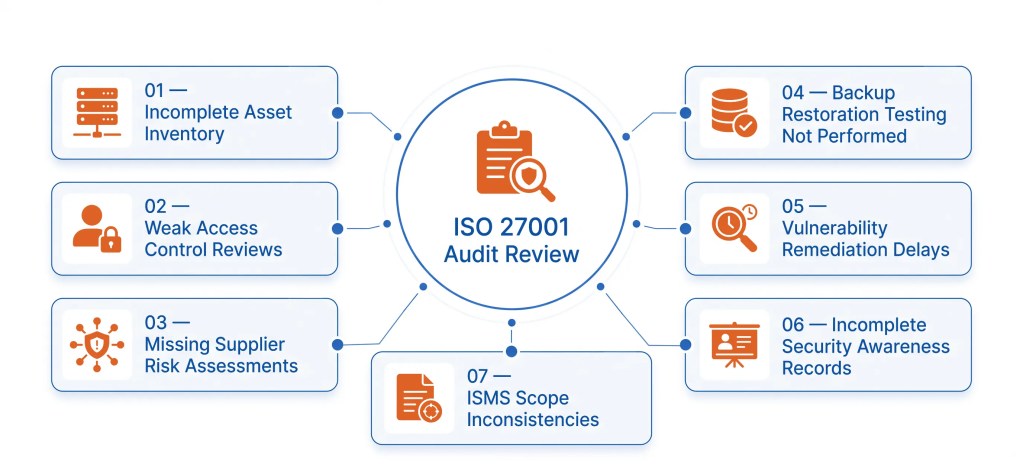
Common ISO 27001 audit findings in UAE organizations
9. Continuous Monitoring and Improvement
ISO 27001 certification is a continuous process. It is not a one-time thing. An organization has to keep on checking its ISMS and keep on improving it in accordance with new challenges.
This is done by keeping on updating the risk assessment, improving it, and conducting periodic audits. Surveillance audits are conducted annually too.
In this way, organizations can keep on improving and continue to hold their certification, keeping themselves one step ahead of all the new challenges of cyber attacks.
Conclusion
ISO 27001 certification provides UAE organizations with a structured and effective approach to managing information security. It not only helps in meeting regulatory and client expectations but also strengthens overall business resilience. By following a step-by-step process—from defining scope to continuous improvement—organizations can build a robust ISMS that protects their most valuable assets. In a competitive and digitally driven market, ISO 27001 is a powerful tool for long-term success.
Unlock new business opportunities and win client trust with ISO 27001 certification. Let ValueMentor guide your UAE organization toward secure and scalable growth.
FAQs:
The certification process typically takes 3 to 6 months, depending on the organization’s size and complexity.
2. Is ISO 27001 mandatory in the UAE?
No, it is not mandatory, but it is highly recommended for organizations handling sensitive data.
3. How much does ISO 27001 certification cost?
Costs vary based on company size, scope, and consultancy requirements, typically ranging from moderate to high investment.
4. Can small businesses in the UAE get ISO 27001 certified?
Yes, ISO 27001 is scalable and suitable for businesses of all sizes.
5. What is an ISMS?
An ISMS (Information Security Management System) is a framework for managing sensitive information securely.
6. Do we need a consultant for ISO 27001?
While not mandatory, consultants can simplify the process and improve success rates.
7. What happens if we fail the certification audit?
You will be given time to address non-conformities and undergo a re-audit.
8. How often are surveillance audits conducted?
Surveillance audits are conducted annually after certification.
9. Does ISO 27001 cover cloud security?
Yes, it includes controls for cloud environments and data protection.
10. Can ISO 27001 integrate with other standards?
Yes, it integrates well with standards like ISO 9001 and ISO 22301 for a comprehensive management system.