


Information security has gained immense importance due to increased cyber attacks and information leakage, hence making its protection necessary for any organization to establish themselves in the market by winning customer trust. One of the most popular ways in which a company ensures all this is by receiving ISO 27001 certification. Nonetheless, there are quite a few myths related to the standards that demotivate firms from adopting such measures.
To clear out misconceptions, ISO 27001 is actually a flexible guideline aimed at managing the information security risks faced by various organizations. Knowing these facts will ensure that firms are well aware of what they are doing and take up actions accordingly. In this blog, let us look into some of the most common myths associated with ISO 27001 certification.
Misconception 1: ISO 27001 Certification Is Only for Large Enterprises
It happens to be one of the major reasons why smaller organizations shy away from ISO 27001. They think that the process entails huge costs and requires big companies because of its complexity.
Reality:
The standard itself is flexible enough to be able to accommodate different situations and needs. In this way, ISO 27001 does not entail the same amount of controls in all companies – depending on the situation, small companies can develop a streamlined ISMS. An example could be that of a young firm managing customer information which needs a simpler system.
In reality, however, SMEs find themselves at a competitive advantage when getting certified because this makes them more trustworthy and credible than the bigger competition, allowing them to work with enterprises who value their credentials.
For example, a 30-person SaaS company handling customer data may require significantly fewer controls and less documentation than a multinational bank, while still achieving ISO 27001 certification.
Misconception 2: ISO 27001 Guarantees Complete Security
A widespread misunderstanding is that ISO 27001 acts as a “shield” that completely prevents cyberattacks or data breaches.
Reality:
There is no technology or certification that can guarantee full security. The primary principle behind ISO 27001 lies in risk management, not risk removal. With the help of this ISO standard, companies can identify potential risks and address them accordingly.
The best part about ISO 27001 is that it follows a proactive approach. Instead of responding to any incidents that may happen, the organization develops mechanisms to address any security issues effectively. This aspect proves much more useful than the notion of complete security.
ISO 27001 reduces the likelihood and impact of security incidents, but it does not eliminate cyber risk entirely.
Misconception 3: It’s Just an IT Department Responsibility
Many organizations treat ISO 27001 as a purely technical initiative and assign it entirely to the IT team.
Reality:
Information security reaches much more than just information technology. The standard ISO 27001 highlights that information security should be viewed holistically through aspects such as people, processes, and technologies. Different departments, from human resources to legal and even operational management, take care of the processes that affect information security.
For instance, awareness and training of employees, access controls, and incident reporting all need input from the entire organization. The participation of management is also vital because they are charged with developing policies and allocating necessary resources.
Misconception 4: ISO 27001 Certification Is Too Expensive
The fear of expenses generally prevents many companies, particularly small enterprises or new ventures, from considering certification.
Reality:
Yes, there are costs involved, but ISO 27001 must be viewed as an investment. The potential expense incurred in a data leak, which would include fines and damage to reputation, could be much greater.
There is also added benefit in the form of generating revenues. A lot of companies demand ISO 27001 certification prior to any dealings with you.
Misconception 5: It Requires Extensive Documentation
Some businesses feel that the ISO 27001 standard entails excessive documentation which does not contribute much to business.
Reality:
In ISO 27001, documentation is used as an instrument for clarity and consistency but not to introduce any sort of bureaucratic procedure. There is always a need for certain documentation related to the information security management of your company.
With the modern approach to documentation, concise and useful documents are prepared in compliance with the practices in the company.
Misconception 6: Certification Is a One-Time Process
There is a belief that once an organization achieves ISO 27001 certification, no further effort is required.
Reality:
The ISO 27001 framework is based on the concept of continuous improvement. Organizations have to undergo periodic surveillance audits following certification and have to ensure the maintenance of the ISMS.
There is always innovation in cybersecurity. Today’s controls may not suffice tomorrow. It is important to keep up with new trends in the cyber world through continuous improvement.
Misconception 7: ISO 27001 Slows Down Business Operations
It is normal for companies to worry about the installation of security measures as they might be inefficient.
Reality:
The proper implementation of ISO 27001 actually increases efficiency in an organization. It makes the organization run efficiently through process standardization, eliminating ambiguities, and defining the roles of everyone.
One example is that clear access control policy eliminates confusion. Another example is that incident response procedures help resolve problems immediately.
Misconception 8: It’s Only About Technology
ISO 27001 is commonly misunderstood as being concerned only with technical measures such as firewalls, encryption, and anti-virus software.
Many successful ISO 27001 implementations spend significant effort on governance, risk assessment, supplier management, awareness training, and business continuity, not just technical controls.
Reality:
Technical elements are but one component of the puzzle. The ISO 27001 standard takes into account human factors, policy formulation, and risk assessment procedures. It is often the case that security breaches happen because of human mistake, including poor password management or phishing operations.
Controls are included in ISO 27001 for employee training, awareness programs, supplier management, and physical security, among other things.
Misconception 9: Certification Is Too Complex to Achieve
Many companies find the implementation of ISO 27001 challenging due to its perceived complexity.
Reality:
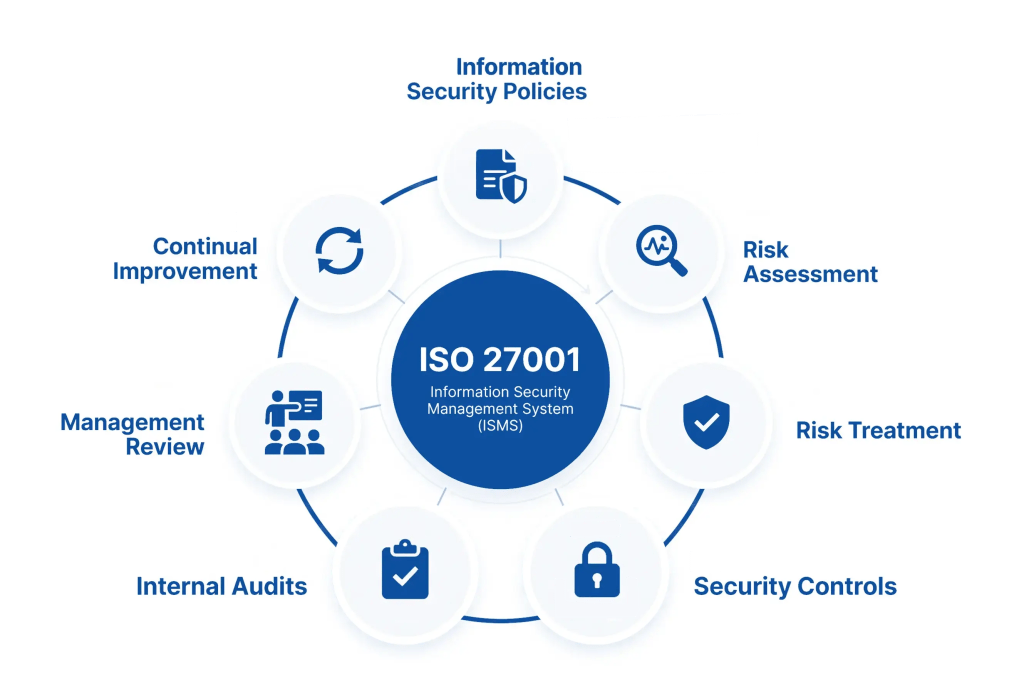
While ISO 27001 may seem complicated because it is a comprehensive model, it is very attainable once it is divided into stages such as gap analysis, risk assessment, control measures, internal audit, and certification audit.
ISO 27001 can be successfully completed in a stipulated time period through proper planning along with the use of software and experts.
Misconception 10: ISO 27001 Is Not Relevant to My Industry
It is the view of some organizations that ISO 27001 is meant for IT firms only.
Reality:
Any organization that deals with confidential information such as customer information, employee information, financial information, or intellectual property can greatly benefit from ISO 27001. This can include organizations from sectors such as health care, finance, education, manufacturing, and retail.
With the digitalization of the current world, information is considered an important resource within all sectors. Therefore, its protection is crucial for every organization regardless of the sector.
Misconception 11: It Doesn’t Add Business Value
There is an impression that ISO 27001 has no more significance than any other regulatory standard and provides little real-world benefit.
Reality:
ISO 27001 creates clear bottom-line advantages. This will help enhance your corporate image and instill confidence in your customers. Moreover, this will help you become more efficient internally and reduce any risk factors for effective decision making.
Further, certification also acts as a key competitive advantage when you expand your business operations. Most companies would much rather collaborate with businesses that are ISO 27001 certified.
Misconception 12: Only External Threats Matter
Organizations often focus heavily on external cyber threats like hackers and malware while overlooking internal risks.
Reality:
Internal risks can be just as damaging as external ones. These include employee negligence, insider threats, and process failures. ISO 27001 addresses both internal and external risks through a comprehensive risk management approach.
By implementing controls such as access management, employee training, and monitoring systems, organizations can reduce vulnerabilities from all angles, ensuring a more robust security posture.
Misconception 13: Certification Means Passing an Audit Only
There are companies that view ISO 27001 as merely a checklist process with the sole purpose of meeting the requirements for certification.
Reality:
Certification is but one step in the entire process. The ultimate goal of ISO 27001 is to create an efficient Information Security Management System (ISMS). The ISMS must not only function effectively but also be continually refined.
By concentrating only on the requirement for certification, many companies overlook the more significant advantages associated with increased security and efficiency.
Misconception 14: Implementation Takes Too Long
Time constraints are another common concern, with businesses assuming that certification will take years to achieve.
Reality:
The timeline for ISO 27001 certification varies depending on factors such as organization size, complexity, and existing processes. However, with a structured approach and dedicated effort, many organizations achieve certification within a few months.
A phased implementation strategy helps manage time effectively. Starting with critical areas and gradually expanding ensures steady progress without overwhelming the organization.
What ISO 27001 Actually Requires
Conclusion
There are several misconceptions associated with the ISO 27001 standard. These make people apprehensive when it comes to implementing the same in organizations. However, ISO 27001 is an easy and valuable framework that can assist organizations in improving their information security status. The following are a few myths related to the ISO 27001 standard. Debunking them will provide organizations with the right perspective towards the ISO 27001 framework. It will allow organizations to view it from the correct perspective and help them understand its significance.
Are you ready to enhance your information security management using ISO 27001? Avoid letting common myths prevent your company from benefiting from the framework. No matter if you are at the beginning stage or want to be certified fast, professional assistance will help you complete your goal efficiently.
ValueMentor offers you top-notch ISO 27001 consultancy services, an optimal way to obtain certification, and all-around help customized to the needs of your business. Take the next step in enhancing your information security management using ISO 27001 certification. Contact us now for a consultation.
FAQs:
No, any business that handles sensitive data regardless of industry can benefit from ISO 27001.
2. Does ISO 27001 guarantee 100% data security?
No certification can guarantee complete security. ISO 27001 helps you manage and reduce risks effectively.
3. Is ISO 27001 too expensive for small businesses?
Not necessarily. It’s scalable and often more cost-effective than dealing with a data breach.
4. How long does it take to get ISO 27001 certified?
Typically 3–6 months, depending on your organization’s size and readiness.
5. Is ISO 27001 only the responsibility of the IT team?
No, it involves the entire organization, including HR, management, and operations.
6. Do I need tons of documentation for ISO 27001?
No, only relevant and practical documentation is required, not unnecessary paperwork.
7. Is ISO 27001 certification a one-time process?
No, it requires ongoing monitoring, audits, and continuous improvement.
8. Will ISO 27001 slow down my business operations?
No, it actually improves efficiency by streamlining processes and reducing risks.
9. Is ISO 27001 difficult to implement?
It may seem complex, but with the right approach and guidance, it’s very manageable.
10. Does ISO 27001 add real business value?
Yes, it builds trust, enhances reputation, and opens doors to new business opportunities.


