Modern health organizations depend on technological solutions to provide care for patients, secure their medical records, and offer connected healthcare solutions. Since cyberattacks have become a persistent threat to modern healthcare organizations, data security has now become an absolute necessity. This is where ADHICS v2.0 plays a critical role.
When considering what ADHICS v2.0 is, it should be noted that it is the latest iteration of the Abu Dhabi Healthcare Information and Cyber Security (ADHICS) Standard created by the Department of Health – Abu Dhabi (DoH). ADHICS v2.0 sets up the cybersecurity, privacy, and information security standards for all the healthcare organizations that operate in Abu Dhabi. In this guide, we’ll explain what ADHICS v2.0 is, why it matters, its core components, key changes, implementation process, and how healthcare organizations can achieve compliance successfully.
What is ADHICS v2.0?
ADHICS v2.0 is an updated cybersecurity and information security standard designed specifically for healthcare organizations licensed by the Department of Health – Abu Dhabi.
It’s an mandatory regulatory cybersecurity and privacy standard for healthcare organizations licensed by the Department of Health – Abu Dhabi. The framework establishes governance, technical, operational, and privacy controls that healthcare organizations are expected to implement and maintain.
The framework aims to:
- Protect patient health information (PHI)
- Strengthen cybersecurity resilience
- Improve data privacy practices
- Standardize security controls across healthcare organizations
- Support regulatory compliance within the UAE healthcare sector
Unlike other cybersecurity guidelines, ADHICS v2.0 specifically considers healthcare threats like EMRs, medical devices, telehealth applications, and cloud health applications.
It is not merely about compliance, but also continuity of patient care through cybersecurity governance.
Why was ADHICS v2.0 introduced?
Healthcare cyberattacks have become more sophisticated, targeting hospitals, clinics, laboratories, pharmacies, and health insurers worldwide.
The updated ADHICS v2.0 framework was introduced to address:
- Modern cyber threats
- Cloud adoption
- Digital transformation initiatives
- Third-party security risks
- Medical device security
- Remote healthcare services
- Increased regulatory expectations
- Regulatory compliance
- Patient safety
- Ransomware protection
- DoH audits
- Third-party assurance
- Cloud security
Version 2.0 expands the scope of security controls to better align with today’s healthcare technology landscape while strengthening patient data protection.
Who needs to comply with ADHICS v2.0?
ADHICS v2.0 applies to organizations regulated by the Department of Health – Abu Dhabi, including:
- Hospitals
- Medical centers
- Clinics
- Specialty healthcare providers
- Diagnostic laboratories
- Pharmacies
- Health insurance organizations
- Telehealth providers
Healthcare technology providers supporting regulated entities
Even vendors and third-party service providers may need to demonstrate compliance if they process or manage healthcare information on behalf of regulated organizations.
Key objectives of ADHICS v2.0
The framework focuses on several strategic cybersecurity objectives.
Protect Sensitive Healthcare Information
The files of patients hold confidential information about their health and personal data. ADHICS necessitates that there be security measures in place to guard against any unauthorized viewing, alteration, destruction, or theft of information.
Strengthen Cybersecurity Governance
Organizations should have good leadership practices, cybersecurity policies, roles, and governance in place.
Improve Risk Management
ADHICS promotes a risk-based approach where organizations continuously identify, assess, and mitigate cybersecurity risks instead of relying on one-time security measures.
Ensure Business Continuity
Healthcare services cannot afford prolonged downtime. The framework emphasizes disaster recovery, incident response, backup management, and operational resilience.
Enhance Patient Trust
Strong cybersecurity practices improve patient confidence by ensuring their confidential medical information remains protected.
Core domains covered in ADHICS v2.0
ADHICS v2.0 consists of multiple cybersecurity and privacy domains that work together to create a comprehensive security program.
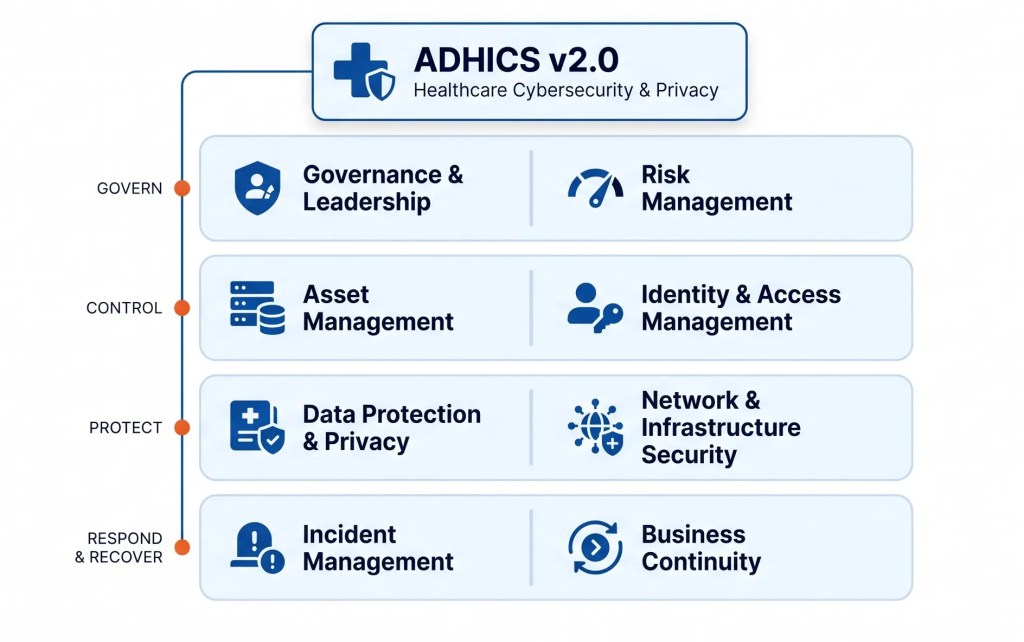
Governance and Leadership
Organizations must establish security governance structures, assign responsibilities, approve security policies, and regularly review cybersecurity performance.
Risk Management
Healthcare providers are expected to perform regular risk assessments, prioritize risks, and implement appropriate security controls based on identified threats.
Asset Management
Organizations should maintain accurate inventories of:
- Information assets
- Medical devices
- Servers
- Applications
- Cloud services
- Network infrastructure
Knowing what assets exist is essential for protecting them.
During ADHICS assessments, organizations are often expected to maintain inventories for EMR servers, PACS systems, laboratory systems, cloud workloads, medical IoT devices, and privileged administrative accounts.
Identity and Access Management
Access to healthcare systems should follow the principle of least privilege.
Security controls include:
- Multi-factor authentication (MFA)
- Strong password policies
- Role-based access control
- User provisioning
- Privileged account management
Data Protection and Privacy
Healthcare organizations must secure patient information through:
- Encryption
- Secure data storage
- Secure transmission
- Data classification
- Data retention policies
- Privacy controls
Network and Infrastructure Security
Organizations must secure internal and external networks using:
- Firewalls
- Network segmentation
- Intrusion detection
- Secure configurations
- Continuous monitoring
Incident Management
ADHICS requires organizations to establish formal incident response processes for:
- Detection
- Reporting
- Investigation
- Containment
- Recovery
- Lessons learned
Business Continuity
Healthcare organizations should prepare for cyber incidents through:
- Backup strategies
- Disaster recovery plans
- Business continuity planning
- Regular recovery testing
Key improvements in ADHICS v2.0
Compared to earlier versions, ADHICS v2.0 introduces stronger cybersecurity expectations.
Some notable enhancements include:
Greater Focus on Cybersecurity
Security controls have expanded beyond traditional information security to include evolving cyber threats and attack vectors.
Better Cloud Security Guidance
As healthcare organizations increasingly adopt cloud services, ADHICS v2.0 includes stronger requirements for cloud governance and cloud risk management.
Enhanced Third-Party Risk Management
Organizations must assess vendors, suppliers, and outsourced service providers that handle healthcare information.
Stronger Privacy Controls
Patient privacy receives greater emphasis with improved requirements for handling, storing, sharing, and protecting personal health information.
Continuous Monitoring
Rather than relying solely on periodic audits, organizations are encouraged to implement continuous monitoring to detect threats proactively.
Benefits of ADHICS v2.0 Compliance
Achieving compliance offers advantages beyond meeting regulatory obligations.
Better Protection Against Cyber Threats
Strong security controls reduce the likelihood of ransomware attacks, phishing incidents, insider threats, and data breaches.
Regulatory Compliance
Healthcare organizations demonstrate alignment with Department of Health requirements and avoid compliance-related issues.
Improved Patient Confidence
Patients are more likely to trust healthcare providers that prioritize the security and privacy of their medical information.
Reduced Business Risk
Effective cybersecurity minimizes financial losses, operational disruptions, and reputational damage caused by security incidents.
Stronger Security Culture
ADHICS promotes ongoing employee awareness, accountability, and security best practices across the organization.
Challenges organizations may face
Although ADHICS v2.0 provides a clear framework, implementation can present several challenges.
Common obstacles include:
- Legacy healthcare systems
- Limited cybersecurity expertise
- Complex medical device environments
- Third-party risk management
- Resource constraints
- Documentation requirements
- Maintaining continuous compliance
Organizations often benefit from conducting gap assessments before beginning implementation.
Based on healthcare cybersecurity assessments, organizations commonly struggle with:
- Incomplete asset inventories
- Missing backup restoration testing
- Delayed vulnerability remediation
- Inadequate third-party risk assessments
- Lack of BCP/DR testing evidence
- Weak privileged access management
- Incomplete cloud security governance
Best practices for ADHICS v2.0 implementation
Successful compliance requires more than simply documenting policies.
Healthcare organizations should:
- Perform a comprehensive gap assessment.
- Establish executive sponsorship and governance.
- Conduct regular cybersecurity risk assessments.
- Implement technical security controls across networks and systems.
- Train employees on cybersecurity awareness and data privacy.
- Continuously monitor security events and vulnerabilities.
- Test incident response and disaster recovery plans regularly.
- Review compliance periodically to address evolving threats and regulatory updates.
Taking a structured, phased approach helps reduce implementation complexity while improving long-term cybersecurity maturity.
Conclusion
ADHICS v2.0 is a considerable breakthrough in enhancing the level of cybersecurity of Abu Dhabi’s healthcare organizations. It does not function as just another compliance tool, but as a guide for healthcare organizations in terms of protecting sensitive data, mitigating cyber risks, increasing operational resiliency, and meeting regulatory compliance requirements.
With the evolution of digital healthcare services, healthcare organizations that will make use of ADHICS v2.0 will have a better chance to withstand any potential threats and provide high-quality healthcare services. Compliance efforts will bring not only regulatory satisfaction, but also help build organizational resiliency and patient trust.
The complexities involved in meeting the requirements of ADHICS v2.0 need appropriate skillset. If you want to begin from a gap analysis, enhance your cybersecurity framework, or even prepare yourself for the audits, we at ValueMentor can assist you in your journey. Join hands with us to analyze your security posture, bridge compliance gaps, and ensure an effective ADHICS v2.0 compliance strategy.
FAQs:
Yes, it is mandatory for healthcare entities regulated by the Department of Health – Abu Dhabi.
What is the primary objective of ADHICS v2.0?
Its primary objective is to protect healthcare information and strengthen cybersecurity across the healthcare sector.
What type of data does ADHICS v2.0 protect?
It protects patient health information (PHI), personal data, and other sensitive healthcare information.
Does ADHICS v2.0 include privacy requirements?
Yes, it includes comprehensive requirements for protecting patient privacy and sensitive data.
Is ADHICS v2.0 aligned with international security standards?
Yes, it incorporates globally recognized cybersecurity and information security best practices.
How often should organizations assess ADHICS v2.0 compliance?
Organizations should perform regular assessments and continuously monitor their security posture.
What role does risk management play in ADHICS v2.0?
Risk management is a core requirement that helps organizations identify, evaluate, and mitigate cybersecurity risks.
Does ADHICS v2.0 address third-party security risks?
Yes, it requires organizations to evaluate and manage risks associated with vendors and service providers.
How does ADHICS v2.0 improve cybersecurity resilience?
It promotes proactive security controls, incident response planning, and continuous monitoring.
Can small healthcare providers comply with ADHICS v2.0?
Yes, organizations of all sizes should implement controls appropriate to their operational risks.