
NCA ECC 2-2024 represents the most significant update to Saudi Arabia’s Essential Cybersecurity Controls framework to date, establishing a revised and expanded mandatory baseline for cybersecurity governance across government and critical sectors. For CISOs, compliance officers, and security leads operating within the Kingdom’s regulatory environment, understanding what the updated framework demands and how to demonstrate that adherence through defensible audit evidence is now a matter of operational and regulatory priority.
Saudi Arabia’s National Cybersecurity Authority has steadily elevated its expectations since the original ECC publication, and the 2024 revision reflects the maturation of both the threat landscape and the Kingdom’s broader digital transformation agenda under Vision 2030. The updated framework does not merely refine existing controls; it introduces new domains and strengthens requirements in areas where prior iterations offered less specificity. Organisations that approached the original ECC as a checkbox exercise will find the 2024 version demands a more rigorous, evidence-based posture.
This blog is structured as a practitioner’s guide. It addresses the scope and structure of NCA ECC 2-2024, the methodology for conducting a meaningful gap assessment, and the standards by which audit evidence will be evaluated during NCA compliance reviews. The objective is to equip CISOs and compliance managers with the clarity required to move from control awareness to demonstrable, audit-ready compliance.
The Essential Cybersecurity Controls in Saudi Arabia
The NCA established the ECC framework to create a uniform, enforceable cybersecurity baseline across Saudi government entities and the critical national infrastructure sectors that underpin the Kingdom’s digital economy. Unlike advisory guidelines or voluntary best-practice documents, the ECC carries regulatory authority; non-conformance carries material consequences for entities operating within NCA’s scope. The framework is structured around multiple control domains, each subdivided into main controls and subcontrols, with compliance assessed against defined maturity levels that distinguish between documented intent and operationalised practice.
The 2024 revision of the Essential Cybersecurity Controls reflects the NCA’s recognition that the threat environment has evolved considerably since the framework’s initial release. Cloud adoption, artificial intelligence integration, and the increasing complexity of digital supply chains have all introduced risk vectors that the original control set addressed inadequately or not at all. The revised framework responds directly to these developments, expanding scope without abandoning the structured domain-based architecture that makes the ECC a practical compliance instrument for organisations of varying size and technical sophistication.
For compliance officers approaching the framework for the first time, it is important to understand that the ECC is not a point-in-time audit standard — it is a continuous compliance regime. Controls must be maintained, monitored, and periodically reviewed. This distinction matters enormously when building an internal compliance programme, because it demands governance structures and operational processes that sustain conformance over time, not merely at the point of assessment.
Domain Coverage at a Glance
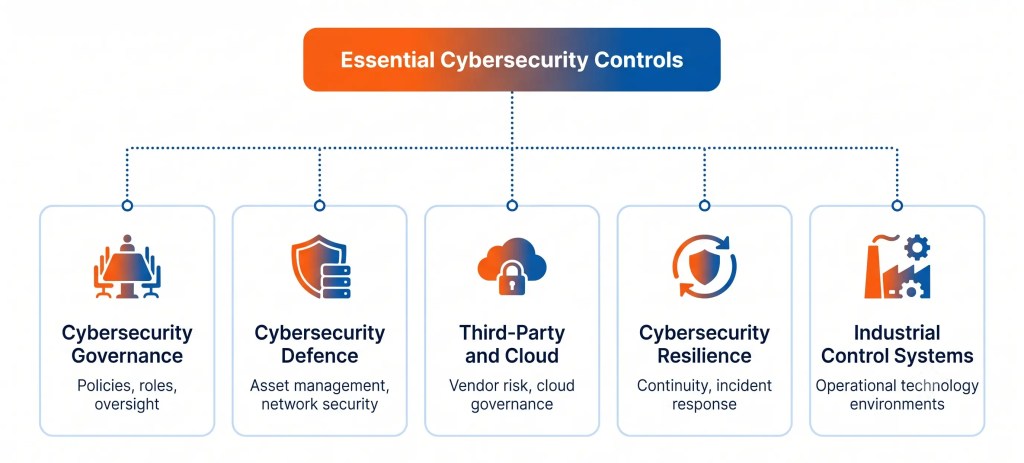
The ECC organises its requirements across several primary domains, including but not limited to:
- Cybersecurity Governance — policies, roles, accountability structures, and board-level oversight
- Cybersecurity Defence — asset management, vulnerability management, secure configuration, and network security
- Third-Party and Cloud Cybersecurity — vendor risk, cloud service governance, and contractual security obligations
- Cybersecurity Resilience — business continuity, disaster recovery, and incident response capability
- Industrial Control Systems Security — where applicable to operational technology environments
Each domain carries its own subcontrol hierarchy, and organisations must demonstrate conformance at the subcontrol level during formal assessments.
NCA ECC Compliance: Scope, Obligations, and Organisational Readiness
Determining whether an organisation falls within the ECC’s mandatory scope is the prerequisite step before any compliance programme can be meaningfully structured. The NCA has defined scope broadly enough to encompass not only direct government entities but also private sector operators whose services are integral to national infrastructure telecommunications, energy, financial services, healthcare, and transportation among them. Organisations uncertain about their regulatory status should seek formal clarification from the NCA or engage a qualified cybersecurity advisory partner to conduct a scope determination assessment.
Organisational readiness for NCA ECC compliance is a function of three interdependent factors: governance maturity, technical control implementation, and documentation rigour. Many organisations possess technical controls that satisfy the spirit of ECC requirements but lack the documented policies, assigned responsibilities, and operational records that an NCA assessor requires as evidence of systematic, managed compliance. This gap between technical capability and documented governance is one of the most common findings in pre-assessment reviews. Addressing it requires deliberate effort that goes beyond the work of the IT or security team alone — it demands engagement from legal, HR, procurement, and senior leadership.
The compliance obligation is also perpetual rather than periodic. Organisations must maintain active compliance programmes that address control changes, respond to emerging threats, and incorporate new NCA guidance as it is issued. Building this into the organisation’s annual security operations calendar — with defined review cycles, ownership assignments, and escalation paths — is what separates genuinely compliant organisations from those that pass a single assessment but drift out of conformance in the months that follow.
Conducting an ECC Gap Assessment: Methodology and Prioritisation
A rigorous gap assessment begins with scope definition confirming which organisational units, systems, processes, and third-party relationships fall within the assessment boundary. This is not a trivial step; underscoping the assessment will produce a gap register that misrepresents the organisation’s true compliance posture and will expose deficiencies during the formal NCA review that were overlooked internally. Assessment scope should align precisely with the boundary that the NCA would apply during its own evaluation.
The assessment methodology itself should map each ECC subcontrol against available evidence, assigning a maturity rating that reflects not merely whether a control exists but whether it is documented, consistently applied, monitored for effectiveness, and subject to periodic review. The distinction between maturity levels is significant: a control that exists informally in the minds of the security team but is not codified in policy and cannot be demonstrated through records will not satisfy NCA assessors. Maturity ratings must be honest, because an inflated self-assessment will produce a remediation roadmap that fails to address the gaps that matter.
Prioritising Remediation After the Gap Assessment
Once the gap register is complete, remediation priorities should be determined by two intersecting criteria: the risk exposure associated with each gap and the effort required to close it. High-risk gaps in core domains such as access control, incident response, and third-party oversight warrant immediate remediation regardless of implementation complexity. Lower-risk gaps in adjacent domains can be sequenced into subsequent work streams without compromising the organisation’s overall compliance trajectory.
The gap assessment output should take the form of a structured remediation roadmap with clear ownership, target completion dates, and defined success criteria for each remediation action. This document serves a dual purpose: it guides the internal compliance programme and, when retained as a managed artefact, can serve as evidence of the organisation’s proactive compliance posture during NCA interactions.
Building NCA Audit Evidence: Standards, Artefacts, and Common Pitfalls
The construction of audit evidence is where compliance programmes most frequently encounter difficulty. Organisations that have implemented technically sound controls often discover, at the point of assessment, that they cannot produce the artefacts required to substantiate those controls to an external assessor. Effective audit evidence is not a retrospective exercise it is a byproduct of well-governed processes that generate records as a natural consequence of their operation.
For each ECC domain, the evidence profile will differ. Governance controls require approved policy documents with version history, distribution records, and periodic review logs. Technical controls require configuration baselines, change management records, vulnerability scan outputs, and access review logs. Third-party controls require vendor risk assessments, contractual security clauses, and periodic supplier review records. Incident response controls require documented playbooks, tabletop exercise records, and post-incident review reports. Each artefact must be traceable to the specific subcontrol it substantiates, and the evidence package as a whole must present a coherent, consistent picture of the organisation’s control environment.
Common Evidence Gaps Identified During NCA Assessments
In practice, several categories of evidence gap recur across organisations undergoing NCA compliance reviews:
- Undated or unversioned policy documents that cannot demonstrate currency or formal approval
- Access control records that reflect permissions as configured but lack evidence of periodic review and recertification
- Third-party agreements that contain general security language but do not map to specific ECC requirements
- Incident logs that record events but do not demonstrate structured analysis, escalation, or lessons-learned processes
- Training records that confirm delivery but do not evidence comprehension or role-specific content
Addressing these gaps proactively before an NCA assessment is scheduled is the defining characteristic of a mature compliance programme. Organisations that treat evidence construction as a pre-assessment sprint rather than an ongoing operational discipline will consistently find themselves unprepared.
Cybersecurity Control Assessment: Aligning Internal Reviews with NCA Expectations
The value of an internal control assessment is directly proportional to its objectivity. Assessments conducted by the teams responsible for implementing the controls in question carry inherent limitations; familiarity with the environment can obscure the gaps that an external assessor approaching the evidence without prior context will readily identify. This is why leading compliance programmes incorporate periodic independent reviews, whether through qualified internal audit functions or external advisory engagements, to stress-test the organisation’s self-assessed compliance posture.
Aligning internal assessments with NCA expectations also requires familiarity with the assessment methodology the Authority applies during formal reviews. NCA assessors evaluate controls not only for existence but for consistent application across the organisation’s full operational scope. A control that is rigorously applied in one business unit but inconsistently implemented in another will not receive full credit. Internal assessments must therefore sample evidence from across the organisation’s operational boundary rather than focusing on the most mature or most visible control implementations.
The cadence of internal control assessments should be formalised typically aligned with the organisation’s annual governance calendar with defined triggers for out-of-cycle reviews when material changes occur. Technology deployments, organisational restructuring, significant vendor changes, and security incidents are all events that can alter the compliance posture of specific control domains and warrant targeted reassessment rather than a wait for the next scheduled cycle.
Conclusion
NCA ECC 2-2024 represents a materially higher compliance standard than its predecessor, and organisations that approach it with the discipline it demands will find that the investment yields resilience well beyond regulatory conformance. The framework’s domain-based architecture spanning governance, technical defence, third-party risk, and operational resilience reflects the full scope of what a defensible cybersecurity posture requires in the current threat environment.
The organisations that achieve and sustain NCA ECC compliance are those that treat it not as a periodic audit event but as a continuous operational discipline. That discipline begins with a credible gap assessment, advances through structured remediation, and matures through the ongoing generation of audit-ready evidence that reflects how the organisation actually operates. With the right advisory partner and a governance framework built for endurance rather than point-in-time performance, compliance with NCA ECC 2-2024 becomes a foundation for long-term cybersecurity excellence. Whether you are preparing for your first NCA review or strengthening an existing compliance programme, we bring the expertise to accelerate your journey aand to ensure that your compliance posture is built to last. Visit our website to learn how ValueMentor can support your NCA ECC 2-2024 compliance programme today.
FAQs
NCA ECC 2-2024 is Saudi Arabia’s updated Essential Cybersecurity Controls framework, establishing mandatory cybersecurity requirements for organisations within its regulatory scope.
2. Who must comply with NCA ECC 2-2024?
Saudi government entities and organisations operating in critical national infrastructure sectors must comply, along with other entities falling within the NCA’s defined scope.
3. What are the main domains covered by NCA ECC 2-2024?
The framework covers cybersecurity governance, defence, third-party and cloud cybersecurity, resilience, and Industrial Control Systems (ICS) security, where applicable.
4. What are the key changes in NCA ECC 2-2024?
The 2024 framework strengthens cybersecurity requirements, with greater emphasis on cloud security, third-party risk, emerging technologies and control maturity.
5. How can an organisation assess its NCA ECC 2-2024 compliance?
Organisations can conduct a gap assessment by mapping each applicable subcontrol against existing policies, implemented controls and supporting evidence to identify compliance gaps.
6. What evidence is required for NCA ECC 2-2024 compliance?
Evidence includes approved policies, access review records, configuration baselines, vulnerability assessment reports, vendor risk assessments, incident logs and training records, mapped to applicable subcontrols.
7. What are the common gaps identified during NCA ECC assessments?
Common gaps include outdated policies, missing access reviews, inadequate third-party
security clauses, incomplete incident records and insufficient employee training evidence.
8. How should organisations prioritise NCA ECC compliance gaps?
Prioritise gaps based on their risk exposure and remediation effort. Address high-risk deficiencies first, with assigned owners, target dates and measurable completion criteria.
9. How often should NCA ECC compliance assessments be conducted?
Organisations should conduct periodic assessments in line with their governance calendar and reassess affected controls following significant technology, organisational, vendor or security changes.
10. How can organisations prepare for an NCA ECC 2-2024 audit?
Organisations should define their assessment scope, conduct a control-level gap assessment, remediate deficiencies and maintain traceable, up-to-date audit evidence for every applicable subcontrol.