If your organization stores, processes, or transmits payment data, PCI DSS penetration testing is not only mandatory but essential for risk management and brand trust. For SAQ D and ROC-level merchants, the requirements around PCI penetration testing under version 4.0 are detailed, time-bound, and critical for audit success. But navigating these requirements can be confusing, especially when deadlines loom and internal resources are stretched. This blog breaks down PCI compliance penetration testing in clear business terms what is required, why it matters and how to approach testing with confidence and efficiency.
Understanding the role of penetration testing in PCI DSS compliance
In the world of payment security, penetration testing serves as a real-world check against theoretical controls. While firewalls, encryption, and access controls are critical, they don’t mean much if attackers can still bypass them through overlooked vulnerabilities. PCI DSS penetration testing is designed to simulate how a malicious actor would attempt to exploit weaknesses in your systems, applications, and networks. It goes far beyond scanning; this is about actively testing the effectiveness of your defenses under realistic threat conditions.
As per PCI DSS, penetration testing helps ensure that:
- Cardholder data environments (CDE) the systems and networks that store, process or transmit cardholder data are truly secure
- Network segmentation controls are properly configured
- Remediation efforts are validated before assessments
In short, PCI penetration testing transforms compliance from a checklist activity into a proactive security posture. It gives organizations a chance to discover flaws before attackers do and that is a win for both security and compliance.
Breaking Down the PCI DSS Penetration Testing Requirements (v4.0)
The latest version of the PCI DSSv4.0 places greater emphasis on testing security controls through realistic, threat-based simulations. Here’s a breakdown of what’s specifically required for PCI compliance penetration testing:
Requirement 11.4.1: Annual and Change-Based Testing
- Conduct both external and internal penetration testing at least once every 12 months.
- Repeat testing after any significant changes to network infrastructure or applications (e.g., firewall changes, new servers, application upgrades).
Requirement 11.4.2: Segmentation Testing
- If your CDE is segmented from other networks, you must verify that segmentation controls effectively isolate the CDE.
- This must also be performed annually and after changes.
Scope and Coverage
- Testing must include all systems and components within scope for PCI DSS.
- Must be based on industry-accepted methodologies (e.g., NIST SP800-115, OWASP, PTES).
Understanding these testing rules is essential not only to pass an audit but to demonstrate that your security program is aligned with evolving threat landscapes.
Who can perform PCI penetration testing?
PCI DSS requires that penetration testing be performed by qualified, independent personnel to ensure reliability and audit credibility.
Internal Teams:
- Can conduct tests if they are experienced in network and application security.
- Must be independent of the systems they test (developers should not test their own applications).
- Must follow industry-recognized methodologies like OWASP, NIST SP800-115, or PTES.
Third-Party Providers:
- Offer independence, expertise, and comprehensive testing.
- Must follow PCI DSS requirements and recognized standards.
- Must provide detailed reports with findings, remediation actions, and retesting evidence.
When it comes to PCI DSS v4.0 penetration testing, both internal teams and third-party providers have their advantages and limitations. Internal teams are often more cost-effective and familiar with the organization’s systems, but they may struggle to maintain true independence developers, for example, cannot test their own code and their findings may hold less weight with auditors. Third-party providers, on the other hand, bring independence, credibility, and deep expertise in simulating sophisticated attacks, which aligns better with QSA expectations. However, this often comes at a higher cost and requires careful coordination with external partners.
When to schedule your PCI compliance penetration tests?
Timing is everything when it comes to PCI DSS testing. Poor planning can lead to rushed remediations, missed deadlines, and failed audits.
To stay on track:
- Schedule testing at least 60-90 days before your PCI audit or self-assessment.
- Test after significant changes not just infra upgrades, but also changes in code, architecture, or even access control mechanisms.
- Coordinate segmentation testing before the QSA audit to ensure network boundaries are validated.
You should also factor in remediation and retesting timelines. If issues are found (and they often are), you’ll need time to fix them and retest because compliance isn’t met unless vulnerabilities are resolved. Well-timed, well-planned PCI compliance penetration testing avoids last-minute scrambles and keeps your compliance calendar running smoothly.
Packaging and presenting penetration testing evidence for PCI audits
When it’s time for a PCI audit, how you present your penetration testing results can make all the difference. It’s not just about handing over a bulky PDF report it is about clearly demonstrating that your testing was thorough, aligned with PCI DSS v4.0 requirements, and addressed relevant vulnerabilities. Auditors look for clarity, completeness, and proof that the findings were acted upon. Make sure your documentation includes test scope, methodology, tester qualifications, key findings, and most importantly, how the risks were remediated. A concise summary report with actionable insights, followed by detailed technical appendices, usually works best. Remember, the goal isn’t just to prove you did the test it is to show that your environment is secure and you’re taking proactive steps to stay that way.
Common pitfalls that can jeopardize your PCI DSS assessment
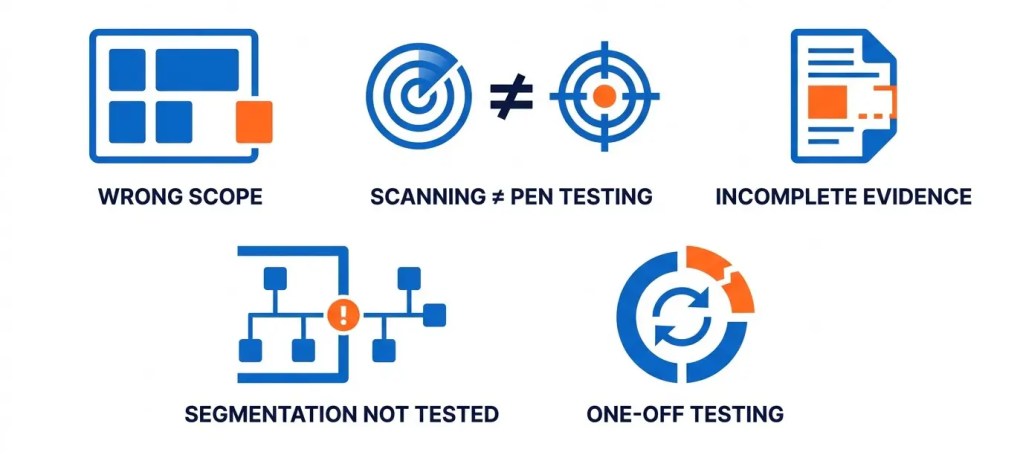
Even organizations with mature security postures can stumble when it comes to PCI DSS compliance particularly around penetration testing. Missteps in strategy, execution, or documentation can lead to audit failures, hefty fines, and reputational damage.
Pitfall 1: Testing the wrong environment
Many businesses mistakenly test only their production systems, ignoring staging or development environments that also process cardholder data. Others overcorrect and test non-CDE systems, wasting time and budget. Avoid this by clearly defining your CDE and the systems that connect to or impact it, then aligning your pen test scope accordingly.
Pitfall 2: Using Automated Scans Instead of True Pen Testing
Automated vulnerability scans ≠ penetration tests. While tools like Nessus or Qualys are useful, they do not meet the requirements of PCI DSS for exploiting vulnerabilities and demonstrating real-world impact. Engage certified ethical hackers who manually test, exploit, and validate vulnerabilities, following industry-standard methodologies.
Pitfall 3: Incomplete Documentation
Many organizations fail to retain or submit proper evidence such as the full testing methodology, scope validation, tester credentials, and retesting results. This leads to auditor pushback or non-compliance findings.Fix this by preparing a complete documentation bundle with signed, timestamped reports and evidence of remediation.
Pitfall 4: Lack of Segmentation Testing
PCI DSS requires testing the effectiveness of network segmentation controls that isolate the CDE. Skipping segmentation testing often results in the entire network being considered in scope exponentially increasing compliance effort and risk. Regularly test firewall rules, VLANs, and access control mechanisms to validate segmentation.
Pitfall 5: Treating PCI Pen Testing as a One-Off Event
A one-and-done approach to penetration testing is a compliance red flag. PCI DSS expects organizations to respond to environmental changes such as new systems, application upgrades or major infrastructure changes by triggering additional testing.Implement a penetration testing strategy that ties into your change management and DevSecOps pipeline.
Concluding Thoughts
By understanding what, who, when and how of PCI DSS penetration testing, businesses can go beyond compliance and uncover critical gaps before they’re exploited. When done right with the proper timing, scope, testing methodologies and remediation processes PCI compliance penetration testing becomes a strategic asset, not just a regulatory requirement. In a payment-driven world, trust is currency. Solidify yours by treating penetration testing as more than a task treat it as a security investment.
Partner with ValueMentor for expert PCI DSS penetration testing and turn compliance into a strategic advantage.
FAQs
Vulnerability scanning is automated and identifies known weaknesses. Penetration testing is manual and simulates real-world attacks to exploit vulnerabilities and test defenses.
2. How often must PCI penetration testing be performed?
At least once annually and after any significant infrastructure or application changes. Segmentation testing must also be done annually if applicable.
3. Do internal teams qualify to perform PCI penetration tests?
Yes, but only if they are qualified, experienced, and independent of the systems they’re testing. Otherwise, it’s best to hire a third-party vendor.
4. What should a PCI penetration test report include?
It should cover the testing scope, methodologies, tester credentials, discovered vulnerabilities, remediation actions, and evidence of retesting.
5. What happens if I fail to perform PCI DSS penetration testing correctly?
You may face audit failures, fines, and increased risk of data breaches. Inaccurate or incomplete testing can also invalidate your SAQ or ROC submission.
6. Is PCI DSS penetration testing mandatory for businesses using third-party payment processors?
Yes, if your systems store, process, or transmit cardholder data, you are still responsible for PCI compliance even when using third-party services. Penetration testing helps validate your environment’s security posture.
7. Can I use automated tools like Burp Suite or Nessus for PCI DSS penetration testing?
Automated tools can assist, but PCI DSS requires manual testing techniques by qualified professionals to simulate real-world attack scenarios. Tools alone are not enough.
8. How does segmentation testing differ from regular penetration testing under PCI DSS?
Segmentation testing verifies that isolated cardholder data environments (CDE) are properly segmented from the rest of your network. This ensures that only in-scope systems are tested and others are protected.
9. Who qualifies as a PCI DSS penetration testing provider?
Qualified providers must have demonstrable expertise in application and network penetration testing, familiarity with industry-accepted methodologies and independence from the systems being tested.
10. Can penetration testing help us detect advanced persistent threats (APTs)?
Yes-when done thoroughly, PCI penetration testing can reveal paths that APTs might exploit, especially in combination with social engineering tests, post-exploitation analysis, and internal testing strategies.